As global wealth expands, investment demands grow more complex, and financial technology rapidly advances, the wealth management industry is shifting from traditional human advisory models toward smart, digital solutions. Artificial intelligence (AI), big data analytics, and automated investment tools are enabling financial institutions to enhance client insights, optimize asset allocation, and deliver highly personalized financial services.
Amid intensifying capital market competition, a key question is how Goldman Sachs can leverage its strengths in traditional asset management while integrating digital financial technology to build a wealth management ecosystem that serves both institutional clients and individual investors. This forms a critical pillar in analyzing its long-term growth strategy.
What Is Goldman Sachs’ Wealth Management Business
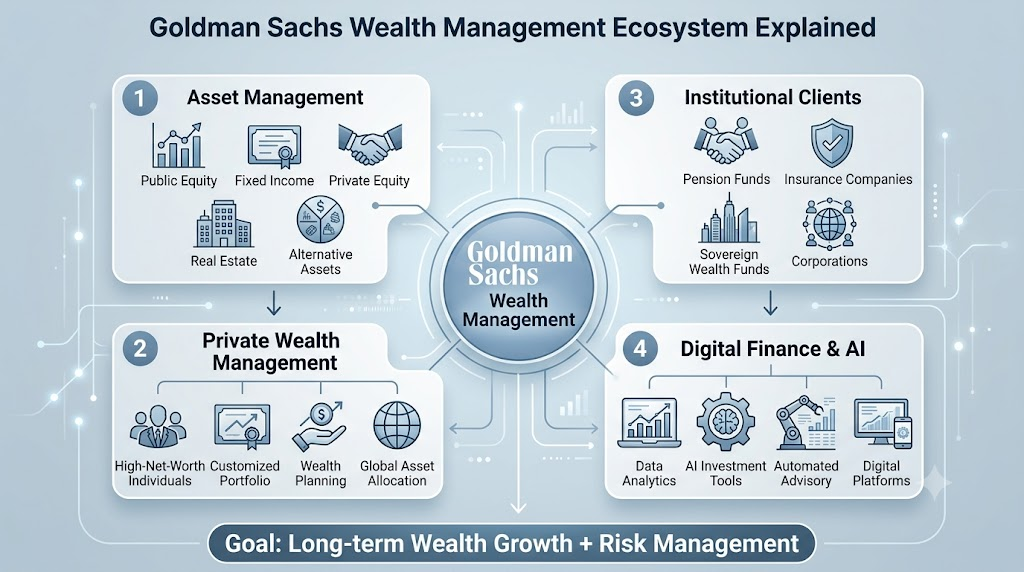
Goldman Sachs’ wealth management business is a core platform connecting global investors, institutional capital, and capital markets. It encompasses Asset Management, Private Wealth Management, and investment advisory services.
Unlike investment banking—which primarily facilitates corporate fundraising—wealth management focuses on helping clients achieve long-term asset growth. Through Goldman Sachs’ expert investment teams, clients allocate capital across equities, bonds, private equity, real estate, alternative investments, and other financial assets.
Traditional wealth management relies heavily on the experience of financial advisors to craft investment plans based on client risk preferences. Today, the industry is shifting toward data-driven models, leveraging market analytics, risk modeling, and AI tools to boost investment decision efficiency.
For Goldman Sachs, wealth management is strategically significant. Unlike investment banking, which is vulnerable to IPO, M&A, and market cycles, asset and wealth management offer more stable, long-term revenue streams.
With global wealth on the rise, institutional investors and high-net-worth individuals are seeking increasingly sophisticated asset allocation, making wealth management a new battleground for major financial institutions.
How Goldman Sachs Approaches the Asset Management Market
Asset management is a cornerstone of Goldman Sachs’ wealth management ecosystem. Goldman Sachs Asset Management (GSAM) delivers investment management services to global institutional clients, including pension funds, insurers, sovereign wealth funds, corporations, and high-net-worth investors.
GSAM’s investment universe spans both traditional and alternative assets: equity funds, fixed income products, private markets, real estate, and infrastructure.
Institutional demand for alternative assets has surged in recent years. As return expectations shift in traditional equity and bond markets, more institutions are allocating to private equity, private credit, and real estate.
Goldman Sachs leverages deep capital markets experience to maintain a strong edge in alternatives. The firm offers not only capital management but also strategic investment support, powered by global research teams tracking industry trends.
Asset management also synergizes with other Goldman Sachs businesses. For example, when the firm leads an IPO or M&A, it can connect with asset management clients, creating a closed-loop capital markets ecosystem.
High-Net-Worth Client Services as a Growth Engine
The high-net-worth client segment is a strategic growth driver for Goldman Sachs. While historically focused on large institutions and corporate clients, the firm has expanded its private wealth management business to target more high-net-worth individuals. These clients have complex needs—beyond equities and bonds, they require tax planning, wealth transfer, risk management, and global asset allocation. Goldman Sachs’ private wealth teams deliver customized investment solutions, with high-net-worth clients placing a premium on expert advice and long-term relationships over standardized products.
As global wealth distribution evolves, more founders, tech entrepreneurs, and emerging industry investors are accumulating significant assets, fueling demand for personalized wealth management. Expanding private wealth management allows Goldman Sachs to reduce reliance on institutional trading cycles and enhance long-term client value.
Digital finance is reshaping the wealth management landscape. Goldman Sachs continues to invest in fintech, using digital platforms to boost client service efficiency. Digital tools empower clients to monitor assets, analyze portfolio performance, and access seamless financial services.
Compared to traditional wealth management, which relies on manual advisor interactions, digital platforms lower service costs and broaden institutional reach.
Digital technology also enables Goldman Sachs to better manage client data. By integrating transaction histories, investment preferences, and market data, the firm gains deeper client insight.
Although Goldman Sachs once explored retail digital banking with Marcus, it has since realigned its strategy around core strengths: high-value client services, corporate finance, and wealth management.
Looking ahead, digital finance will not fully replace traditional wealth management, but will serve as a critical tool to enhance professional service capabilities.
AI is a major technological catalyst in wealth management. For investment analysis, AI can process vast market data—including corporate earnings, macroeconomic indicators, and trading activity—to help investment teams uncover opportunities.
On the client side, AI analyzes risk preferences and asset structures to deliver more precise investment recommendations. Big data further enhances risk management; real-time analytics can flag portfolio risks and help managers adjust strategies proactively.
For Goldman Sachs, AI is more than an efficiency tool—it’s foundational to future competitiveness.
In the future, wealth management is likely to adopt a hybrid model: “professional investment teams + AI technology + data analytics,” making services smarter and more personalized.
How Does Goldman Sachs’ Wealth Management Strategy Differ from JPMorgan and Morgan Stanley
Goldman Sachs, JPMorgan, and Morgan Stanley are all expanding their wealth management businesses, but with differing strategic emphases.
Morgan Stanley is a leading competitor, leveraging a vast network of financial advisors and client relationships to dominate the personal wealth management space.
JPMorgan builds its wealth management business on its massive commercial banking client base, offering investment services to retail banking customers through its banking infrastructure.
Goldman Sachs stands out by emphasizing investment expertise and premium client service. With a legacy of serving institutional investors and large corporations, the firm excels in complex products, alternative assets, and global market research.
In short, Morgan Stanley is advisor-driven, JPMorgan is anchored in its banking ecosystem, while Goldman Sachs prioritizes capital markets expertise and a professional investment platform.
Challenges Facing the Wealth Management Industry
Despite strong long-term growth prospects, the wealth management industry faces several challenges.
First, competition is intensifying. Traditional banks, investment firms, and fintech companies are all competing for high-net-worth clients.
Second, the investment environment is more complex. Global interest rate shifts, geopolitical risks, and economic cycles complicate asset allocation.
Third, technology is raising client expectations. Younger investors prefer digital services, seeking greater transparency, speed, and intelligence in their investment experience.
Regulatory requirements are also tightening. Wealth management firms must strengthen compliance to ensure investment advice and product sales meet regulatory standards.
For Goldman Sachs, sustaining investment excellence while advancing digital service capabilities will be key to future competitiveness.
The Future of Goldman Sachs’ Wealth Management
Goldman Sachs’ wealth management business is expected to advance along three major paths:
-
Expanding asset management scale. As institutional demand rises, the firm can grow its management base through both traditional and alternative investments.
-
Strengthening AI and digital finance applications. Smart tools will help Goldman Sachs improve client service efficiency and reduce operational costs.
-
Deepening global wealth services. As wealth surges in Asia, the Middle East, and other regions, the high-net-worth segment offers significant growth potential.
Goldman Sachs will likely continue to enhance synergies between wealth management, investment banking, and trading, maximizing client lifetime value through a comprehensive financial ecosystem.
Over the long term, wealth management will be a strategic pillar for Goldman Sachs, reducing earnings volatility and strengthening income stability.
How to Invest in Goldman Sachs (GS) via Gate Stock Trading
As global investors seek broader financial asset allocation, tools bridging digital assets and traditional equities are gaining traction. Gate Stock Trading offers access to global equity markets, supporting USDT trading for US stocks like Goldman Sachs (GS).
Gate Stock Trading covers over 11,000 stocks and ETFs, including 10,000+ US stocks and ETFs, 1,000+ Hong Kong stocks, and supports major exchanges such as NYSE, Nasdaq, NYSE Arca, NYSE American, and BATS.
For those following Goldman Sachs’ wealth management and fintech strategies, GS stock performance reflects both the company’s profitability and the market’s outlook on the financial sector’s long-term prospects. Gate Stock Trading supports fractional shares, with a minimum purchase of 0.01 shares, enabling users to allocate assets according to their capital.
Additionally, Gate Stock Trading offers a 24/7 trading experience—including pre-market, after-hours, overnight, and weekend sessions—giving global investors maximum flexibility.
Note that financial stocks remain subject to economic cycles, interest rate changes, market volatility, and regulatory shifts. Investors should assess their own risk tolerance and make informed judgments regarding Goldman Sachs’ business trajectory and industry trends.
Summary
Goldman Sachs’ wealth management ecosystem is transitioning from traditional asset management toward a more integrated, digital, and intelligent model.
Through asset management, high-net-worth client services, digital finance platforms, and AI-driven solutions, Goldman Sachs is steadily expanding its global wealth management footprint.
Unlike traditional models that rely solely on capital markets transactions, wealth management offers more stable, long-term revenue and is poised to be a core component of Goldman Sachs’ future strategy.
As global wealth rises and fintech continues to evolve, Goldman Sachs’ ability to integrate investment expertise, data technology, and client service systems will determine its long-term competitive edge in the next era of financial services.