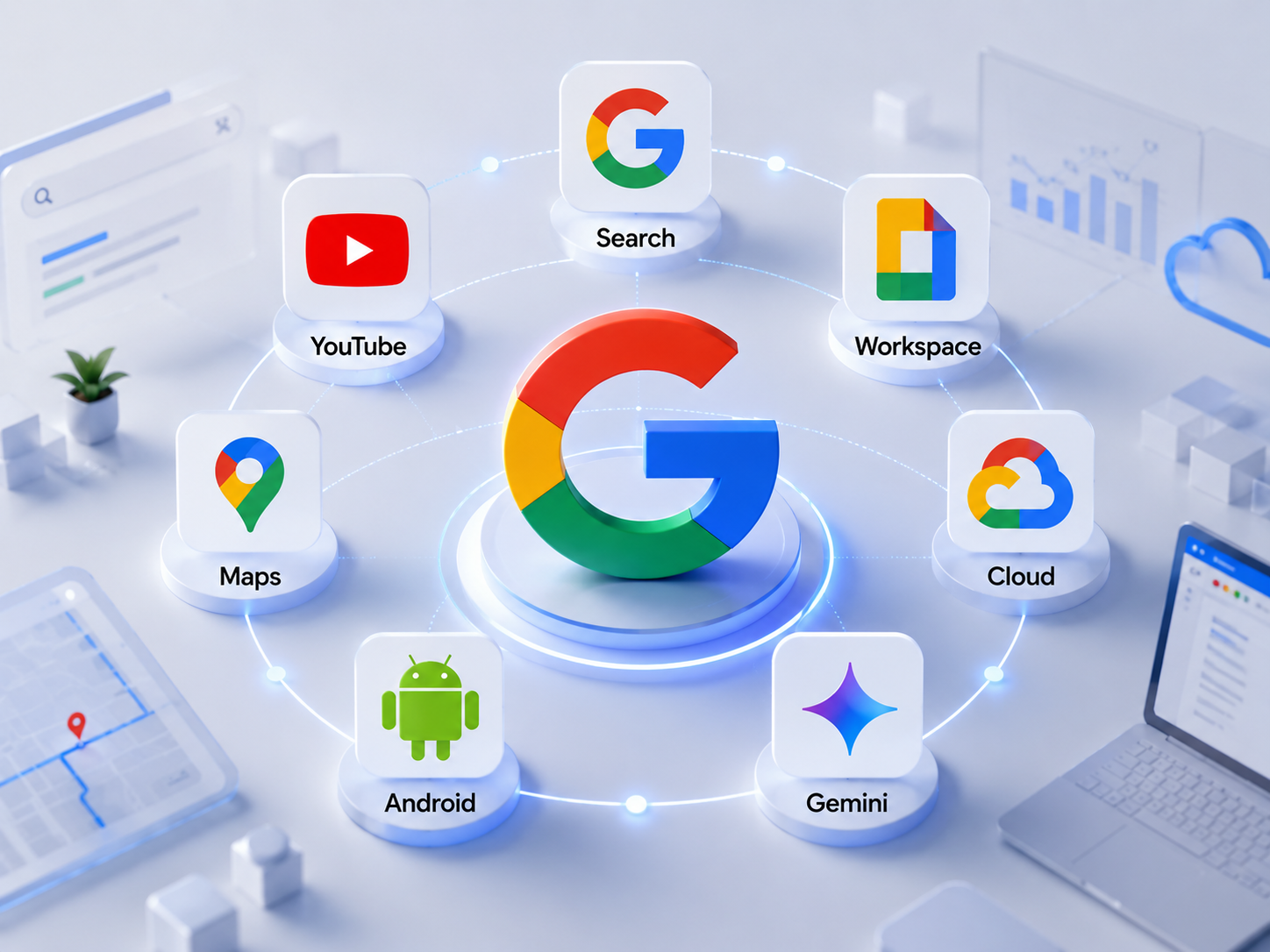
Compared with a single internet product, the value of Google does not come from one application alone, but from the synergy among multiple platforms. Users can access information, consume content, collaborate on work and complete AI assisted tasks within the same ecosystem. This is one of the key reasons Google has maintained its global influence over the long term.
What Are Google’s Core Products?
Google’s product system spans multiple areas across both consumer and enterprise markets.
For everyday users, Google Search, YouTube, the Chrome browser, Google Maps, Gmail and the Android operating system are the products they encounter most often. For enterprise customers, Google Workspace and Google Cloud are important productivity and infrastructure tools.
Google’s main products can currently be divided into the following categories:
| Product Category |
Representative Product |
| Search services |
Google Search |
| Video platform |
YouTube |
| Productivity and collaboration |
Google Workspace |
| Cloud computing services |
Google Cloud |
| Maps and navigation |
Google Maps |
| Artificial intelligence |
Gemini |
| Mobile ecosystem |
Android |
Together, these products form the Google ecosystem and cover a wide range of scenarios, including work, study, entertainment and business operations.
Main Use Cases of Google Search
Google Search is one of the most widely used tools in the world for accessing information.
Through keyword searches, users can quickly find news, academic materials, product information, company websites and a wide range of specialized knowledge. For individual users, Google Search has become a key gateway to information on the internet.
Businesses also rely heavily on Google Search.
Many companies use search engine optimization, SEO, to increase brand visibility, search ads to acquire potential customers, and search data to analyze changes in market demand.
The main use cases of Google Search include:
-
Information lookup
-
Product research
-
Local service search
-
Academic research
-
Business marketing
Continued improvements in search capabilities also provide the foundation for Google’s later development of AI search products.
How YouTube Serves the Content Ecosystem
YouTube is one of the world’s largest online video platforms.
YouTube provides a publishing channel for individual creators, media organizations, educational institutions and corporate brands, while also giving users a platform for learning, entertainment and information.
For creators, YouTube offers monetization methods such as advertising revenue sharing, channel memberships and brand partnerships. For businesses, YouTube has become an important digital marketing channel.
YouTube’s content ecosystem covers a very broad range of areas, including:
| Content Area |
Main Scenario |
| Education |
Online courses and knowledge sharing |
| Entertainment |
Video programs and livestreams |
| Technology |
Product reviews and industry analysis |
| Business |
Brand marketing and advertising promotion |
This content ecosystem further strengthens Google’s competitive advantage in the digital advertising market.
How Google Workspace Supports Enterprise Productivity
Google Workspace is Google’s productivity and collaboration platform for businesses and teams.
Tools such as Google Docs, Sheets, Slides, Meet and Gmail help teams collaborate online and work remotely.
Compared with traditional office software, Google Workspace places greater emphasis on real time collaboration. Multiple users can edit documents at the same time, share data and hold online meetings, improving overall work efficiency.
The main use cases of Google Workspace include enterprise management, project collaboration, education and training, and communication among teams across different regions.
As remote and hybrid work models continue to develop, Google Workspace has become one of the important digital workplace solutions for enterprises around the world.
How Google Cloud Serves Enterprise Customers
Google Cloud is an important business segment for Google in the enterprise market.
Google Cloud provides enterprises with computing resources, data analytics tools, database services and artificial intelligence development platforms, helping companies reduce the cost of building IT infrastructure.
Many enterprises use Google Cloud to build digital platforms and deploy application services globally.
The core use cases of Google Cloud include:
As demand for artificial intelligence grows, Google Cloud is also becoming one of the important choices for enterprise AI infrastructure.
Gemini’s Role in AI Applications
Gemini is an important part of Google’s current artificial intelligence strategy.
As a large language model platform, Gemini can help users with tasks such as organizing information, generating content, assisting with code and answering knowledge based questions.
Compared with traditional search tools, Gemini places greater emphasis on understanding complex questions and generating natural language answers. Google is gradually integrating Gemini into Search, Workspace, Android and Cloud products.
Gemini’s main application areas currently include:
| Application Area |
Main Function |
| Intelligent Q&A |
Natural language interaction |
| Content generation |
Text and creative assistance |
| Programming assistance |
Code generation and optimization |
| Enterprise productivity |
Workflow automation |
The development of Gemini also reflects Google’s shift from a search company toward an AI platform provider.
Which Industry Scenarios Does the Google Ecosystem Cover?
Google’s ecosystem has already reached deeply into multiple industries.
Educational institutions use Google Workspace for teaching and collaboration; retail companies use Google ads to acquire customers; technology companies use Google Cloud to build application platforms; and content creators build personal brands through YouTube.
At the same time, Google Maps is widely used in logistics and navigation services, while Gemini is beginning to enter enterprise workflow automation and AI assistant scenarios.
From individual users to large enterprises, Google products now cover many of the core links in the digital economy and create cross platform synergies.
This ecosystem advantage is also one of the important reasons Google has maintained its position as a global technology leader over the long term.
Summary
Google’s product ecosystem includes far more than a search engine. It also covers video platforms, productivity software, cloud computing services and artificial intelligence tools. Google Search, YouTube, Workspace, Google Cloud and Gemini together form a complete digital ecosystem serving both individual users and enterprise customers.
As artificial intelligence and cloud computing continue to develop, Google is gradually combining traditional internet services with AI capabilities and expanding their application across multiple industry scenarios. Understanding the use cases of Google’s product ecosystem helps provide a fuller view of its business value and market influence.
FAQs
What Are Google’s Core Products?
Google’s core products include Google Search, YouTube, Gmail, Google Maps, Android, Google Workspace, Google Cloud and Gemini.
What Is Google Search Mainly Used For?
Google Search is mainly used for information lookup, product research, academic search, local service discovery and business marketing.
How Is Google Workspace Different from Microsoft Office?
Google Workspace places greater emphasis on online collaboration and cloud-based productivity, while Microsoft Office has strong advantages in local software and enterprise productivity.
What Is Google Cloud Mainly Used For?
Google Cloud is mainly used for enterprise data analytics, cloud computing deployment, big data processing, AI development and network infrastructure management.
What Role Does Gemini Play in the Google Ecosystem?
Gemini is Google’s artificial intelligence platform. It supports intelligent Q&A, content generation, productivity assistance and AI application development.
Which Industries Does Google’s Product Ecosystem Cover?
Google products are widely used across education, retail, media, technology, finance, logistics and enterprise digital transformation.