The rapid rise of generative AI is revolutionizing how digital content is produced. From image design and advertising to video editing, workflows that once required specialized expertise and manual effort are now shifting toward AI-assisted creation. AI not only enables users to generate content quickly, but also contributes to creative ideation, design optimization, and commercial content production.
As businesses seek more robust digital marketing, brand content, and personalized experiences, the importance of AI-driven creative tools continues to grow. Adobe, building on its extensive Creative Cloud ecosystem, has integrated Firefly into established design workflows—aiming to create an AI content ecosystem that spans creative production, business applications, and enterprise services.
What Is Adobe Firefly
Adobe Firefly, introduced in 2023, is a suite of generative AI models developed by Adobe, designed primarily for image generation, design assistance, and creative content production.
Unlike traditional software tools, Firefly’s core strength lies in understanding natural language prompts and generating or modifying visual content based on textual input. Users can describe a scene for the AI to create a new image, or alter existing works by changing backgrounds, adding elements, or enhancing visual effects.
Firefly is not a standalone AI image generator, but a key pillar of Adobe’s future creative ecosystem. Rather than simply competing on AI model capabilities, Adobe’s strategy is to deeply embed generative AI into the design software that users already know and trust.
Firefly is now available across multiple Adobe products, including Photoshop, Illustrator, and Adobe Express. Users can access AI features directly within their current workflows—no need to switch platforms.
Technically, Firefly is a generative AI application powered by machine learning models trained on massive visual datasets. These models learn to understand image structure, stylistic features, and the interplay between text and visuals, enabling AI to create new visual content tailored to user needs.
How Generative AI Is Transforming Digital Content Creation
Generative AI’s most profound impact on the digital content industry is its transformation of production efficiency and creative processes. Previously, designing a commercial image, producing marketing assets, or developing a brand visual strategy required multiple stages—creative planning, asset preparation, design work, and iterative revisions—often demanding significant time from skilled professionals.
Generative AI automates many repetitive tasks. Marketing teams can quickly generate multiple creative directions for designers to filter and refine; businesses can rapidly produce personalized content for different user segments, boosting marketing efficiency.
This shift doesn’t mean AI will fully replace designers. Instead, it changes their focus: designers will move from execution-heavy tasks to emphasizing creative direction, brand expression, and final visual decisions.
In advertising, AI enables rapid testing of visual concepts; in e-commerce, it helps create product display scenarios; in film and gaming, it supports concept design and creative exploration.
Ultimately, generative AI acts as a new productivity tool—expanding the creative capacity of individuals and organizations alike.
How Firefly Integrates into Photoshop, Illustrator, and More
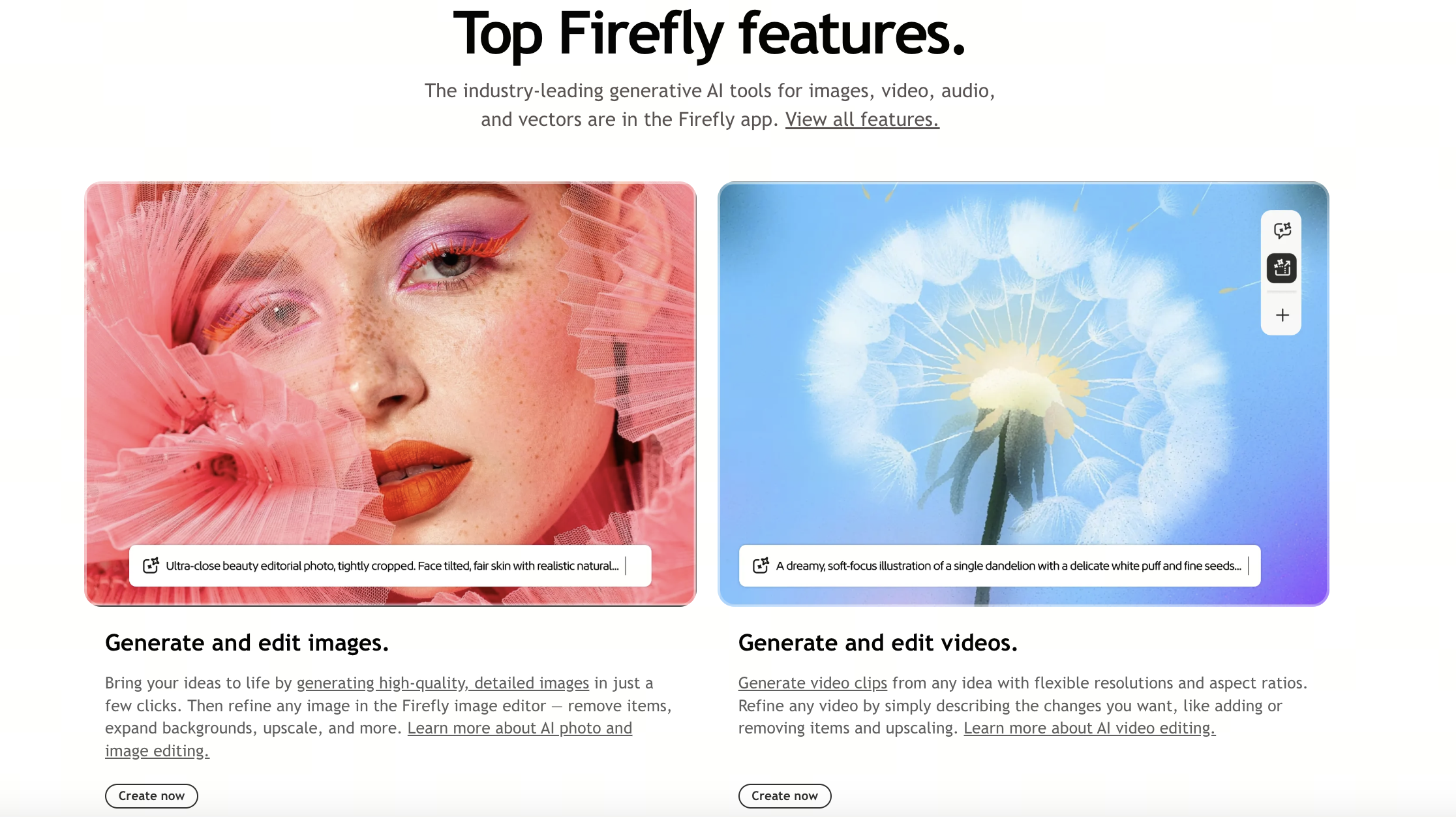
One of Adobe’s core advantages is its mature software ecosystem. Rather than launching standalone AI tools, Adobe embeds Firefly into existing products, making AI an integral part of the creative process. In Photoshop, Firefly’s Generative Fill and related features have redefined image editing—users can expand images, remove objects, or add content using simple text prompts. For example, a photo with a plain background can be transformed by instructing AI to generate new environmental elements that seamlessly blend with the original.
This reduces the technical barrier for complex image editing and boosts professional designers’ productivity. Edits that once required multiple steps can now be drafted in seconds with AI. In Illustrator, Firefly supports vector design and brand visual creation—designers can explore alternative directions, generate creative concepts, and fine-tune results as needed.
For Adobe Express users, Firefly simplifies the creation of social media posts, marketing visuals, and basic designs. Non-professional users, who may lack experience with complex tools, benefit from AI lowering the entry barrier—making digital content creation accessible to more people.
By serving both professionals and everyday users, Adobe is building a comprehensive AI ecosystem that spans individual creativity and enterprise-scale content production.
The fundamental difference between AI image generators and traditional design software lies in the creative approach. Traditional design tools prioritize user-driven control—designers painstakingly build their work layer by layer, adjusting tools and parameters for precise results. This high degree of control has made Adobe products a mainstay in professional design.
Generative AI, on the other hand, changes the interaction model. Users express their ideas via text prompts, and AI generates initial results—eliminating the need for mastery of complex operations. While this boosts creative efficiency, it comes with limitations: AI can rapidly produce visuals, but cannot fully grasp brand strategy, cultural nuance, or complex business objectives. For professional scenarios, AI is best used as an assistive tool—not a replacement for human judgment.
Future creative workflows are likely to evolve into hybrid models: AI delivers rapid generation, testing, and optimization, while humans provide creative direction, aesthetic discernment, and final decision-making.
How Adobe Addresses Copyright and Commercial Use of AI Content
Copyright is a central concern in the evolution of generative AI.
AI models require vast training datasets, making data sources, copyright ownership, and commercial usage rights key issues for enterprise users.
Adobe has prioritized commercial safety and copyright management in Firefly’s development. Unlike open-data training approaches, Adobe aims to use controlled data sources to minimize copyright risks for enterprise clients using AI-generated content.
Adobe has also introduced content authentication mechanisms such as Content Credentials, which use digital identifiers to indicate whether content was generated or modified by AI.
For ad agencies, brands, and large organizations, copyright safety is a critical factor in selecting AI tools. Enterprises need not only content generation capability, but also assurance that content can be safely used in commercial contexts.
Adobe’s competitive edge thus lies not only in its AI technology, but also in its deep experience serving enterprises with copyright management and commercial software solutions.
How Adobe Differs from Midjourney, Canva, and OpenAI in AI Creation
The AI creative market is increasingly competitive, with each company charting its own course.
Midjourney specializes in AI image generation, excelling in visual effects and artistic style—quickly producing creative images that attract artists and creators worldwide.
Adobe, by contrast, focuses on integrating AI with professional design workflows. Firefly’s value is not just in generating images, but in connecting with established tools like Photoshop and Illustrator, making AI part of an end-to-end creative process.
Canva targets the mass market, using templates and simple tools to lower the barrier to design. Canva’s AI features help everyday users quickly produce social media and marketing content.
Adobe is positioned for professional creators and enterprise clients, while Canva emphasizes broad accessibility.
OpenAI takes a broader approach, covering text, images, and multimodal interactions. OpenAI pursues general-purpose AI, while Adobe is dedicated to deep, creative-industry integration.
As a result, the future of AI creation will likely feature multiple platforms with distinct strengths rather than a single dominant ecosystem.
Despite rapid progress, AI creative tools face significant challenges:
-
Content quality and controllability need further improvement. While AI can generate large volumes of content, complex design needs, brand consistency, and fine-tuned details still require human input.
-
Copyright and legal issues remain unresolved. Different countries interpret copyright for AI-generated content differently, requiring enterprises to carefully assess risks before commercial use.
-
Competition among AI tools is intensifying. As more players enter the market, user selection criteria are shifting from raw generation capability to ecosystem integration, security, and business value.
For Adobe, maintaining professional user trust while attracting a new generation of AI creators will be key to future growth.
The Future of Adobe’s AI Ecosystem
Looking ahead, Adobe’s AI strategy is likely to focus on three main directions:
-
Deepening AI integration with Creative Cloud. Adobe will likely continue to expand Firefly’s capabilities in images, video, animation, and more—bringing AI to every stage of the creative process.
-
Advancing AI service commercialization. For enterprises, AI is not just about efficiency—it’s about lowering content production costs and maximizing marketing impact. Advanced AI features can help Adobe deliver greater value to business users.
-
Expanding enterprise-grade AI applications. As businesses become more digital, the links between content generation, customer experience management, and intelligent marketing grow stronger. Solutions like Adobe Experience Cloud may further integrate AI to deliver comprehensive digital experience platforms.
In the long term, Adobe aims not to be simply an AI image generator, but to build an AI creative ecosystem that spans creative production, content management, and commercial applications.
Conclusion
Adobe Firefly is at the heart of Adobe’s generative AI strategy, signaling the evolution of traditional creative software into intelligent platforms.
By embedding AI into Photoshop, Illustrator, Adobe Express, and more, Adobe is reshaping digital content creation—transforming AI from a standalone tool into a core part of the creative workflow.
Rather than focusing solely on AI generation, Adobe prioritizes professional workflows, enterprise needs, and copyright safety—key factors that set it apart from competitors like Midjourney, Canva, and OpenAI.
As AI technology matures, digital content creation is poised for a new era of human-machine collaboration. Adobe’s continued leadership will depend on Firefly’s pace of innovation, commercialization, and its ability to redefine creative software’s value in the AI age.