The global pharmaceutical industry is moving beyond traditional chemical drugs and entering a new era of precision medicine, biopharmaceuticals, and AI-driven R&D. Innovative drugs today must address complex therapeutic needs while leveraging advanced technologies to accelerate development timelines and improve clinical success rates. As a result, R&D capabilities have become the central competitive factor for leading pharmaceutical companies.
Johnson & Johnson has built a strong competitive position in immunology, oncology, and neuroscience through its global R&D network, strategic acquisitions, and an expanding drug pipeline. Going forward, the company’s growth will hinge on the efficiency of its new drug development, the integration of biotechnology, and its ability to navigate patent cycles and intensified market competition.
How Johnson & Johnson's Pharmaceutical Business Has Evolved
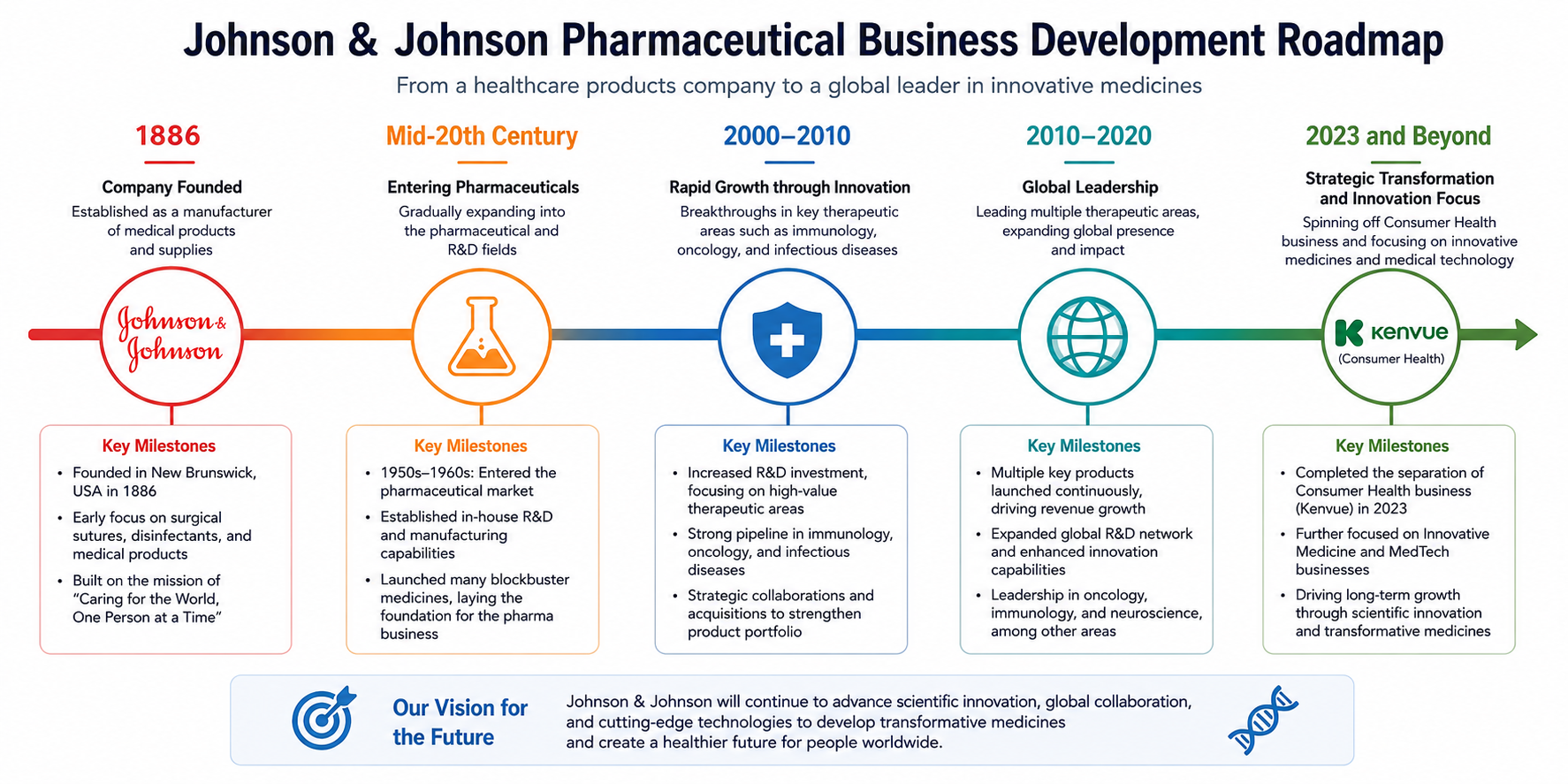
Johnson & Johnson (JNJ) operates one of the world’s most influential pharmaceutical businesses, primarily through its Innovative Medicine segment, which focuses on the research, development, manufacturing, and commercialization of breakthrough therapies.
Founded in 1886, Johnson & Johnson originally specialized in medical and hygiene products. As modern medicine advanced, the company expanded into pharmaceuticals, scaling its drug business through in-house innovation and targeted acquisitions.
In the latter half of the 20th century, Johnson & Johnson ramped up its investment in life sciences, evolving from a traditional medical products company into a diversified healthcare group. By building capabilities in prescription drugs, innovative therapies, and biotech platforms, the company established a robust R&D system spanning multiple disease areas.
In recent years, Johnson & Johnson has significantly restructured its business. In 2023, it spun off its consumer health division as Kenvue, allowing Johnson & Johnson to sharpen its focus on innovative pharmaceuticals and medical technology.
This strategic shift mirrors a broader industry trend: major healthcare companies are divesting low-growth businesses and channeling resources into high-value, innovation-driven sectors with longer R&D cycles, higher technical barriers, and greater profit potential.
Today, Johnson & Johnson’s pharmaceutical segment is a major contributor to the company’s revenue and profit, with a strong presence in oncology, autoimmune diseases, neuroscience, and cardiovascular markets.
Why Immunology, Oncology, and Neuroscience Are Strategic Priorities
Johnson & Johnson’s focus areas reflect evolving global healthcare needs.
Immunology: Stable, Expanding Demand
Immunology has long been a strategic focus for Johnson & Johnson.
With an aging global population and rising rates of chronic disease, the number of patients with immune-related conditions—such as rheumatoid arthritis, inflammatory bowel disease, and psoriasis—is steadily increasing. These conditions often require long-term treatment, ensuring consistent market demand.
Johnson & Johnson has built a competitive edge in immunology through biologics and targeted therapies.
Biologics can more precisely target disease pathways than traditional drugs, making them a key growth driver in the pharmaceutical industry.
Oncology: The Epicenter of Drug Innovation
Oncology is among the most competitive and dynamic fields in global pharmaceuticals.
Historically, cancer treatment relied on surgery, radiation, and chemotherapy. Advances in genetic testing, biomarker analysis, and immunotherapy have ushered in an era of precision oncology.
Johnson & Johnson has a strong presence in hematologic malignancies—Darzalex (daratumumab) for multiple myeloma is a flagship product.
The company is also developing next-generation cancer therapies, including cell therapies, antibody-drug conjugates (ADC), and other precision approaches.
Neuroscience: High-Potential Growth Frontier
Neuroscience is a rapidly emerging focus for major pharmaceutical companies.
Neurological diseases such as Alzheimer’s, Parkinson’s, and psychiatric disorders represent vast unmet medical needs, but drug development remains highly challenging due to the brain’s complexity.
Advances in AI-powered drug design, neuroscience research, and biotechnology are making this field a new frontier for innovation.
Johnson & Johnson is investing in internal R&D and external partnerships to build long-term competitiveness in neuroscience.
How Innovative Drug Development Fuels Growth
Innovative drug development is the primary growth engine for modern pharmaceutical companies. Unlike consumer goods, pharma company value is driven by technological innovation and intellectual property. A successful new drug can create significant market barriers and generate stable revenues during the patent protection period.
For Johnson & Johnson, innovative drug development comprises several key stages:
- Disease mechanism research and target identification: Scientists identify the biological pathways driving disease and pinpoint actionable targets.
- Candidate drug development and clinical trials: Compounds undergo lab research, animal studies, and multi-phase human clinical trials.
- Regulatory approval and commercialization: Even after successful development, drugs must be approved by global regulators and supported by a comprehensive sales infrastructure.
This process can take years and is fraught with risk. To mitigate the impact of failures, large pharmaceutical companies must invest continuously in R&D and maintain a diversified pipeline.
Johnson & Johnson’s mature R&D system enables it to advance multiple projects across therapeutic areas simultaneously, increasing the predictability of future growth.
How JNJ’s Pipeline Sustains Competitiveness
A robust R&D pipeline is a key indicator of future growth for pharmaceutical companies. Johnson & Johnson continually expands its product portfolio through internal R&D, partnerships, and acquisitions. In innovative pharmaceuticals, no single blockbuster can deliver perpetual growth. As patents expire and competitors emerge, companies must launch new therapies to sustain momentum.
Johnson & Johnson’s strategic priorities include:
- Extending the lifecycle of core drugs by expanding indications and optimizing regimens to maximize product value
- Accelerating entry into new areas such as cell therapy, precision medicine, and next-generation biologics
The company also actively taps external innovation. Increasingly, major pharma companies partner with biotech firms to acquire new technologies and drug assets via investment, acquisition, or co-development.
This model helps reduce R&D timelines and costs, and improves the efficiency of entering new therapeutic areas.
How Biotechnology Is Reshaping Pharma
Biotechnology is transforming global pharmaceutical competition and is a key growth driver for companies like Johnson & Johnson.
Historically, the industry relied on chemically synthesized drugs and large-scale manufacturing. Today, advances in gene editing, cell therapy, protein engineering, and AI are pushing drug development toward greater precision and personalization.
Biologics are now a major growth engine.
Compared to traditional small molecules, biologics involve more complex R&D but can more precisely target disease mechanisms. Innovations such as antibody drugs, cell therapies, and gene therapies are opening new avenues for cancer, autoimmune, and genetic disease treatment.
Johnson & Johnson is actively expanding its biologics presence in immunology and oncology. As more diseases are understood at the molecular level, precision medicine is becoming a key competitive arena.
AI is revolutionizing drug discovery. While traditional R&D relied on extensive manual screening of candidate molecules, AI leverages machine learning to analyze massive biological data, predict molecular structures, optimize experiments, and accelerate drug discovery. For global players like Johnson & Johnson, AI boosts R&D efficiency, cuts costs, and increases the probability of success.
Biotechnology is also changing business models. With more innovation coming from small biotech firms, large pharma must build open innovation systems through partnerships and acquisitions. In the future, competition will center not just on scale, but on R&D, data science, and technology integration.
How Johnson & Johnson Differs from Pfizer, Merck, and AbbVie
Johnson & Johnson faces competition from global leaders like Pfizer, Merck, and AbbVie in innovative drugs.
While all are pharmaceutical giants, their business models and strategic focuses differ.
Johnson & Johnson: Integrated Healthcare Ecosystem
Johnson & Johnson’s hallmark is its diversified structure.
Alongside innovative pharmaceuticals, it is a global leader in medical devices, enabling powerful synergies between drugs, devices, and healthcare solutions.
In pharma, Johnson & Johnson targets high-growth areas such as oncology, immunology, and neuroscience, and reduces reliance on any single product through a broad pipeline.
Pfizer is a global pharmaceutical powerhouse with strengths in vaccines, anti-infectives, and innovative therapies.
The company achieved rapid growth during the pandemic with its COVID-19 vaccine, but now must identify new growth drivers as demand shifts.
Compared to Pfizer, Johnson & Johnson’s business is more balanced and less exposed to fluctuations in any single market.
Merck: Oncology Immunotherapy Focus
Merck’s core strength is oncology immunotherapy, with Keytruda (pembrolizumab) a leading global cancer drug.
Johnson & Johnson’s oncology portfolio is broader, spanning hematologic cancers, biotech, and other modalities.
AbbVie: Biopharma and Strategic Acquisitions
AbbVie built its market position on Humira (adalimumab) and has expanded into hematologic oncology and neuroscience through acquisitions.
Johnson & Johnson relies more on its internal R&D and diversified business mix.
In summary, Pfizer, Merck, and AbbVie are more specialized pharma firms, while Johnson & Johnson is an integrated healthcare group bridging innovative drugs and medical technology.
Challenges Facing the Innovative Drug Market
Despite long-term growth prospects, innovative pharmaceuticals face several key challenges.
Escalating R&D Costs
Innovative drug development is capital-intensive and high-risk.
Bringing a new drug to market can take years and require massive investment, with many candidates failing in clinical trials.
Companies must continually improve R&D efficiency to avoid financial strain.
Patent Expiry and Revenue Pressure
Patent protection underpins the innovative drug business model.
Patents allow companies to command premium pricing, but once they expire and generics enter the market, revenues from original drugs drop sharply.
Major pharma companies must consistently launch new drugs to offset revenue declines from mature products.
Johnson & Johnson must also maintain a steady stream of innovation to keep its portfolio current.
Intensifying Drug Price Regulation
Global efforts to control healthcare costs are increasing.
Governments, insurers, and health systems are pushing for lower drug prices, which can impact profitability.
In major markets like the US, changes in drug pricing policy can directly affect business models.
Intensifying Biotech Competition
A surge of biotech companies has entered innovative pharmaceuticals in recent years.
Though smaller in scale, these firms often focus on niche technologies such as gene therapy, cell therapy, or AI-driven drug discovery.
Large pharma must acquire innovation through partnerships, investments, and acquisitions or risk falling behind technologically.
The Future of JNJ’s Pharmaceutical Business
Looking ahead, Johnson & Johnson’s pharmaceutical strategy will focus on innovative therapies, precision medicine, and digital R&D. The company will continue to strengthen its core areas—oncology, immunology, and neuroscience—which are poised for long-term growth as global disease patterns evolve. To maintain competitiveness and offset the impact of mature product cycles, Johnson & Johnson must consistently bring new drugs to market.
The company is advancing precision medicine, moving beyond one-size-fits-all approaches to personalized care based on genetics, disease characteristics, and individual health status. Precision medicine can improve outcomes and unlock greater value.
AI is set to become an essential tool in R&D, helping analyze clinical data, optimize drug design, and boost efficiency. Companies with advanced AI capabilities will gain an edge in innovation speed and cost control. Johnson & Johnson is also likely to continue expanding its technology footprint through strategic partnerships and acquisitions.
As drug development becomes increasingly interdisciplinary, it is harder for a single company to handle the entire R&D process. Open innovation is set to become the industry standard.
Conclusion
Johnson & Johnson’s pharmaceutical business is now central to the company’s future growth. By focusing on high-value therapeutic areas—immunology, oncology, and neuroscience—the company is evolving from a traditional healthcare group into an innovation-driven pharmaceutical leader.
Innovative drug development is the key to Johnson & Johnson’s long-term competitiveness. Through its global R&D network, biotech expansion, and AI integration, the company is advancing its capabilities in drug discovery and commercialization.
Compared to other global leaders such as Pfizer, Merck, and AbbVie, Johnson & Johnson’s greatest strength is its integrated healthcare ecosystem. The company combines innovative pharmaceuticals with medical device technology, achieving a broader and deeper presence across the global healthcare value chain.
Nevertheless, the innovative drug sector faces rising R&D costs, patent expirations, regulatory pressures, and intensifying biotech competition. Johnson & Johnson’s ability to maintain its lead will depend on the strength of its pipeline, its capacity for technological innovation, and its insight into healthcare trends.
With global aging, the advance of precision medicine, and the rise of AI-driven drug discovery, the innovative drug market offers substantial long-term growth potential—and Johnson & Johnson is set to remain a leading force in global healthcare innovation.