Stablecoins have become a critical infrastructure bridging traditional financial systems and the cryptocurrency market. From fund settlements on cryptocurrency exchanges to liquidity management in DeFi protocols, and from cross-border payments to digital asset trading, stablecoins play a key role throughout the Web3 ecosystem.
Within the EU's cryptocurrency regulatory framework, MiCA designates stablecoins as a primary regulatory focus. Compared to exchange licensing regimes or token issuance rules, stablecoin regulation encompasses broader areas such as payment systems, currency circulation, and financial risk management. Consequently, MiCA imposes stricter compliance requirements on USDT, USDC, and future European native stablecoins than those applied to ordinary crypto assets.
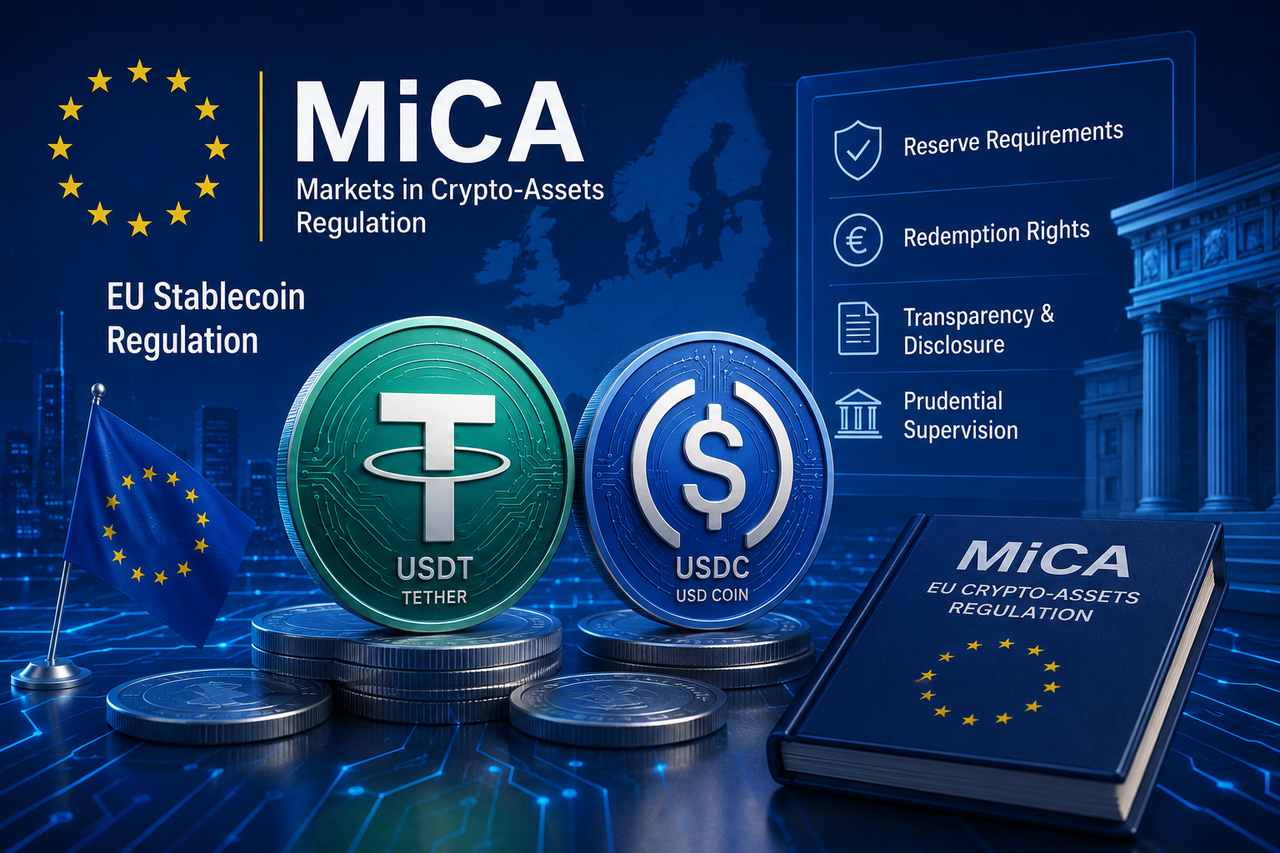
How MiCA Defines Stablecoins
MiCA does not directly use "stablecoin" as a legal classification. Instead, it divides relevant assets into two main categories: Electronic Money Tokens (EMTs) and Asset-Referenced Tokens (ARTs).
This classification approach enables regulators to formulate rules tailored to different stabilization mechanisms, thereby more accurately assessing risk levels and regulatory requirements.
Understanding the distinction between EMTs and ARTs is fundamental to grasping MiCA's stablecoin regulatory framework.
What Is an EMT (Electronic Money Token)
An Electronic Money Token (EMT) is a digital asset pegged to a single fiat currency.
For example, stablecoins pegged to the U.S. dollar or the euro typically fall under EMT regulation. EMTs are designed to replicate the value stability of traditional electronic money in a digital environment, and therefore are subject to stricter payment-related regulatory requirements.
MiCA requires EMT issuers to ensure that the token's value remains consistently aligned with the corresponding fiat currency and to provide holders with clear redemption rights.
In the current market, most major fiat-backed stablecoins are likely to be classified as EMTs.
What Is an ART (Asset-Referenced Token)
An Asset-Referenced Token (ART) is a digital token pegged to the value of multiple assets.
These assets may include multiple fiat currencies, commodities, bonds, or other digital assets. Because the value source of ARTs is more complex, their potential impact is also broader.
Compared to EMTs, ARTs typically face stricter capital requirements and risk management obligations. Regulators aim to mitigate systemic risks that may arise from complex asset structures through additional oversight measures.
Certain multi-asset stablecoins and multi-reserve stablecoins are generally classified as ARTs.
How Is USDT Classified Under MiCA?
USDT (Tether) is currently one of the largest stablecoins in circulation globally, with its value typically pegged 1:1 to the U.S. dollar.
From MiCA's classification logic, USDT is a stablecoin pegged to a single fiat currency, making it closer to the EMT category.
However, MiCA considers not only the pegging mechanism but also whether the issuer meets requirements regarding reserve management, transparency disclosures, and regulatory cooperation.
Thus, whether a stablecoin meets MiCA standards does not depend solely on its technical structure, but on whether the issuer fulfills the compliance obligations under the EU regulatory framework.
Why Is USDC Considered Closer to MiCA's Regulatory Framework?
USDC (USD Coin) is also a U.S. dollar stablecoin, with its value corresponding to the U.S. dollar.
Since USDC's issuer has long adopted periodic reserve disclosures and third-party audits, the market generally views its operational structure as relatively aligned with the transparency principles emphasized by MiCA.
However, MiCA does not automatically grant regulatory recognition solely because a stablecoin demonstrates high transparency. All stablecoin issuers must fulfill compliance responsibilities according to uniform standards and are subject to ongoing regulatory oversight.
Therefore, whether USDC meets MiCA requirements fundamentally depends on its specific compliance arrangements in the European market.
What Requirements Does MiCA Impose on Stablecoin Issuers?
MiCA requires stablecoin issuers to establish a comprehensive risk control system and ensure that users can always understand the asset backing behind the tokens.
First, issuers must hold sufficient reserve assets and ensure that reserves match the scale of stablecoins in circulation. Reserve assets must have high liquidity to support user redemption needs.
Second, stablecoin holders must have clear redemption rights. Users should be able to exchange stablecoins for the corresponding fiat currency under specified conditions without unreasonable restrictions.
Additionally, issuers must continuously disclose reserve information, operational status, and potential risks, and submit relevant reports to regulators.
The core objective of these requirements is to enhance market transparency and strengthen user trust in the stablecoin system.
What Are "Significant Tokens"?
MiCA introduces the concept of "Significant Tokens" to identify stablecoin projects with significant market influence.
Regulators consider factors such as user base, circulation scale, trading volume, and cross-border impact to determine whether a stablecoin qualifies as a Significant Token.
Once designated as a Significant Token, the project faces stricter regulatory requirements, including higher capital standards, more frequent disclosures, and additional risk management obligations.
This mechanism reflects MiCA's risk-tiered regulatory approach: the greater the influence of a stablecoin, the higher the regulatory responsibility it bears.
How Will MiCA Change the European Stablecoin Market?
The implementation of MiCA is driving the European stablecoin market toward greater standardization.
For large stablecoin issuers, a unified regulatory framework helps reduce legal uncertainty and provides clearer rule foundations for long-term business development.
For users, stricter disclosure and reserve management requirements enhance transparency and fund security, thereby strengthening market trust.
At the same time, MiCA may encourage the emergence of more euro-denominated stablecoins that meet regulatory standards, promoting the development of Europe's native digital payment and digital asset ecosystem.
In the long term, the stablecoin market is expected to gradually transition from rapid expansion to a more mature and institutionalized development model.
Summary
MiCA establishes the world's first systematic regulatory framework for stablecoins, dividing them into two major categories: Electronic Money Tokens (EMTs) and Asset-Referenced Tokens (ARTs). Through reserve asset management, user redemption rights, information disclosure, and ongoing oversight mechanisms, MiCA seeks to balance innovation support with financial stability.
For major stablecoins such as USDT and USDC, MiCA does not represent a ban or restriction but rather mandates that issuers meet uniform regulatory standards. As Europe's stablecoin regulatory framework matures, MiCA is becoming a key global reference model for digital asset regulation, driving the stablecoin industry toward higher transparency and compliance.
FAQs
Does MiCA Ban USDT in Europe?
MiCA does not directly prohibit USDT from circulating in the European market. MiCA's core objective is to require stablecoin issuers to meet regulatory requirements regarding reserve management, transparency disclosures, and user protection, rather than banning specific stablecoins.
Is USDT an EMT or ART?
USDT maintains a value peg to the U.S. dollar, so from MiCA's classification logic, it is closer to the Electronic Money Token (EMT) category. However, the final regulatory classification will depend on the issuer's structure and specific compliance arrangements.
Does USDC Comply with MiCA?
USDC operates on a fiat reserve backing model and has long disclosed reserve information, so its operational model is relatively aligned with the transparency principles emphasized by MiCA. However, whether it fully meets MiCA requirements depends on the specific review results of EU regulators.
Why Does MiCA Focus on Regulating Stablecoins?
Stablecoins have become important payment and settlement tools in the cryptocurrency market. Since large stablecoins may affect financial system stability, MiCA requires issuers to establish reserve management, redemption mechanisms, and risk control systems to mitigate potential risks.
What Are Significant Tokens?
Significant Tokens refer to stablecoin projects that reach certain thresholds in user scale, circulation, or market influence. Once designated as Significant Tokens, issuers must comply with stricter capital, transparency, and regulatory requirements.
Will MiCA Promote the Development of Euro Stablecoins?
MiCA establishes a clear regulatory framework for stablecoins, helping to reduce market uncertainty. As the regulatory environment becomes clearer, more euro-denominated stablecoin projects that comply with EU rules may emerge, thereby promoting the development of Europe's digital payment and digital asset markets.







