This mechanism is significant because content consumption in traditional games usually ends with a one-time acquisition, whereas NEXPACE aims to make gameplay actions continuously generate value. Players don't just obtain assets—they influence the entire network's operation through asset circulation, content participation, and ecosystem building, creating a more enduring engagement.
How NEXPACE Works
NEXPACE's operational mechanism is built on the MapleStory Universe Layer 1 network. The entire ecosystem revolves around the MapleStory IP and forms a complete structure through base applications and developer tools.
The base layer provides unified asset capabilities. In-game characters, equipment, consumables, and key items are designed as NFTs or FTs, with their status, attributes, and transaction history recorded on a unified network. All assets can be recognized and invoked across multiple applications, not just within a single game.
The ecosystem includes several core applications that power its operation. MapleStory N serves as the game entry point, Marketplace handles asset trading, Navigator provides asset query and encyclopedia features, Explorer displays on-chain data, Swap and Warp enable asset exchange and cross-chain functionality, and Reactor coordinates asset generation and exchange.
Developers can access the ecosystem via the SDK. The development tools expose asset interfaces, metadata extensions, and NESO commercial capabilities, allowing the community to continuously create new use cases around existing assets.
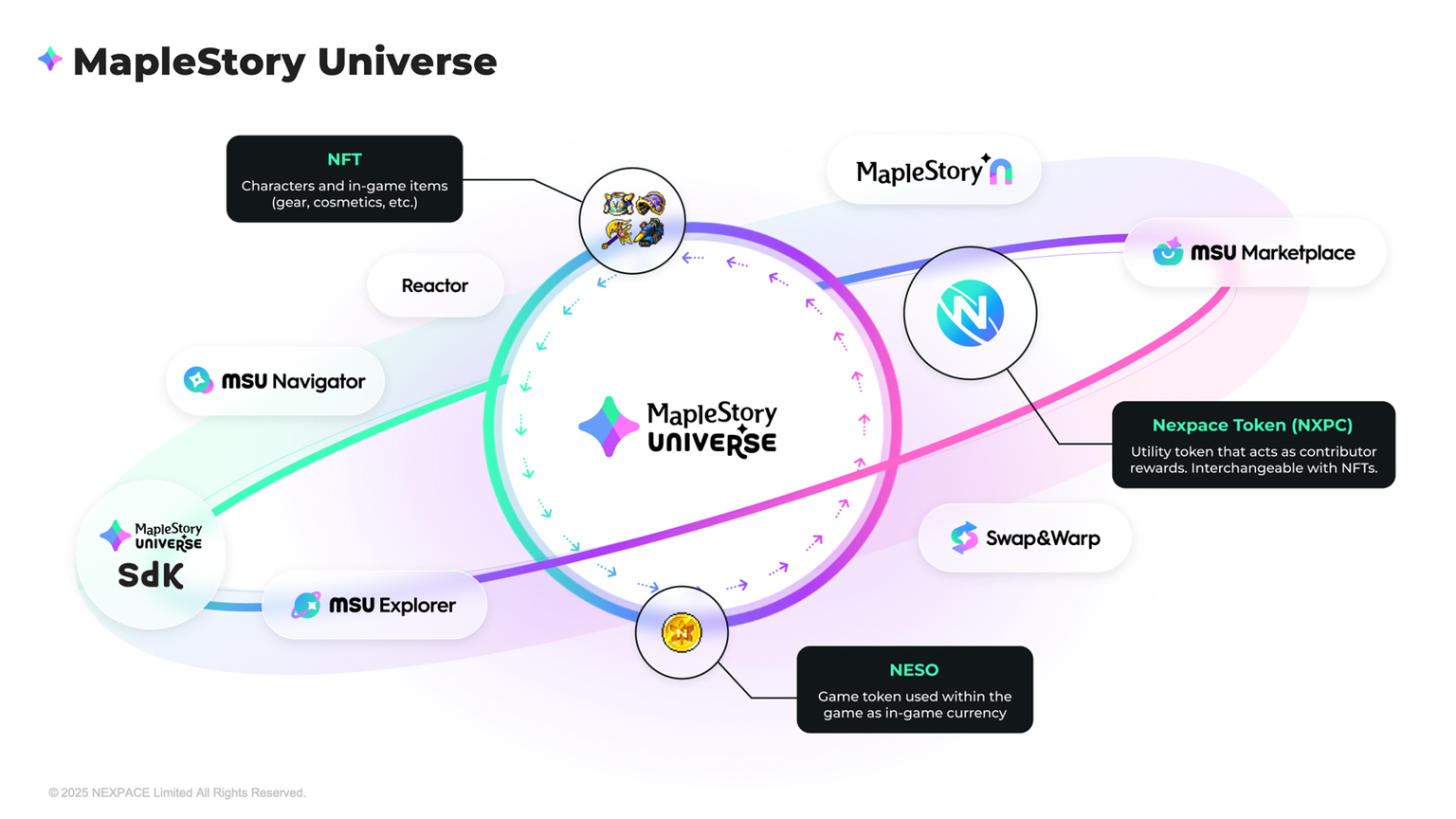
Source: nexpace.io
NEXPACE redefines gaming assets as independent digital assets.
In traditional online games, the operator maintains the database. Players can use characters and items but never truly control the lifecycle of those assets. Their value is often trapped within a single server.
In the MapleStory Universe, core gaming items are issued as NFTs and FTs with fixed supply rules. Limited quantity creates clear scarcity, while on-chain records ensure transparent tracking of origin, circulation, and ownership.
Once ownership is established, items become more than functional tools—they become cross-application resources. The same equipment asset can exist simultaneously in gameplay, marketplace trading, community showcases, and future extended applications, increasing its overall use value.
This mechanism also redefines player relationships. Players are no longer just content consumers; they begin to participate in asset creation and value expansion.
How Users Participate in Content Creation and Circulation
NEXPACE doesn't limit users to being content consumers.
By opening up development tools, the project enables teams and community members to build new experience layers around the MapleStory Universe. Developers can read character data, market information, NFT status, and network data to build standalone applications.
The SDK supports custom metadata, allowing developers to add new functionality to existing NFTs. For example, the same asset can have different interpretations and interaction logic across different applications.
Once content is created, assets enter circulation. The Marketplace supports trading of characters, equipment, and items, with some consumable assets using an order book format for efficiency. User actions within applications then feedback into asset value and usage scope.
Content and assets form a two-way cycle, not a one-way consumption relationship.
How NXPC Drives Ecosystem Incentives
NXPC serves as a key value coordination layer for the entire ecosystem.
The design allows players to acquire specific NFT collections with NXPC and also convert eligible NFTs back into NXPC, creating a two-way exchange structure. This directly links gameplay experience to the value system.
The contribution reward mechanism broadens incentives further. The ecosystem periodically distributes NXPC rewards to participants who boost asset utilization and ecosystem growth—including regular users, developers, and project builders.
Reward amounts follow a gradual decline model, similar to a halving schedule. As new rewards decrease, ecosystem growth relies more on genuine usage demand than on continuous resource release.
This design aims to balance long-term participation with resource control.
How the Gaming Economic Cycle Is Established
NEXPACE's economic cycle is not a traditional consumption loop but a continuous expansion centered on asset usage.
Players first obtain assets in the game and build value connections through NXPC. Assets then enter the marketplace for circulation, where others can acquire them or use them in new application scenarios.
NESO acts as the daily ecosystem medium. It maintains a transparent conversion relationship with NXPC and can be integrated into in-app rewards and business models.
The ecosystem also introduces dynamic rewards and pricing mechanisms.
In MapleStory N, high-activity zones see gradually decreasing rewards, while low-activity zones accumulate more opportunities, encouraging exploration. Some equipment enhancement costs change based on real-time demand, redistributing resources.
This allows the economic system to continuously adjust rather than remain permanently fixed.
What Are the Advantages and Challenges of the Mechanism Design
NEXPACE's advantages come from open asset capabilities and a long-term ecosystem structure.
Putting game assets on-chain gives users greater portability, developers more creative freedom, and the ecosystem stronger growth through community contributions. Compared to closed gaming structures, value is no longer concentrated within a single product.
But the open structure also brings challenges.
Asset synergy complexity continues to rise, and multi-application compatibility demands higher data consistency standards. While fixed supply enhances scarcity, it also requires balancing the new user onboarding experience.
Furthermore, whether the contribution reward system can sustain effective incentives depends on whether the ecosystem generates genuine long-term usage demand.
Thus, an on-chain gaming ecosystem needs not just technical support but also continuous content supply and community building.
Summary
NEXPACE builds a complete on-chain gaming economy through a Layer 1 network, NFT assets, the NXPC incentive system, and NESO circulation.
The project's core goal isn't simply to move games onto the blockchain—it's to create ongoing interaction among players, developers, and the ecosystem through asset ownership, content expansion, and contribution rewards.
This mechanism gives gaming assets long-term value extension capabilities and evolves gaming experiences from one-off consumption to an open ecosystem.
FAQ
What is the core operational logic of NEXPACE?
NEXPACE connects gaming actions, asset circulation, and ecosystem incentives using NFTs, NXPC, NESO, and contribution mechanisms to create a continuous cycle.
Why are gaming assets issued as NFTs?
NFTs give gaming assets clear ownership, fixed supply rules, and the ability to be used across multiple applications.
What is the difference between NXPC and NESO?
NXPC handles asset exchange and ecosystem incentives, while NESO focuses on internal use and circulation within applications.
How can developers participate in the NEXPACE ecosystem?
Developers can build applications using the MapleStory Universe SDK, access asset data, and earn rewards based on their contributions to the ecosystem.
How does NEXPACE sustain ecosystem growth?
The project drives long-term expansion through contribution rewards, open development tools, and asset composability, with reward releases gradually decreasing over time.







