As distributed energy resources continue to grow, energy systems are shifting from traditional centralized models toward more open and flexible network structures. Infrastructure such as electric vehicles, home energy storage systems, solar power equipment, and smart meters is becoming an important part of the power grid. Yet these devices are vast in number and widely dispersed. Without a unified coordination mechanism, their potential value is difficult to fully unlock.
OpenVPP aims to address this problem. As an energy DePIN network built on the concept of a Virtual Power Plant(VPP), OpenVPP connects real-world energy devices through blockchain and uses smart contracts to enable energy data recording, device identity management, and value settlement.
What Is OpenVPP’s Overall Operating Logic?
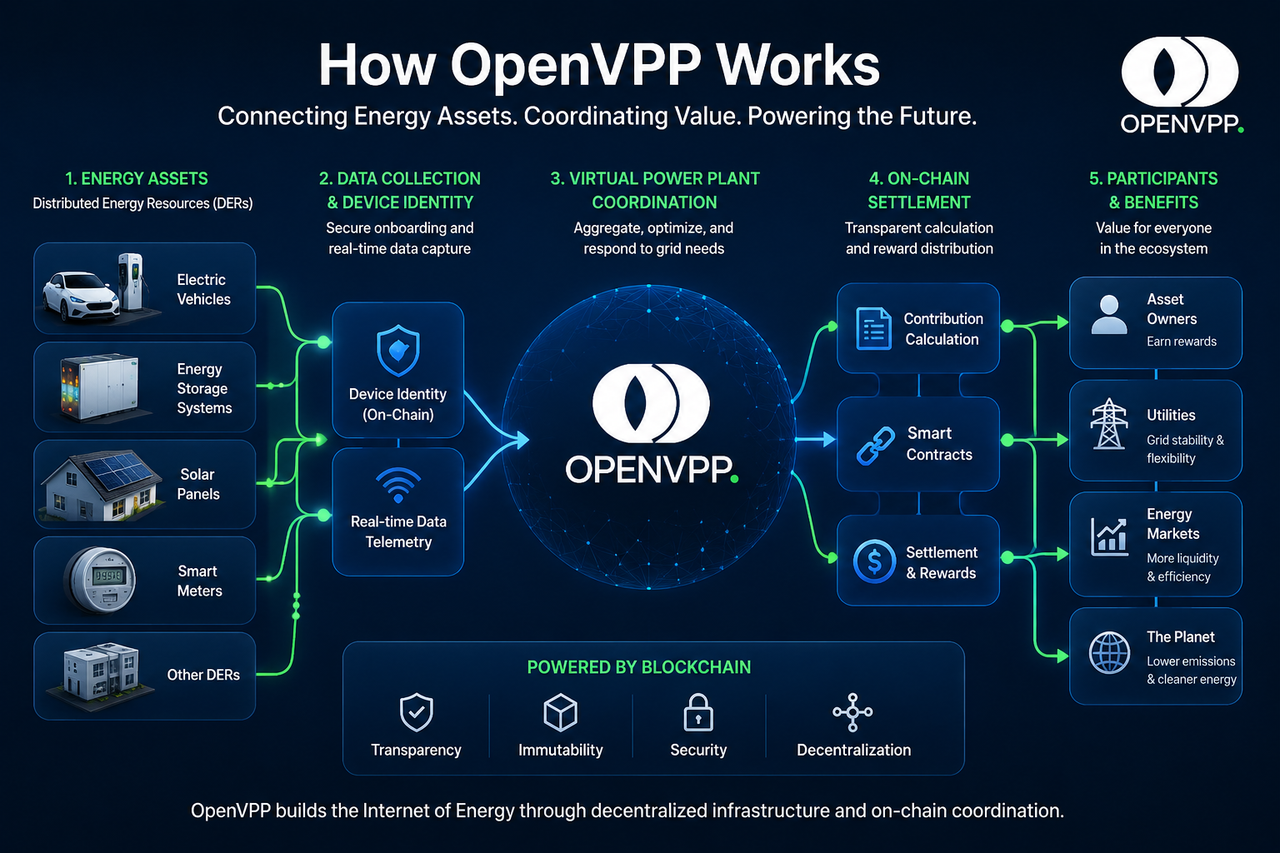
OpenVPP’s core goal is to organize large numbers of distributed energy devices into a unified energy network.
From an operational perspective, OpenVPP can be divided into six main stages:
-
Devices connect to the network
-
Digital identities are created
-
Real-time data is collected
-
Energy resources are aggregated
-
Energy contributions are calculated
-
On-chain settlement and incentive distribution are completed
Compared with traditional virtual power plants, OpenVPP not only coordinates the operation of energy devices, but also records the flow of energy value.
The entire system can be understood as a digital platform that manages both energy flows and value flows.
How Do Devices Connect to the OpenVPP Network?
Device integration is the starting point of OpenVPP’s operating process.
Users first need to connect their energy devices to a communication network supported by OpenVPP. The access method may vary depending on the type of device.
At present, OpenVPP mainly targets the following devices:
-
Electric vehicles(EVs)
-
EV charging stations
-
Home energy storage batteries
-
Commercial and industrial energy storage systems
-
Rooftop solar equipment
-
Smart meters
-
Smart energy management systems
After a device is connected, the system verifies its parameters and operating capabilities, then establishes the communication connection needed for later processes.
This process is similar to registering an IoT device, except that the connected objects are energy infrastructure.
How Does OpenVPP Create Digital Identities for Devices?
Digital identity is an important part of the OpenVPP network.
Traditional energy systems usually record device information through centralized databases, while OpenVPP attempts to build an on-chain identity system.
After each device connects to the network, the system creates a corresponding digital identity record, including:
Digital identity helps the network identify where a device comes from and ensures that future energy contribution records are verifiable.
This mechanism is also an important foundation for future energy asset digitalization and energy device tokenization.
How Does OpenVPP Collect Energy Data?
Energy data is the core basis for the entire system’s operation.
After a device is connected, it continuously uploads operating status information to the network.
Common data includes:
-
Power generation
-
Power consumption
-
Remaining battery level
-
Energy storage capacity
-
Grid response status
-
Device online status
This data is usually collected through smart meters, charging devices, or energy management gateways.
OpenVPP uses this real-time information to build an energy status map, allowing it to understand energy supply and demand across the entire network.
Compared with traditional energy platforms, the blockchain recording mechanism can improve data transparency and traceability.
How Does OpenVPP Aggregate Energy Resources?
Energy resource aggregation is the core capability of a virtual power plant.
A single home battery or electric vehicle can provide only limited energy capacity, but when thousands or even millions of devices are combined, they can form a large energy network.
OpenVPP dynamically aggregates resources based on device operating status.
For example:
-
Calling on energy storage resources when grid demand increases
-
Scheduling devices to charge when electricity prices are lower
-
Increasing energy storage utilization when renewable energy is oversupplied
-
Coordinating demand response during peak load periods
This coordination mechanism allows large numbers of distributed devices to work together and form regulation capabilities similar to those of a traditional power plant.
How Does OpenVPP Participate in Demand Response?
Demand Response is an important application scenario for virtual power plants.
When grid load suddenly increases, the traditional approach is usually to start backup generation facilities.
OpenVPP uses a different approach.
The system can coordinate energy devices across the network to respond collectively to changes in demand, such as:
-
Adjusting EV charging speeds
-
Calling on home energy storage systems to release power
-
Optimizing industrial equipment electricity plans
-
Adjusting some non-critical loads
This approach can reduce pressure on the grid and improve energy efficiency.
Demand response capability is also one of the key sources of value for virtual power plants participating in energy markets.
How Does OpenVPP Calculate Energy Contributions?
After energy coordination is completed, the system needs to determine each participant’s actual contribution.
OpenVPP calculates energy value based on the data provided by each device.
Calculation dimensions may include:
-
Power generation contribution
-
Energy storage contribution
-
Grid stability contribution
-
Level of demand response participation
-
Online time
-
Data quality
Through unified rules, the system can quantify the value each device creates for network operations.
This process is similar to how blockchain networks measure node contributions.
How Does OpenVPP Complete On-Chain Settlement?
On-chain settlement is one of the biggest differences between OpenVPP and traditional virtual power plants.
Traditional energy platforms usually use centralized databases to calculate revenue and manage payments.
OpenVPP instead uses smart contracts to automatically execute settlement logic.
After the system confirms a device’s contribution:
-
Data enters the settlement module;
-
Smart contracts verify the contribution record;
-
The corresponding reward is calculated;
-
On-chain incentives are distributed;
-
The device’s reputation record is updated.
The entire process can be completed automatically without manual intervention.
This mechanism improves transparency and reduces the administrative costs found in traditional settlement processes.
What Role Does the OVPP Token Play Throughout the Process?
OVPP is the core value carrier in the OpenVPP network.
Across the full operating process, OVPP mainly serves three functions.
The first is incentives.
After devices participate in the energy network, they can receive OVPP rewards based on their contributions.
The second is settlement.
Some network services and ecosystem activities may use OVPP for payments and value exchange.
The third is governance.
OVPP holders can participate in protocol upgrades and community governance decisions.
Therefore, OVPP is not just a digital asset. It is an important medium connecting energy activities with the on-chain economic system.
How Is OpenVPP Different from a Traditional Virtual Power Plant Process?
| Process Stage |
OpenVPP |
Traditional Virtual Power Plant |
| Device Management |
On-chain identity system |
Centralized database |
| Data Recording |
Blockchain proof records |
Platform records |
| Resource Aggregation |
Decentralized coordination |
Centralized operation |
| Incentive Method |
Token mechanism |
Fiat compensation |
| Settlement Process |
Automatically executed by smart contracts |
Manual or platform-based settlement |
| Data Transparency |
High |
Relatively limited |
Both perform energy coordination, but OpenVPP places greater emphasis on open networks and on-chain value exchange.
Conclusion
OpenVPP builds a complete decentralized virtual power plant network through multiple steps, including device integration, digital identity creation, data collection, energy aggregation, demand response coordination, and on-chain settlement. Compared with traditional energy management platforms, OpenVPP focuses not only on energy flows, but also on establishing a system for energy value flows, enabling real-world energy devices to participate in the digital economy.
As the energy internet and DePIN ecosystem continue to develop, the model explored by OpenVPP is helping virtual power plants evolve from simple energy management tools into open energy infrastructure.
FAQs
How Does OpenVPP Connect Real-World Energy Devices?
OpenVPP connects distributed energy resources such as electric vehicles, energy storage systems, and solar equipment through smart meters, energy management systems, charging devices, and communication gateways, while collecting device operating data in real time.
Why Does OpenVPP Need a Digital Identity System?
A digital identity system records device attributes, operating history, and contribution data, ensuring that energy activities are verifiable and traceable. It is also an important foundation for energy asset digitalization.
How Does OpenVPP Calculate Device Contributions?
OpenVPP evaluates device contributions across several dimensions, including power generation, energy storage capacity, demand response participation, and device online time, then uses the results for later incentives and settlement.
What Role Does the OVPP Token Play in Settlement?
OVPP is mainly used for ecosystem incentives, value exchange, and governance activities. The system can distribute OVPP rewards to participants based on device contributions and support value circulation within the ecosystem.
What Is the Biggest Difference Between OpenVPP and a Traditional Virtual Power Plant?
OpenVPP uses blockchain and smart contracts to manage device identities, energy data, and value settlement, while traditional virtual power plants usually rely on centralized platforms. As a result, OpenVPP differs in transparency, openness, and value circulation mechanisms.