In recent years, as real-world assets (RWAs) have progressively moved toward tokenization, a growing number of Web3 platforms have begun exploring whether—beyond simply migrating assets onto the blockchain—they can also build fully functional on-chain trading markets. While earlier RWA efforts focused primarily on asset issuance and ownership tokenization, the market is now evolving toward more comprehensive financial applications including lending, derivatives, yield management, and liquidity.
It is against this backdrop that Variational has captured the market's attention. By leveraging a Request-for-Quote (RFQ) trading model, TradFi liquidity integration, and the Arbitrum Layer 2 infrastructure, the platform aims to build an on-chain market enabling derivatives trading for real-world assets such as gold, crude oil, and silver. This reflects how DeFi is gradually breaking free from its crypto-only origins and forging deeper connections with traditional financial markets.
Why RWA Is No Longer Just about Tokenization?
Over the past two years, RWA (Real World Assets) has emerged as one of the most closely watched development directions in Web3. From U.S. Treasury bonds and real estate to private credit, gold, and energy commodities, an increasing number of traditional financial assets are being tokenized via blockchain technology. However, the market has come to realize that tokenization is merely the first step—the true challenge lies in building a complete financial market.
If on-chain systems can only hold assets without supporting trading, lending, hedging, or liquidity management, the financial value of RWAs remains limited. As a result, the role of DeFi is undergoing a transformation: it is no longer just a financial system for cryptocurrencies but is gradually becoming a new trading venue for real-world assets. Variational's strategic direction is precisely to bring these traditional financial trading capabilities onto the blockchain, turning RWAs from static tokens into fully functional on-chain financial products with complete market infrastructure.
How Variational Is Driving the RWA Derivatives Market?
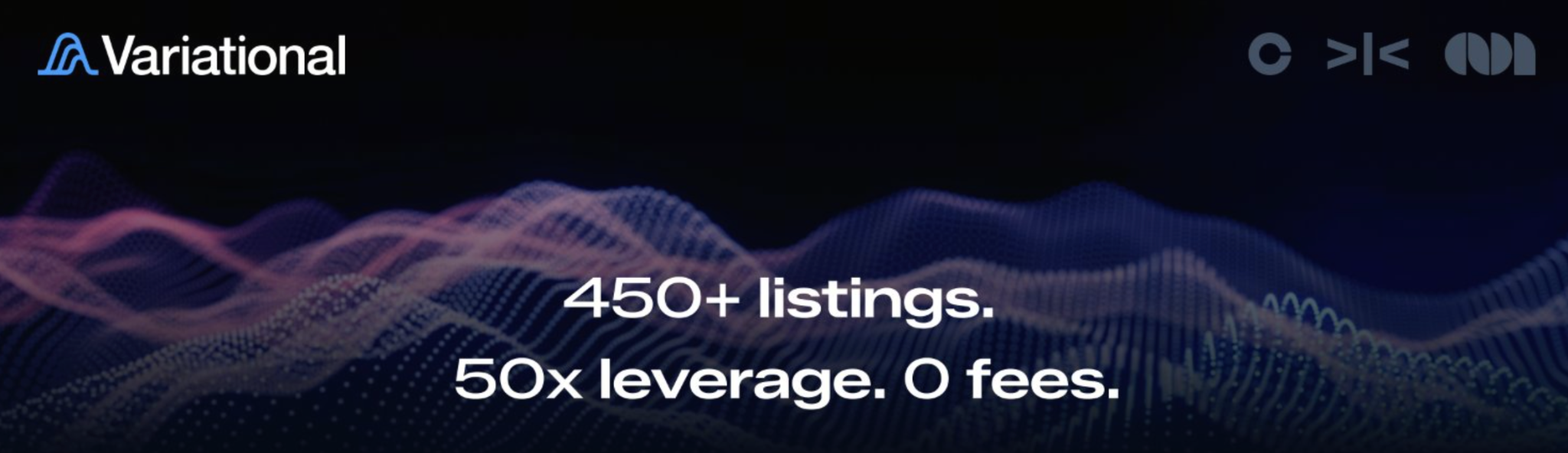
On most DeFi platforms, the primary trading instruments remain crypto assets like BTC, ETH, and SOL. Variational, however, aims to extend trading scope to a broader range of real-world assets.
The platform currently plans to introduce commodity markets including gold, silver, crude oil, and copper, with the expectation of gradually supporting additional TradFi markets in the future. This means users can directly participate in derivatives trading of traditional commodities through an on-chain platform, without relying on traditional brokerages or futures brokers. The key significance of this design is that it allows DeFi to step beyond the crypto ecosystem and begin serving a portion of traditional financial trading demand, thereby broadening the application scope of on-chain finance.
TradFi and DeFi Are Forging a New Cooperative Model
The core ethos of early DeFi was to build a decentralized financial system completely independent of traditional finance. However, recent years have seen a new direction emerge: the convergence of TradFi and DeFi (TradFi × DeFi). This convergence does not involve one replacing the other but rather combines the strengths of both. Traditional finance offers mature liquidity, established market structures, and deep trading expertise, while DeFi provides 24/7 operation, on-chain transparency, and global participation. By merging the two, a financial market that is both efficient and open can be created. Variational's architecture embodies this thinking. Rather than relying solely on on-chain liquidity, the platform seeks to connect with traditional market resources, enabling on-chain trading to achieve quality comparable to mature financial markets.
Why Liquidity Is Central to RWA Development
After RWA tokenization, liquidity becomes one of the key determinants of market maturity. If trading volume is insufficient—even for tokenized assets—investors may be deterred by difficulty in buying or selling, high price volatility, or low execution efficiency. This common challenge has plagued many early RWA projects.
Variational employs the RFQ (Request for Quote) model, where liquidity providers proactively submit quotes rather than relying entirely on public order books. This approach helps reduce slippage and improve trade execution efficiency, particularly for large trades and professional traders. More importantly, through its OLP (Omni Liquidity Provider) architecture, the platform aims to bring TradFi liquidity into DeFi, ensuring that new markets enjoy meaningful trading depth from the start—rather than depending solely on gradual community-driven liquidity accumulation.
What Changes Could RWA Derivatives Bring?
If the on-chain derivatives market continues to mature, the scope of RWA applications will expand beyond asset holding into a full-fledged financial market. First, investors will be able to manage price volatility using derivatives—for example, by establishing hedging strategies with commodity futures or perpetual contracts, rather than simply holding assets. Second, the market could see a wider variety of trading strategies, including leveraged trading, arbitrage, cross-market allocation, and portfolio investing, bringing on-chain finance closer to the functionality of traditional financial markets.
Moreover, as more assets become freely tradable, overall market liquidity improves, transforming RWAs from mere tokens into genuinely valuable financial instruments.
DeFi Infrastructure Must Also Undergo Simultaneous Upgrades
The rise of RWA derivatives is not just about adding new trading products—it demands a concurrent upgrade of DeFi infrastructure. Price oracles must deliver more timely and reliable market data; liquidation mechanisms need to accommodate a broader range of asset types; cross-margin systems must support multi-market position management; and risk models must account for the distinct volatility characteristics of commodity markets versus crypto markets.
Variational's adoption of a cross-margin architecture is one such critical design. By managing different trading positions under a unified framework, users can improve capital efficiency and adjust their portfolios more flexibly—a standard practice in professional financial markets.
What Challenges Still Face the Integration of TradFi and Web3?
Despite the clear trend toward integration, building a mature on-chain RWA derivatives market still requires overcoming several hurdles.
First, the reliability of real-world asset price sources is paramount. Since commodity prices originate from traditional markets, oracle accuracy directly impacts on-chain trading security. Second, regulatory frameworks for derivatives trading, securities laws, and RWAs vary significantly across jurisdictions. Platforms aiming to expand globally must continuously adapt to local requirements. Additionally, there remain substantial differences between TradFi and DeFi in trading systems, risk management, and market operations. Balancing the introduction of more sophisticated financial architecture with the preservation of decentralization will be a key issue to watch going forward.
Variational's Role in the Future Web3 Ecosystem
As more traditional financial assets enter the blockchain market, the demand is not just for token issuance platforms but for a comprehensive financial infrastructure capable of supporting trading, liquidity management, capital allocation, and risk control. Variational is positioning itself accordingly. It is not merely an on-chain derivatives platform; it aspires to be a trading layer connecting TradFi and Web3, enabling a more direct interaction between traditional financial markets and the blockchain ecosystem. Should more institutional capital and traditional commodity markets continue to enter Web3, platforms like Variational—which combine RFQ, TradFi liquidity, and RWA derivatives—are likely to play an increasingly pivotal role in the on-chain financial landscape.
Summary
RWA development is progressing from simple asset tokenization toward a complete on-chain financial market, with derivatives trading serving as a key catalyst for this transformation. Through its RFQ quote model, TradFi liquidity integration, cross-margin architecture, and RWA commodity strategy, Variational demonstrates that DeFi is no longer limited to cryptocurrency markets—it is beginning to accommodate real-world financial needs. As blockchain infrastructure continues to mature, the boundaries between TradFi and Web3 will gradually blur. In the future, innovative platforms like Variational that blend traditional finance with decentralized finance have the potential to become critical infrastructure driving the expansion of on-chain financial markets, bringing greater diversity and liquidity to the RWA ecosystem.







