Retirement investing has long been a critical part of personal financial planning. In the past, most retirement accounts primarily allocated stocks, bonds, mutual funds, or certificates of deposit among traditional financial instruments, aiming to accumulate retirement funds through long-term investing. However, rapid changes in global financial markets in recent years—including inflation, high interest rates, geopolitical risks, and the rapid growth of the digital asset market—have prompted many investors to rethink their retirement asset allocation strategies.
Against this backdrop, Self-Directed IRAs have gained increasing market attention. Unlike regular retirement accounts, Self-Directed IRAs offer greater investment autonomy, allowing investors to allocate retirement funds to alternative assets such as cryptocurrencies, gold, silver, and real estate, in addition to traditional financial instruments. This enables the creation of more flexible long-term investment portfolios. Among the many platforms offering Self-Directed IRA services, iTrustCapital has attracted market discussion for integrating cryptocurrency and precious metals trading and providing a digital interface. While the platform is just one element of the retirement investment ecosystem, it reflects the broader trend toward digitization, one-stop management, and multi-asset allocation in retirement investing.
What Is a Self-Directed IRA?
A Self-Directed IRA (SDIRA) is a retirement account that offers higher investment autonomy. Its defining feature is that investors can choose from a much wider range of investment options based on their own needs, without being limited to traditional instruments such as stocks, bonds, or mutual funds. Compared to a regular IRA, a Self-Directed IRA is not an entirely new retirement system; rather, it expands the scope of eligible investments within the existing retirement account framework. As long as relevant regulations and account rules are met, investors can allocate different asset types through qualified platforms, including cryptocurrencies—which have recently gained attention—as well as gold and silver, which are precious metals traditionally seen as safe havens. This model provides greater asset allocation flexibility and frees retirement planning from the constraints of traditional financial markets. For those looking to diversify risk across different asset classes, Self-Directed IRAs offer a new option for retirement investing. At the same time, greater autonomy means investors need to conduct their own research on markets and understand the characteristics and risks of various assets. Therefore, when using a Self-Directed IRA, it remains essential to build an investment strategy that aligns with individual needs.
How Are Self-Directed IRAs Different from Traditional IRAs?
Many people first encountering Self-Directed IRAs often ask how they differ from regular retirement accounts. In reality, the biggest difference lies not in the retirement system itself, but in the types of assets eligible for investment and how they are managed.
Traditional IRAs are typically offered by financial institutions, with investment scopes limited to publicly traded instruments such as stocks, ETFs, mutual funds, and bonds. Their operation model is relatively mature and tends to suit the usage habits of average investors. Self-Directed IRAs, on the other hand, offer greater autonomy, allowing investors to access a wider range of alternative assets, such as cryptocurrencies, gold, silver, and even certain real estate or private equity investments. This makes it possible to build more diversified portfolios that can be more easily adjusted based on market conditions. In addition to different investment targets, Self-Directed IRAs typically require specialized platforms or account administrators to handle asset custody, trade execution, and related administrative processes. iTrustCapital is one of the platforms offering such services.
How Does iTrustCapital Utilize Self-Directed IRAs?
iTrustCapital is not a retirement system itself, but a fintech platform built on the Self-Directed IRA framework.
After completing account setup, investors can manage their retirement assets through the platform and select different asset types based on the account's eligible investment scope. The platform brings together cryptocurrencies and precious metals—which might otherwise be held across different financial institutions—into a single interface, making it easier for investors to view asset allocation, transaction history, and market prices.
Compared to the past, when managing retirement assets meant dealing with separate brokerages, metal dealers, and custodians, iTrustCapital aims to simplify the process through a unified platform, lower the barrier to entry, and improve the efficiency of retirement investment management. In addition, the platform operates entirely online, allowing investors to complete most transactions and account management tasks through a digital interface. This reflects how the retirement investment market is gradually embracing financial technology.
How Is a Retirement Investment Transaction Completed?
 (Source: iTrustCapital)
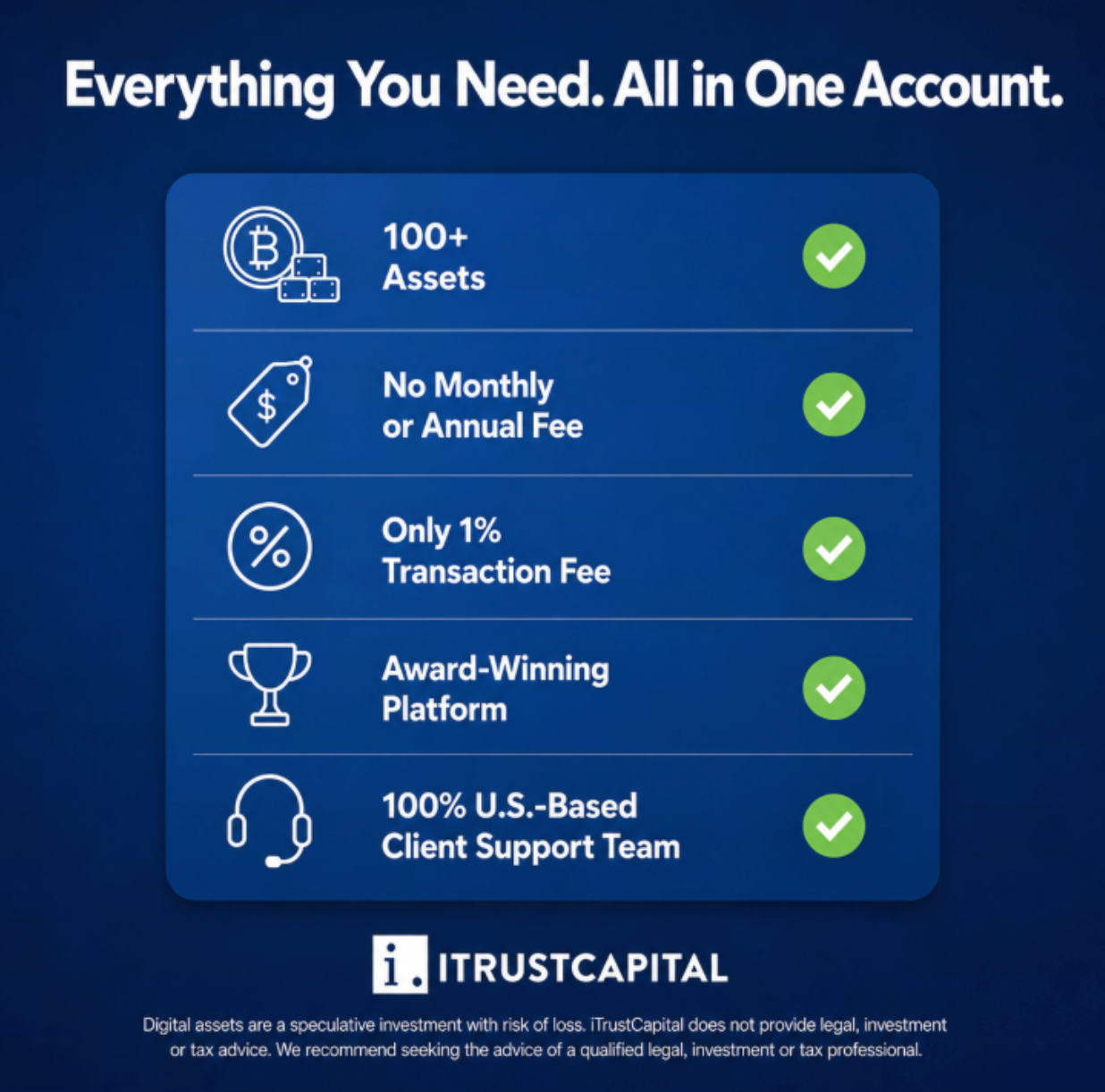
From a process perspective, retirement investing through iTrustCapital can be broken down into several steps. First, investors need to establish a qualified Self-Directed IRA and complete identity verification and account setup. Next, eligible retirement funds are deposited into the account, for example, through a rollover from an existing retirement account or from a compliant funding source. Once funds are allocated, investors can log into the platform, view available cryptocurrencies, gold, or silver assets, and execute trades according to their investment plan. After a transaction is completed, the platform updates the account holdings. Investors can check asset allocation, market prices, and transaction history at any time, and make subsequent adjustments as market conditions change. The entire process is digital, which, compared with traditional retirement investment models relying on phone calls or manual handling, better suits the preferences of modern investors.
Why Are Cryptocurrencies and Gold Entering Retirement Investing?
The core objective of retirement investing is long-term asset accumulation, so asset allocation strategies continue to evolve with market developments. In recent years, some investors have begun to view cryptocurrencies such as Bitcoin as digital assets with growth potential, while gold and silver—given their long history and status as safe-haven assets—still have a place in portfolio allocation.
The emergence of Self-Directed IRAs allows investors to include these two different asset types in the same retirement account. By combining growth-oriented and safe-haven assets, investors can build more diversified retirement portfolios based on their own risk tolerance and investment goals. iTrustCapital leverages this framework to let investors manage different asset types on a single platform, without needing to use separate financial services.
Beyond offering more diversified investable assets, the digitization of retirement investment platforms has become a key trend in recent years. In the past, many retirement investments still relied on paper documents, phone confirmations, and manual transaction processes, which were not only inefficient but also made it difficult to track asset changes in real time. Fintech platforms integrate trading, account management, price lookup, and asset allocation through a digital interface, allowing investors to perform most operations on a single platform and lowering the barrier to information access. The management model adopted by iTrustCapital reflects the gradual digitization of retirement investing. As more stocks, ETFs, or other financial products are integrated into the same platform in the future, retirement asset management may move toward one-stop, diversified services.
Development Trends of Self-Directed IRAs
In recent years, the retirement investment market has been gradually expanding from traditional financial instruments to more alternative assets, reflecting investors' desire to build more flexible long-term asset allocation strategies. As the cryptocurrency market matures, digital asset regulation improves, and fintech platforms continue to develop, the application scope of Self-Directed IRAs is also likely to broaden further. In the future, besides cryptocurrencies and precious metals, more types of financial products may gradually be incorporated into retirement accounts, allowing investors to manage multi-asset portfolios through a single platform, enhancing the convenience and efficiency of retirement investing.
Summary
A Self-Directed IRA is not a new retirement system, but a retirement account model that offers higher investment autonomy. It allows investors to access alternative assets such as cryptocurrencies, gold, and silver, thereby building more diversified retirement portfolios. iTrustCapital, through its fintech platform, digitizes the management process of Self-Directed IRAs, integrates different asset types and trading functions, and makes retirement investing more transparent and convenient. As the retirement market continues to move toward digitization and multi-asset allocation, such platforms combining alternative assets with online management may play an increasingly important role in the future retirement investment market.
FAQ
Q1: What Is a Self-Directed IRA?
A Self-Directed IRA is a retirement account that offers higher investment autonomy. It allows investors to allocate alternative assets such as cryptocurrencies, gold, and silver according to relevant regulations, without being limited to traditional stocks and funds.
Q2: What Is the Biggest Difference Between a Self-Directed IRA and a Regular IRA?
The biggest difference is the range of eligible investments. Traditional IRAs mainly invest in publicly traded financial instruments, while Self-Directed IRAs can cover a wider range of alternative assets, offering greater investment flexibility.
Q3: What Role Does iTrustCapital Play in Self-Directed IRAs?
iTrustCapital is a fintech platform that provides services related to Self-Directed IRAs. Through a digital interface, it integrates assets such as cryptocurrencies, gold, and silver, helping investors manage their retirement investments.
Q4: Why Are More People Paying Attention to Self-Directed IRAs?
As the investment landscape becomes increasingly diverse, alternative assets such as cryptocurrencies and precious metals have gained more attention. Self-Directed IRAs offer greater asset allocation flexibility, making them an increasingly important direction in the retirement investment market.







