With the rapid advancement of generative AI technology, the film and television industry is undergoing a fundamental shift in production methods. What once required sustained collaboration among screenwriters, artists, cinematographers, actors, dubbing artists, and post-production teams can now see many creative tasks automated through AI tools. A growing number of digital content projects are exploring how AI can add value to film and TV production.
SHOW, a key initiative in the AI entertainment ecosystem, integrates scriptwriting, character generation, video production, and community collaboration into a single framework. By lowering content creation barriers with AI, it enables more creators to participate in filmmaking and advances the convergence of AI with the Web3 content economy.
What Phases Does AI Film Production Include?
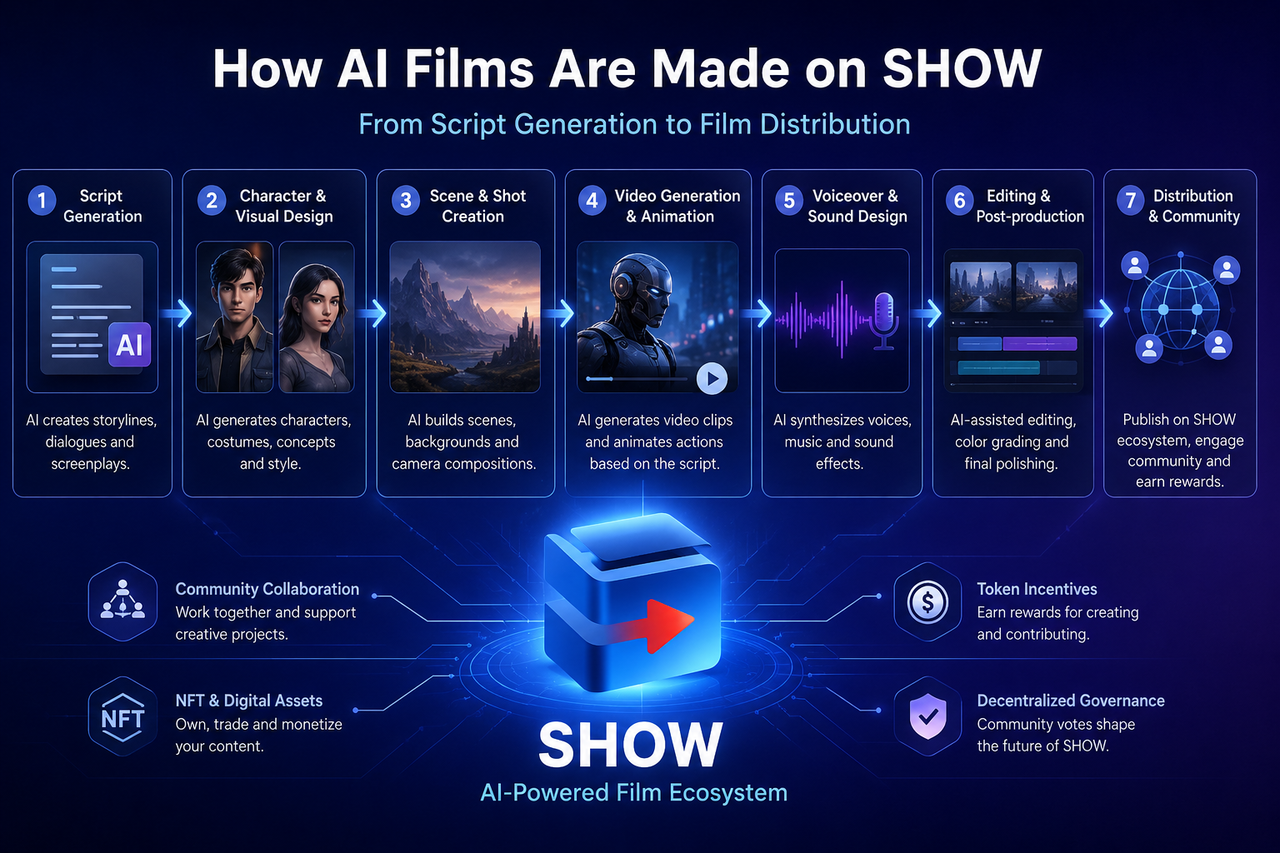
AI film production generally consists of six main phases:
- Idea and script generation
- Character design and visual development
- Scene and shot creation
- Video generation and animation processing
- Dubbing and audio production
- Release and community distribution
Each phase leverages AI to boost production efficiency and shorten development timelines compared to traditional filmmaking.
How Is a Script Generated?
Script generation typically marks the starting point of AI film production.
The creator first defines the film's theme, story background, and target audience. A large language model then generates a story outline, character profiles, and plot structure.
Based on input requirements, AI can produce:
- Storylines
- Character dialogue
- Storyboard scripts
- Scene descriptions
- World-building elements
The creator then refines and adjusts the script to better meet specific creative objectives.
Compared to the traditional screenwriting process, AI rapidly delivers multiple creative directions, significantly improving content planning efficiency.
How Does AI Handle Character Design and Visual Development?
Character design is a critical component of any film or TV work.
In this phase, AI image generation models create character images, costume styles, and design sheets from text descriptions.
Creators can specify:
- Age
- Personality traits
- Appearance style
- Artistic style
- World background
AI then generates several design options from which creators can select and refine.
Beyond characters, scene concept art, prop designs, and visual style references can also be automatically generated by AI.
How Are Scenes and Shots Created?
Once character design is complete, the film's visual environment is built.
AI tools can generate:
- Urban scenes
- Natural environments
- Sci-fi spaces
- Architectural designs
- Special effects backgrounds
The creator then maps out camera language and narrative structure based on the script.
AI-generated scene assets can be used directly in video production or serve as base material for further animation.
This phase determines the film's overall visual style and narrative rhythm.
How Does AI Generate Video Content?
Video generation is the core stage of AI film production.
Recent generative video models can automatically produce dynamic footage from text descriptions or image inputs.
The creator provides:
- Storyboard scripts
- Scene descriptions
- Character actions
- Camera instructions
The AI system then generates corresponding video clips, which are later assembled into a complete story.
Unlike traditional filming, AI video generation eliminates the need for camera equipment, actors, or physical sets, dramatically reducing production costs.
How Are Dubbing and Sound Effects Handled?
Film and TV content relies on both visual and audio elements.
AI speech synthesis produces natural dialogue and mimics different vocal characteristics.
Dubbing production typically includes:
- Character dialogue generation
- Multi-language dubbing
- Emotional expression adjustment
- Narration generation
Meanwhile, AI music and sound effect tools create background music, ambient sounds, and special effects.
Together, these elements deliver a complete auditory experience.
What Does Post-Editing and Optimization Include?
After video generation, the post-production stage begins.
Post-editing mainly involves:
- Shot sequencing
- Transition design
- Subtitle generation
- Color grading
- Audio-video synchronization
- Image enhancement
AI tools automatically detect and correct visual issues, improving final output quality.
This phase determines the work's overall polish and viewing experience.
How Are Films Released in the SHOW Ecosystem?
Completed content can be published and distributed within the SHOW ecosystem.
In the Web3 content framework, films function not only as entertainment but also as digital assets.
Post-release, content can integrate with:
- NFT asset systems
- Community governance mechanisms
- Creator reward programs
- Content funding models
Some works can also record authorship attribution via digital copyright.
This model creates a closed loop connecting content production with value circulation.
How Does SHOW's AI Film Compare to Traditional Filmmaking?
SHOW's AI film production differs markedly from traditional methods.
| Comparison Dimension |
SHOW AI Film |
Traditional Film Production |
| Script creation |
AI-assisted generation |
Completed by screenwriting team |
| Character design |
AI automatic generation |
Designed by art team |
| Scene production |
AI creation |
Real sets or CG production |
| Video generation |
AI automatic generation |
Camera shooting |
| Dubbing production |
AI speech synthesis |
Professional voice actors |
| Production cycle |
Relatively short |
Typically longer |
| Production cost |
Relatively low |
Typically higher |
| Community involvement |
Supports on-chain collaboration |
Minimal involvement |
AI technology does not necessarily replace traditional methods entirely, but it is reshaping the organizational model and efficiency structure of film and TV content production.
Summary
SHOW's AI film production workflow spans script generation, character design, scene creation, video generation, dubbing, post-editing, and content release. Through generative AI tools, the filmmaking process—once heavily reliant on large teams of specialists—can achieve far greater automation. At the same time, SHOW bridges AI content production with the Web3 ecosystem, enabling creators, communities, and digital asset systems to jointly drive content value creation.
FAQs
Are AI films always made entirely by artificial intelligence?
Not necessarily. Most AI films still require human input for planning, editing, and refinement. AI primarily handles content generation and assists in creative tasks.
What steps are included in SHOW's AI film production process?
The process includes seven phases: script generation, character design, scene production, video generation, dubbing synthesis, post-editing, and content release.
What is the difference between AI video generation and traditional filming?
AI video generation relies on algorithms and models to create visuals automatically, while traditional filming requires camera equipment, actors, and physical sets.
Why does SHOW combine AI with Web3?
SHOW aims to boost content production efficiency with AI while using blockchain for community governance, digital asset management, and creator incentives.
What future applications might AI films have?
Beyond entertainment, AI films could be applied in education and training, advertising and marketing, digital media production, game storyline development, and virtual world content creation.