The rise of the NFT market has driven growing demand for trading, yet fragmented liquidity remains a major challenge for the industry. With numerous NFT assets scattered across various platforms, users are often forced to hop between different marketplaces to secure the best price—increasing transaction costs and reducing overall market efficiency.
Tensor has emerged as a key solution to this problem within the Solana NFT ecosystem. As a professional NFT trading infrastructure, Tensor aggregates orders and liquidity from multiple markets into a single platform. Through its order book and automated market-making mechanisms, it optimizes trade execution, delivering a trading experience that mirrors traditional financial markets.
What Is Tensor's Trading Architecture?
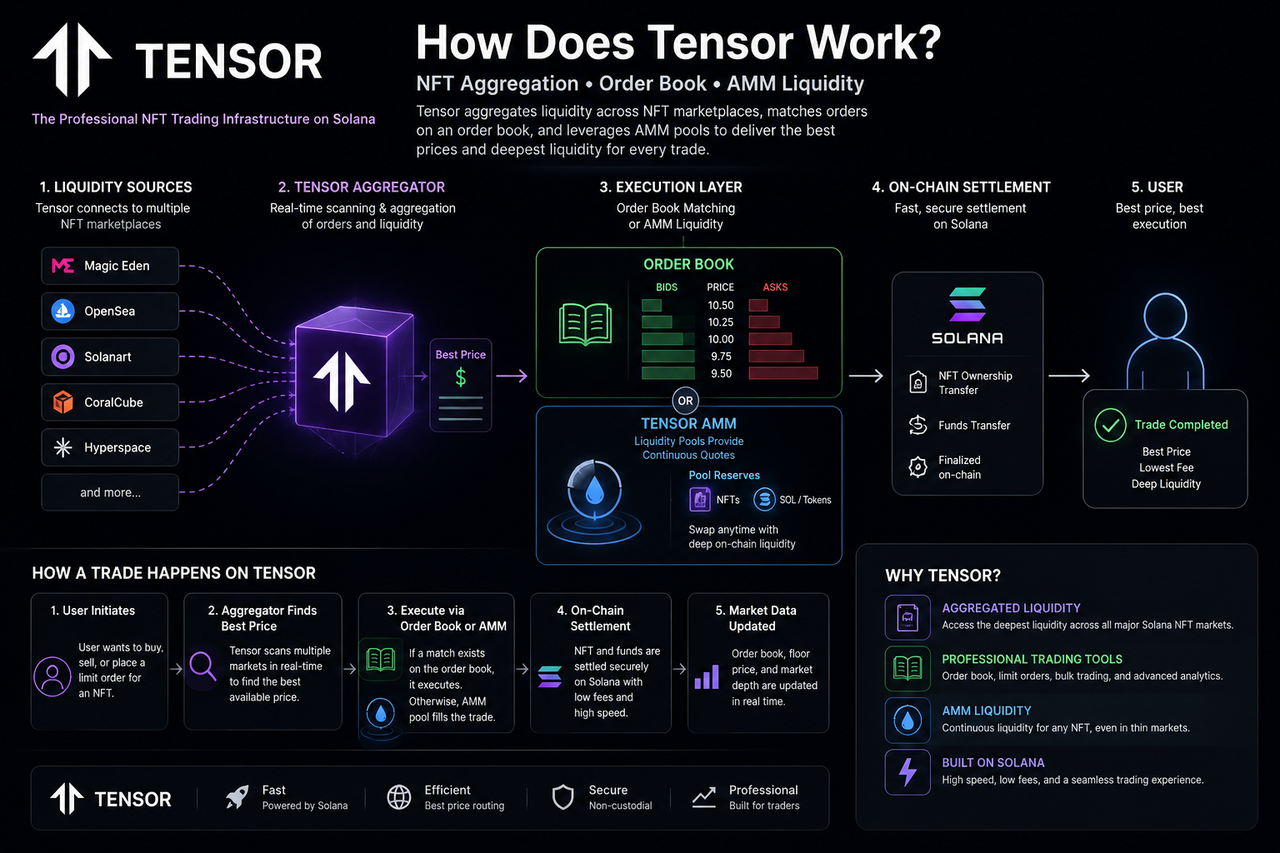
Tensor's trading architecture is built on three core modules: an NFT aggregator, an order book trading system, and the Tensor AMM liquidity pool. These components work in unison to form a complete NFT trading infrastructure.
The NFT aggregator collects order data from different marketplaces, the order book system drives price discovery and trade matching, and the AMM liquidity pool supplies additional liquidity when counterparties are scarce. This architecture enables Tensor to effectively tackle the long-standing issue of liquidity fragmentation in the NFT space.
How Does Tensor Integrate Market Liquidity?
Tensor continuously monitors order feeds from multiple NFT marketplaces, updating buy and sell quotes in real time. When a user wants to buy or sell an NFT, the system automatically compares prices and liquidity across markets.
If a better quote is available on a particular platform, Tensor routes the trade there, helping users achieve a more favorable fill price. This entire process runs seamlessly in the background, so users never have to manually hunt for the best trading path.
This liquidity aggregation model mirrors the routing logic used in cryptocurrency aggregator exchanges. The core objective is to boost execution efficiency and minimize trading friction.
How Does Tensor's Order Book System Work?
The order book is one of Tensor's most distinctive features compared to conventional NFT marketplaces. While most NFT platforms rely on a simple listing model, Tensor allows users to place both buy and sell orders in advance.
Buyers can set the price they are willing to pay for an NFT, and sellers can define their target sale price. When the two sides align, the system automatically matches and executes the trade—much like a standard cryptocurrency spot market.
This order book mechanism enhances price discovery, allowing asset prices to more accurately reflect supply and demand. It also enables traders to implement more sophisticated strategies based on market conditions.
How Does Tensor AMM Improve NFT Liquidity?
The Automated Market Maker (AMM) is a vital part of Tensor's liquidity framework. By using liquidity pools to provide continuous buy and sell quotes, the AMM reduces dependence on individual counterparties.
Liquidity providers can deposit NFTs or capital into these pools, and the system generates quotes algorithmically according to predefined rules. When a user executes a trade, assets are swapped directly with the liquidity pool—no need to wait for a matching counterparty.
For low-liquidity NFT assets, the AMM significantly improves market depth and the likelihood of a successful trade, making it a cornerstone of the NFTFi ecosystem.
How Is an NFT Trade Completed on Tensor?
Step 1: User Initiates a Trade Request
After selecting a target NFT on Tensor, the user can buy, sell, or place a limit order. The system then begins searching for the optimal trading route.
Step 2: Aggregator Finds the Best Price
The Tensor aggregator scans multiple NFT marketplaces in real time, comparing prices, order sizes, and market depth. It prioritizes the path that best serves the user's interest.
Step 3: Order Book or Liquidity Pool Executes the Trade
If a matching order exists in the order book, the system completes the match there. If no suitable counterparty is available, the trade is executed via the Tensor AMM liquidity pool.
Step 4: On-Chain Settlement
Once the trade is complete, ownership of the NFT and the corresponding funds are settled on the Solana blockchain. Thanks to Solana's high throughput and low fees, this process is typically fast and efficient.
Step 5: Market Data Update
After execution, Tensor updates the order book, floor price, and market depth. This data feeds into future price discovery and trading decisions.
What Are the Differences Between Tensor and Traditional NFT Markets?
Tensor's key advantage lies in its liquidity aggregation capability. Traditional NFT platforms only offer their own listings, while Tensor combines liquidity from multiple sources, giving users a much deeper view of market conditions.
In terms of trading mechanics, traditional NFT platforms operate more like e-commerce sites, whereas Tensor resembles a professional financial trading terminal. Tools such as order books, limit orders, batch trading, and AMM liquidity pools allow Tensor to serve the needs of advanced traders.
Tensor also offers richer data analytics—including market depth, real-time trade history, and floor price trends—all of which are highly valuable to active participants.
| Comparison Dimension |
Tensor |
Traditional NFT Market |
| Liquidity Source |
Multi-market aggregation |
Single platform |
| Order Book Trading |
Supported |
Typically not supported |
| Automated Market Maker (AMM) |
Supported |
Typically not supported |
| Batch Trading |
Supported |
Limited support |
| Market Data Analysis |
Extensive |
Basic functionality |
| Target Users |
Professional traders |
Collectors |
Summary
Tensor has built a comprehensive NFT trading infrastructure by combining an NFT aggregator, an order book system, and an Automated Market Maker (AMM). The aggregator consolidates market liquidity, the order book enables price discovery, and the AMM provides ongoing trading depth—together enhancing the efficiency of the NFT market.
Compared to traditional NFT marketplaces, Tensor is closer to a professional financial trading platform. Its goals go beyond simple buying and selling: it aims to improve liquidity management, boost price discovery efficiency, and support the growth of the NFTFi ecosystem. This is why Tensor has become a cornerstone infrastructure project within the Solana NFT ecosystem.
FAQs
What is the role of the Tensor aggregator?
The Tensor aggregator combines orders and liquidity from multiple Solana NFT markets and surfaces the best available quotes. By reducing market fragmentation, it improves trading efficiency and lowers the cost of searching for users.
Why does Tensor use an order book system?
The order book system improves price discovery in the NFT market and enables users to place limit orders. Compared to the traditional listing model, the order book is better suited for professional traders who need to manage assets and execute strategies.
What's the difference between Tensor AMM and the order book?
The order book relies on buyers and sellers submitting orders that are then matched, while the Tensor AMM provides continuous quotes through liquidity pools. The order book emphasizes price discovery; the AMM focuses on liquidity provision. Together, they form a complete trading system.
How does Tensor find the best NFT price?
Tensor scans order data from multiple NFT markets in real time and automatically compares quotes and liquidity across platforms. It then selects the optimal trading route to help users secure a better fill price.
Does Tensor only serve NFT trading?
Tensor's primary focus is NFT trading infrastructure, but its liquidity pools, price discovery tools, and market data capabilities also support NFTFi applications, extending its role well beyond conventional NFT trading.
Is Tensor's trading process fully on-chain?
Ownership transfers and fund settlements are ultimately executed on the Solana blockchain. Tensor handles order aggregation, price matching, and trade routing, while asset settlement relies on on-chain execution and verification.