Over the past decade, global investors have primarily accessed U.S. stocks, Hong Kong stocks, ETFs, and gold through traditional brokers. However, as cross-border account opening hurdles, regional restrictions, deposit and withdrawal processes, and shifting regulations have mounted, a growing number of users are seeking more flexible ways to trade global assets. Following the scaling back of cross-border offerings by certain online brokers, demand for solutions like "how to keep buying U.S. stocks" and "how to use USDT to invest in traditional assets" has surged.
At the same time, the crypto industry is rapidly expanding into traditional finance. The rise of stablecoins, RWA (Real World Assets), tokenized stocks, and on-chain ETFs has transformed crypto platforms from pure digital currency exchanges into a new financial gateway connecting global asset markets. Today, users can trade not only BTC and ETH but also traditional assets like the Nasdaq index, gold, crude oil, U.S. Treasuries, and stock prices.
Currently, crypto platforms provide exposure to traditional asset prices via three primary structures: CFDs (Contracts for Difference), tokenized stocks, and RWA products.
Among these, CFDs are currently one of the most widely used methods. Users can trade price movements without holding the underlying stock or commodity. For instance, you can trade the price action of Nvidia, Apple, Tesla, gold, or crude oil via CFDs. These instruments typically support two-way trading and leverage, making them well suited for short- to medium-term price strategies.
Another structure gaining traction is tokenized stocks. The core concept involves mapping real-world stocks into on-chain assets: a custodian holds the actual shares and issues corresponding tokens on the blockchain. Users can trade these stock tokens just like any cryptocurrency, enabling more flexible cross-market liquidity.
As the RWA sector matures, traditional assets such as U.S. Treasuries, ETFs, gold, and fund shares are also being tokenized on-chain. This signals that blockchain is extending beyond digital currencies into the broader global financial market.
What's the Difference between Stock CFDs and Real Stocks?
This is one of the most frequently asked questions. Stock CFDs are derivatives—users trade price changes, not the actual stock. Consequently, users do not receive shareholder voting rights or other equity benefits tied to the underlying shares.
Real stocks represent actual ownership and are generally more suited to long-term investors. CFDs, by contrast, emphasize trading flexibility, offering features like short selling, leverage, and a lower capital barrier. The use cases are therefore distinctly different.
For many users accessing traditional markets via crypto platforms, CFDs function more as a "price trading tool" rather than a traditional securities holding.
Why Are More TradFi Assets Moving On-Chain?
Asset tokenization is emerging as a major trend in global finance. Increasingly, institutions are mapping real-world assets—stocks, bonds, gold, real estate, and ETFs—onto blockchain networks.
The core logic behind this shift is that blockchain enhances liquidity, reduces cross-border friction, and enables round-the-clock trading. Traditional markets are bound by trading hours, geographic restrictions, and complex settlement procedures, whereas on-chain assets offer more open global liquidity.
DeFi's growth has further accelerated RWA expansion. On-chain assets can be traded, used as collateral, serve as yield-bearing instruments, or form part of the liquidity infrastructure, creating new financial compositions.
How to Trade Global Assets Using USDT
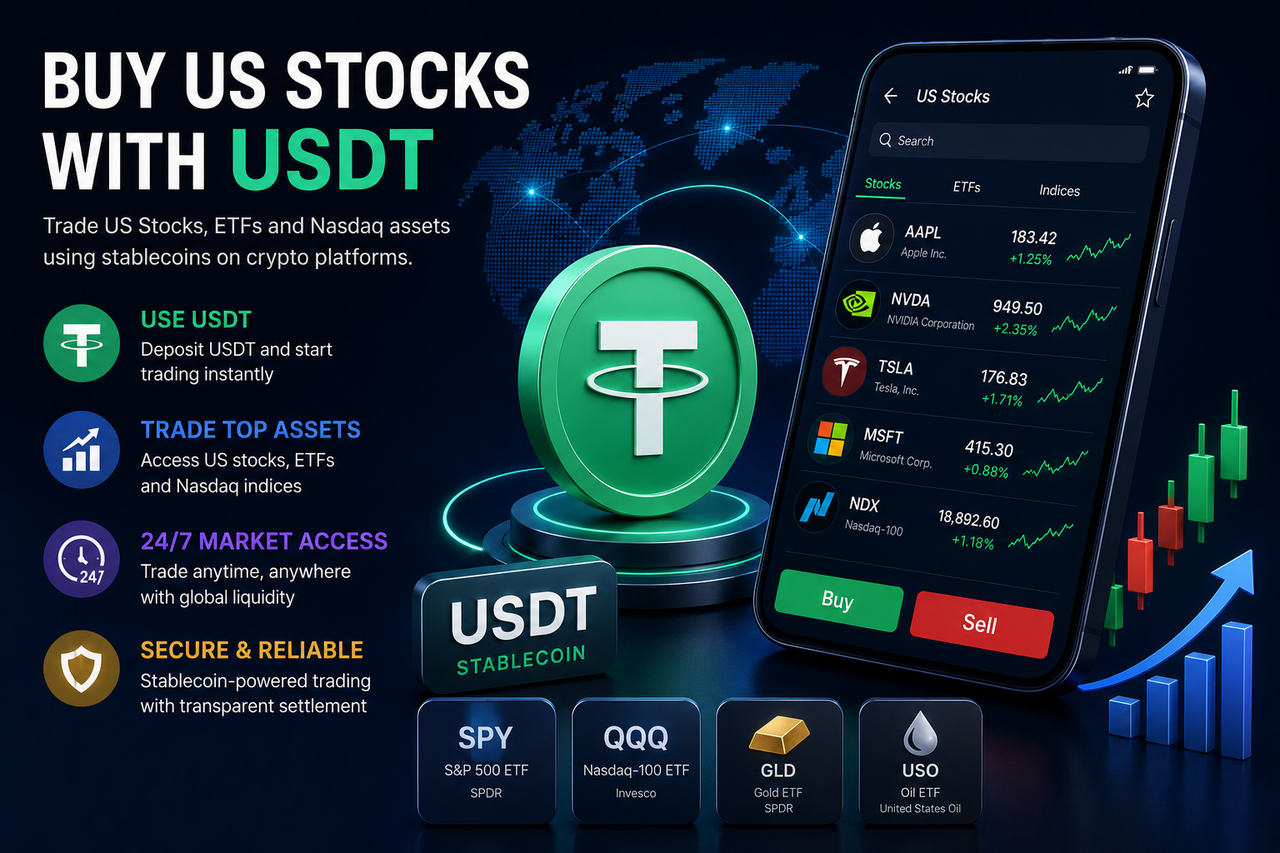
Today, crypto platforms like Gate allow users to trade stocks, ETFs, and commodities using stablecoins. Typically, users must register an account, complete KYC, and deposit stablecoins as margin to access the relevant TradFi product markets.
During trading, platforms may offer:
- U.S. Stock CFDs
- Hong Kong Stock CFDs
- Gold CFDs
- Crude Oil CFDs
- Nasdaq Index Products
- ETF Price Trading
The most significant shift here is that stablecoins are replacing traditional bank accounts as the unified settlement medium for global asset allocation.
Conclusion
Crypto platforms are evolving from pure digital currency exchanges into comprehensive global asset trading gateways. Through CFDs, tokenized stocks, and RWA products, users can now use stablecoins to participate in traditional financial markets, including U.S. stocks, Hong Kong stocks, gold, crude oil, and ETFs.
For those looking to use USDT for global asset allocation and to reduce cross-border financial barriers, the combination of stablecoins and on-chain financial infrastructure may be redefining the future of asset trading. As TradFi and Crypto continue to converge, global capital markets are entering a new, more open, digital, and on-chain era.
FAQs
Can I buy real U.S. stocks on a crypto platform?
Some platforms offer real stock services, but most crypto platforms currently provide price exposure through CFDs or tokenized stocks, which does not necessarily equate to owning the actual shares.
Is a stock CFD the same as owning actual shares?
No. Stock CFDs are price derivatives. Users do not hold real stocks, voting rights, or shareholder benefits.
What are tokenized stocks?
Tokenized stocks are on-chain representations of real stock assets. A custodian holds the underlying shares and issues corresponding tokens on the blockchain.
Is it legal to buy U.S. stocks using USDT?
Legality depends on the platform's jurisdiction, the user's local regulations, and the platform's compliance structure. Regulatory requirements for these products vary by country and region.