When deploying asset projects on Solana, it's common to focus solely on the outcome of the sale and overlook the critical process design before and after issuance.
The key takeaway from the Metaplex asset infrastructure overview is that Metaplex offers an asset engineering framework—not just a one-time mint button.
The framework's value lies in repeatable processes: requirement definition, component integration, parameter orchestration, launch execution, and ongoing governance.
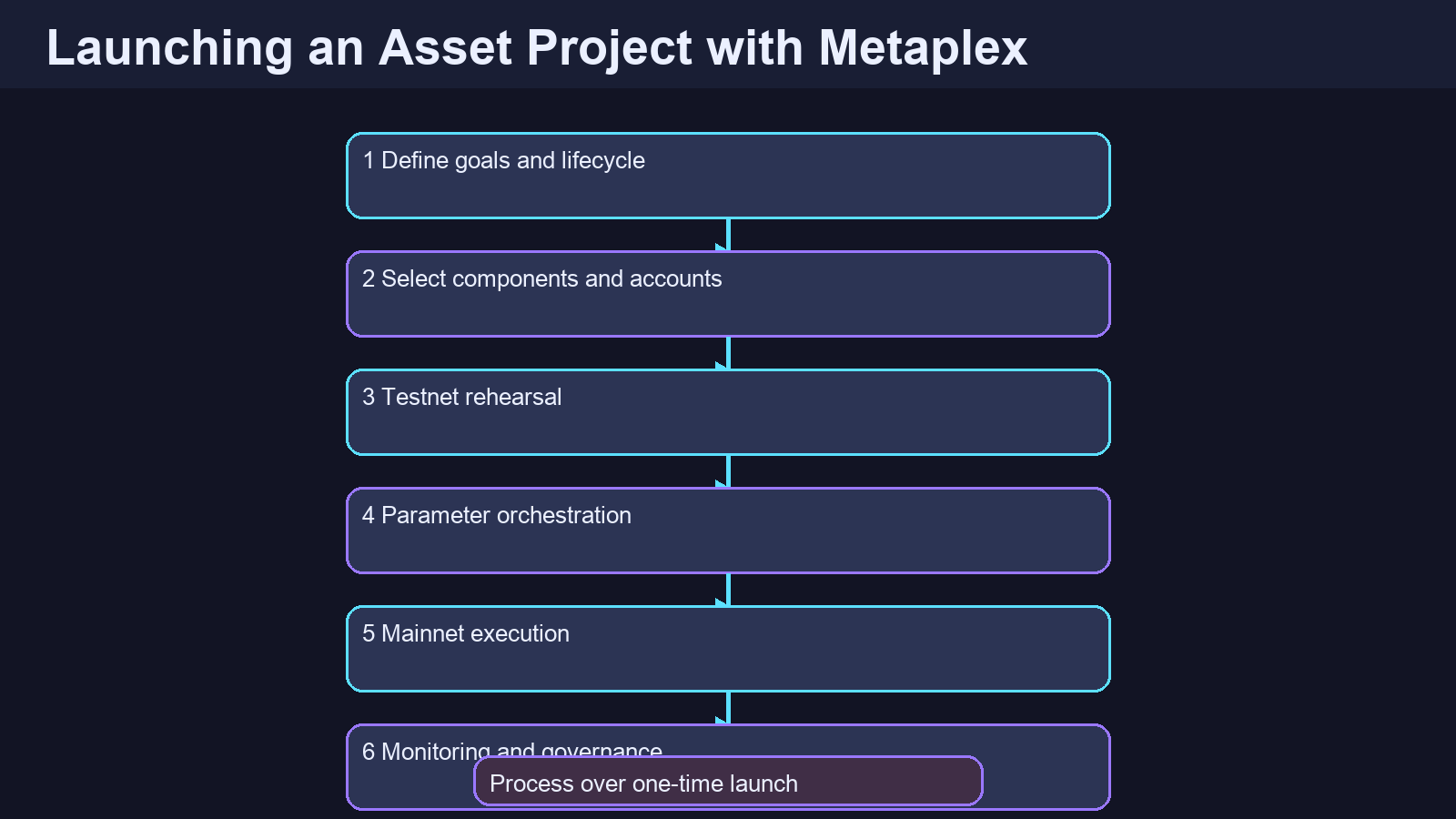
Figure 1. Six-step workflow for launching an asset project on Solana with Metaplex: from defining objectives to post-launch governance.
Why Should You Define the Asset Model Before Scheduling the Sale?
Once assets are deployed on-chain, their permission structures, supply logic, and metadata rules remain in effect long-term. If you lock in the sale date before finalizing technical details, you risk patchwork processes, excessive permission centralization, and sharply increased upgrade costs.
A process-driven approach addresses three questions first: Who will use the asset? What scenario does it solve? How will its lifecycle end? This ensures every subsequent step is verifiable and reviewable.
Step 1: How Do You Define Asset Objectives, Audience, and Lifecycle?
The first step is to create an asset design specification—at a minimum, clearly outlining target users, use cases, state transitions, and termination conditions. Metaplex delivers implementation mechanisms but does not replace business definition.
It's recommended to break the lifecycle into "creation—distribution—usage—update—archive." Each stage should specify the executor, trigger conditions, and on-chain evidence, avoiding reliance on post-launch script fixes.
| Lifecycle Stage |
Key Decisions |
Common Mistakes |
| Creation |
Asset type, metadata fields, supply strategy |
Mixing display and governance fields in a single structure |
| Distribution |
Whitelist, batch minting cadence, wallet thresholds |
Setting only by marketing pace, ignoring on-chain congestion |
| Usage |
Transfer rules, composability, permission boundaries |
Overlooking secondary use cases, resulting in non-reusable assets |
| Update |
Upgradable fields, version compatibility |
Discovering migration issues only after launch |
| Archive |
Deactivation conditions, traceability requirements |
Lack of archiving standards makes historical states hard to audit |
This stage table directly informs subsequent technical tasks.
The second step centers on mapping business requirements to components. If the project prioritizes programmability and long-term scalability, the Core path is typically chosen; for standardized batch issuance, Candy Machine is more common.
For a complete comparison of these paradigms, see Metaplex Core vs traditional NFT creation.
Component selection must align with account structure. At minimum, distinguish mint control, parameter control, and upgrade control to avoid concentrating all permissions in a single key.
Step 3: How Do You Set Up the Development Environment and Complete Testnet Rehearsal?
The goal here is not just "executable code," but a "repeatable process." Your team should validate creation, minting, frontend reading, and exception rollback on testnet, and document the results.
Testing should cover at least three areas: functional correctness, exception boundaries, and operational feasibility. Only when all three pass is the mainnet launch truly controllable.
| Test Dimension |
Content to Verify |
Pass Criteria |
| Asset Creation |
Metadata structure, supply parameters, account initialization |
Consistent results, repeatable tracking |
| Minting Process |
Whitelist logic, batch execution, failure retries |
Failures can be rolled back, retries don't create dirty states |
| Permission Management |
Multi-role signatures, parameter change permissions |
Clear role responsibilities, no unauthorized access paths |
| Frontend Interaction |
Wallet connection, status reading, error prompts |
Complete user flow, understandable error messages |
| Monitoring Records |
Transaction logs, key events, alert thresholds |
Exceptions are identified within preset windows |
The key deliverable in this phase is an executable launch script.
Step 4: How Do You Orchestrate Issuance Parameters and Minting Rules?
This step translates business strategy into parameters: total supply, batch size, whitelist window, fees, and stop conditions. A robust approach starts by defining failure convergence mechanisms—such as error rate thresholds, congestion mitigation rules, and multisig change boundaries.
If your team struggles to balance complexity and maintenance costs, refer to Metaplex vs other Solana asset issuance frameworks for guidance.
Step 5: How Do You Execute Launch and Complete the Frontend Interaction Loop?
Launch execution can be divided into "pre-window confirmation—window execution—post-window review." Key metrics are configuration completeness, transaction success rate, and state consistency.
Focus on consistency over speed during execution. On-chain state, frontend display, and operational standards must be synchronized to avoid asset visibility without usability.
Step 6: How Do You Monitor, Govern, and Iterate Post-Issuance?
Completion of issuance does not end the process. Issues with metadata readability, permission usage, and parameter changes often emerge during ongoing operations.
Post-issuance, it's recommended to maintain three layers of monitoring: on-chain events, product behavior, and governance decisions. The advantage is replicable processes; the risk is increased coordination costs; the limitation is higher upfront investment.
Summary
Launching asset projects on Solana with Metaplex is not about a single sale result, but about a repeatable process. The six-step path can be summarized as: model definition, component selection, test rehearsal, parameter orchestration, launch execution, and post-issuance governance. The clearer the process, the more stable the asset system.
FAQ
Why Should Metaplex Asset Projects Prioritize Process Design Over Sale Page Creation?
The sale page is just the entry point and cannot replace on-chain rule definition. Metaplex project stability depends on asset model, permission boundaries, and parameter strategy. Prioritizing process design reduces post-launch patchwork.
What Step Is Most Often Overlooked in the Launch Process?
Full-chain testnet rehearsal is often compressed, but it directly determines mainnet quality. If exception paths and rollback plans aren't validated, unpredictable states are likely after mainnet launch.
Is There a Significant Process Difference Between Metaplex Core and Traditional NFT Minting?
The main difference lies in process predefinition. Core emphasizes defining asset behavior before issuance, while traditional methods often mint first and add logic later. The former maintains consistency better; the latter is more direct for short-term launches.
Does Asset Project Governance Continue After Launch?
Yes. On-chain assets face ongoing issues with permissions, versions, and usage deviations. Governance ensures parameter changes are recorded, bounded, and auditable.
How Can You Tell If a Metaplex Issuance Process Is Repeatable?
A repeatable process typically has three features: steps with clear inputs and outputs, preset exception handling, and unified lists across roles. If different members can consistently reproduce the process, the project has reached engineered asset management.