For over a decade, Proof-of-Work (PoW) has stood as the blockchain industry's most classic consensus mechanism. Bitcoin miners rely on ASIC devices to perform hash computations, competing for new block rewards. Yet the core drawback of traditional PoW remains: massive amounts of hashrate are wasted on hash computations that serve no practical purpose.
With the rise of Zero-Knowledge Proof (ZK) and AI infrastructure, the industry is now exploring a new frontier: Useful Proof of Work. Nockchain was born from this vision, aiming to transform the conventional hash competition into verifiable proof generation.
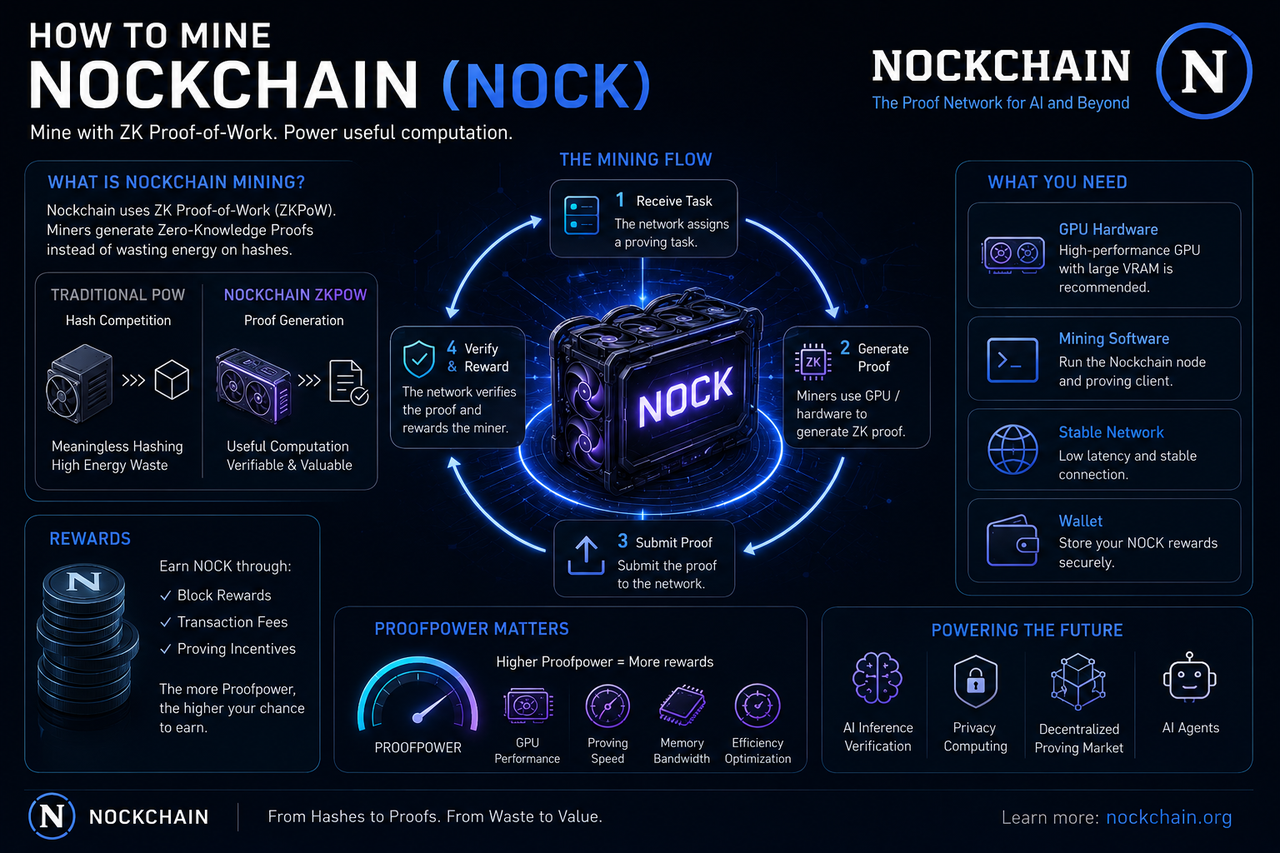
How Does Nockchain Mining Work?
In a traditional PoW network, miners spend their efforts continuously cycling through random hashes until they find one that satisfies the network's difficulty target.
In Nockchain, miners execute proving tasks instead.
The network assigns miners specific proving computations; miners then generate the corresponding Zero-Knowledge Proof using GPUs or specialized proving hardware. Once the proof is verified on-chain, the miner receives the block reward and associated revenue.
As a result, the core of Nockchain mining is no longer hashrate—it is proof generation capability.
Simply put:
- Bitcoin Mining competes for hashes
- Nockchain Mining competes for proofs
This design ensures that miners' computational resources serve real-world computing needs, rather than merely maintaining network security.
What Is Proofpower?
Within the Nockchain ecosystem, Proofpower is a critical metric for assessing a miner's capability.
It resembles hashrate in the Bitcoin network, but the meaning differs.
Proofpower refers to a miner's ability to generate valid Zero-Knowledge Proofs.
A miner's Proofpower is typically influenced by:
- GPU performance
- Proving speed
- Proving efficiency
- Hardware optimization
- Memory bandwidth
Because Zero-Knowledge Proof generation demands high hardware performance, GPU acceleration and proving hardware are likely to become key pillars of the Nockchain mining ecosystem moving forward.
What Do You Need to Join Nockchain Mining?
Participating in Nockchain Mining generally requires the following core components:
First, GPU hardware. ZK proving is heavily dependent on parallel computing, so high-performance GPUs typically deliver higher Proofpower.
Second, proving software. Miners must run the corresponding Nockchain node and proving client to receive proving tasks, generate proofs, and submit them to the network.
In addition, a stable network environment and reliable node operation are essential—miners need to stay synced with the Nockchain network and submit proofs in a timely manner.
Compared with traditional ASIC mining, Nockchain Mining is closer to a "High-Performance Computing (HPC) + ZK proving" model.
Where Does Nockchain Mining Revenue Come From?
NOCK Mining revenue is primarily derived from block rewards and network transaction fees.
When a miner successfully generates a valid proof that passes network verification, they can earn block rewards, transaction fees, and proving incentives. Since Nockchain's consensus mechanism is built on proof generation, miners are essentially providing proving services to the entire network.
Looking ahead, as AI inference verification, privacy computation, and decentralized proving markets develop, the demand for proofs is likely to grow further.
How Is Nockchain Mining Different from Bitcoin Mining?
Although both follow a PoW model, their operational logic is entirely distinct.
Bitcoin Mining uses hash competition to secure the network, while Nockchain Mining aims to direct hashrate toward verifiable computation.
In Bitcoin, miners run SHA-256 hash operations repeatedly; in Nockchain, miners perform Zero-Knowledge Proof generation.
Their hardware requirements also diverge:
- Bitcoin is more ASIC-dependent
- Nockchain is more GPU- and proving-hardware-dependent
For this reason, Nockchain is seen as a major step in evolving the PoW model toward Useful Proof of Work.
What Are the Risks of Nockchain Mining?
While Nockchain's technical direction is innovative, its mining model is still in an early phase.
First, Zero-Knowledge Proof generation places high demands on GPUs and proving hardware, which may mean significant hardware costs for miners.
Second, the entire proving economy is still nascent—real market demand has yet to fully materialize.
Additionally, the Nockchain ecosystem is still expanding; the developer ecosystem, proving market, AI application demand, and node network size all need further growth.
Therefore, for miners, NOCK Mining is best suited for participants with a long-term technical outlook.
Summary
By introducing ZK Proof-of-Work (ZKPoW), Nockchain transforms traditional meaningless hash competition into Zero-Knowledge Proof generation with real-world utility. Miners no longer simply consume energy—they actively participate in building verifiable computation and proving infrastructure.
FAQs
What Is the Difference Between NOCK Mining and Bitcoin Mining?
Bitcoin Mining relies on hash competition, whereas NOCK Mining relies on Zero-Knowledge Proof generation.
What Is Proofpower?
Proofpower is a miner's ability to generate valid Zero-Knowledge Proofs, analogous to hashrate in traditional PoW networks.
Does Nockchain Mining Need a GPU?
Typically, yes. Zero-Knowledge Proof generation demands substantial parallel computing power, making high-performance GPUs the preferred choice for Nockchain Mining.
Why Is Nockchain Related to AI?
Nockchain is focused on verifiable computation and proving infrastructure, which can be applied to AI inference verification and AI Agent execution proofs.







