The main focus when participating in CASHCAT isn't about "getting in the fastest"—it's about "making the fewest mistakes." Before engaging in actual operations, first understand the positioning of Cash Cat (CASHCAT): it's a meme token on Robinhood Chain, with a narrative built around a historical naming anecdote. Public disclosures make clear it's not an official Robinhood project. By separating project positioning from operational flow, you avoid mistaking cultural storytelling for shortcuts. The path from zero to one is essentially a repeatable on-chain checklist: is your wallet and network ready, has your funding arrived, can the contract be cross-verified, are there swap preview anomalies, and should you tighten authorizations after the trade?
What are the essential prerequisites before trading?
The essentials are wallet, network, funds, and information sources. Your wallet handles signing and asset management; the network determines access to Robinhood Chain; funds are needed for swaps and gas; and information sources are used to verify contracts and official entry points. Missing any one of these could result in failure or operational errors down the line.
| Preparation Item |
Target Status |
Quick Self-Check |
| Wallet |
Can sign and switch networks normally |
Can you reliably view on-chain assets? |
| Network |
Robinhood Chain configured |
Are Chain ID and RPC correct? |
| Funds |
Main coin and trading funds available |
Do you have enough for gas and test trades? |
| Info Source |
Official site and X accessible |
Are the contract address sources consistent? |
Treat these four as "parallel thresholds." Opening your wallet doesn't guarantee the network is set up right; seeing funds on other chains doesn't mean you have a usable balance on Robinhood Chain. For information, always cross-check the Cash Cat official site and X account—don't rely on group chat screenshots or forwards alone. For first-time setup, save your wallet version, network name, RPC source, and bridging tool for future troubleshooting.
How do you bridge funds and confirm the network?
Cross-chain funds are usually bridged with dedicated tools. Always start with a small test transaction; only proceed after funds arrive. After bridging, double-check that your wallet network and asset display match—avoid the common pitfall of "funds are on-chain but the wallet is on the wrong network."
First-time users should save the bridging transaction hash; if there are delays or display issues, the hash is your key to debugging. Successful bridging doesn’t mean you can immediately trade large amounts: always confirm your target chain’s main coin balance is enough for gas, and that your wallet is switched to Robinhood Chain. The main risk in bridging isn’t "can you bridge" but "do you verify after bridging." Make "small test bridge—save hash—switch network—check balance" your fixed four-step routine to avoid common mistakes.
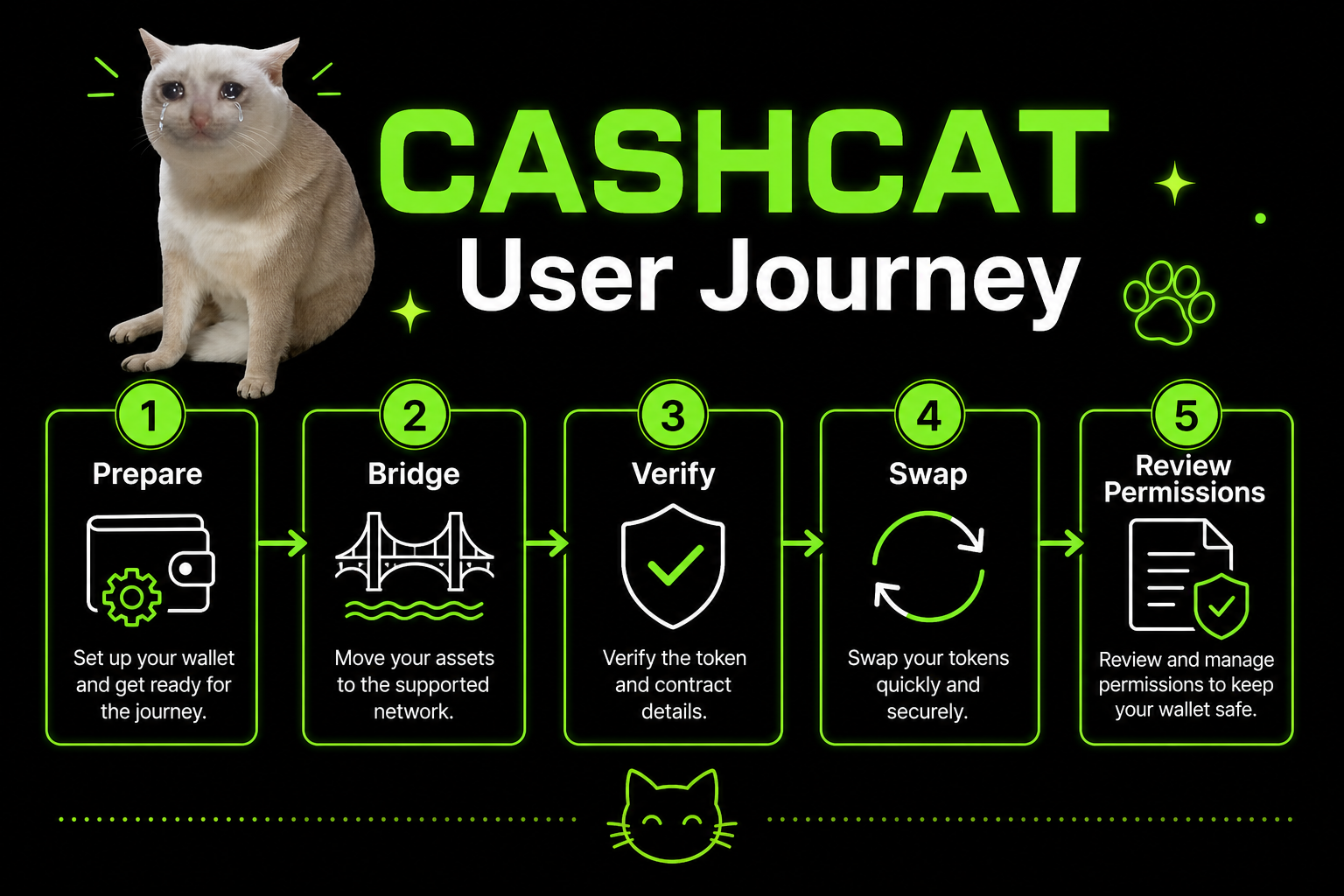
Figure 1. CASHCAT user journey: from setup and bridging to verification, trading, and post-trade review.
How do you verify the CASHCAT contract and make your first trade?
Your first trade should follow the "small test trade + dual contract verification" rule. Cross-check the contract address on the official website and X, then import the token on the DEX and review the route preview. If the preview looks off (major price deviation, extremely low expected return), pause and re-verify—don’t just keep raising slippage to force execution.
For complete details, see the CASHCAT on-chain transaction path: one covers the "zero-to-one" operational flow, the other focuses on single-swap network, routing, and error handling. Together, they create a closed loop of "operational steps + troubleshooting logic."
For contract verification, do at least three checks: the address shown on the official website, the address announced on X, and the token details in the block explorer. If any of the three don’t match, stop and re-confirm the source. After importing, check the token symbol, decimals, and liquidity pool against public info—similar symbols don’t guarantee the same contract.
When executing your first swap, use a small, affordable amount to test the entire flow: is the signature valid, is the route reasonable, does the receipt arrive on time? Once your test trade succeeds, you can decide whether to increase trade size; scaling up doesn’t change the process—just apply the same checklist to a larger amount.
| Trading Stage |
Key Action |
Pause Signal |
| Import Token |
Paste contract and check symbol |
Symbol/decimals don’t match public info |
| Route Preview |
Check expected amount and path |
Abnormally low amount or unclear route |
| Signature Confirm |
Check authorization target/amount |
Unknown target or excessive amount |
| Trade Pending |
Save transaction hash |
Long wait, no confirmation, not on explorer |
Knowing "when to stop" is more important than just "how to proceed." Most meme asset losses happen when users ignore warning signs and keep going.
How do you review trades and manage authorizations post-transaction?
After a trade, check at least three things: transaction status, token receipt, and authorization scope. Confirm transaction status on the block explorer; check wallet holdings for receipt; use authorization management tools to review approvals. If you see unnecessary large authorizations, tighten or revoke them promptly.
| Review Aspect |
Check Action |
Risk Control Purpose |
| Transaction Status |
Confirm hash shows success |
Prevents "assumed completion" mistakes |
| Receipt Status |
Check token display and amount |
Catches display issues and routing errors |
| Authorization |
Review approval amount and target |
Reduces risk of future asset exposure |
Reviewing upgrades your results from "page notifications" to "verifiable facts." A DEX "success" message doesn’t always mean final confirmation on-chain; missing tokens in your wallet may just mean you haven’t added a custom token. Check all three states separately to avoid relying on a single interface.
Authorization management is critical. Many users focus only on the trade result, ignoring leftover approvals; high limits—whether you trade again or not—still leave you exposed. Reviewing and tightening authorizations after each trade is a low-cost, high-impact security step.
How do you manage risk when participating in CASHCAT?
Risk management comes down to position discipline, frequency discipline, and information discipline. Position discipline means only trading what you can afford to lose; frequency discipline means not chasing high-frequency trades; information discipline means using only the official website, X, and on-chain verifiable sources. For parameter-level understanding, see CASHCAT Tokenomics: total supply, tax rate, and LP status are for verification, not yield promises.
A more systematic risk framework is in CASHCAT Risks and Limitations. The four most common issues in meme trading are volatility, liquidity, fake info, and operational mistakes. Following a process reduces emotional decision-making: complete your checklist first, then decide whether to continue. To compare CASHCAT with the broader meme category, see CASHCAT vs Typical Meme Coin: narrative and chain context may affect your info quality assessment, but the core steps—contract verification, small test trade, and trade review—don’t change.
What are common mistakes in the participation process?
Common pitfalls include: trading without contract verification, making large trades without testing, not reviewing the network after bridging, ignoring authorization records, and relying solely on social media hype. The fix is to turn every step into a repeatable checklist and always pause if you see warning signs. Watch for two types of "identity confusion" as well: mistaking cultural storytelling for Robinhood endorsement, or assuming 0/0 tax and LP burned automatically mean low risk. Parameters can reduce some friction, but can’t replace position discipline and contract verification.
Summary
The key to participating in CASHCAT from scratch is to break down on-chain operations into five steps—preparation, bridging, verification, trading, and review—setting minimum checkpoints at each stage. Wallet and network readiness, traceable funding, cross-verifiable contracts, repeatable test trades, and adjustable authorizations together create a repeatable participation framework. Only optimize for efficiency after your process is stable; chasing speed from the start is rarely prudent.
FAQ
Why do a small test trade when first using CASHCAT?
Small test trades verify that the contract, route, slippage, and settlement all work as expected. Even if something goes wrong, losses are limited. It’s a crucial, low-cost way to check your process.
Is it enough to just check the contract address on official X?
Always do at least two checks: cross-verify with the official site and X, then confirm token details on the block explorer. One extra check can greatly reduce the risk of fake addresses.
Why review authorizations after trading?
Authorizations define what assets can be accessed later. Many users focus on trade results and ignore leftover approvals. Reviewing and tightening authorizations reduces long-term security risks.
What are the three most important things in the process?
Contract verification, step-by-step execution, and trade review. Together, they ensure your operations are verifiable, traceable, and correctable. For meme assets, this is a more stable foundation than reacting to short-term market sentiment.
Is CASHCAT an official Robinhood project?
No. Public disclosures clearly state that CASHCAT is not affiliated with Robinhood; its narrative is closer to a community-driven cultural asset. Always distinguish between "brand anecdote" and "official endorsement" before participating.
What should you check after bridging?
At minimum: confirm your wallet is switched to Robinhood Chain, the target chain balance has arrived, and you have enough main coin for gas. Save your bridging transaction hash so you can troubleshoot any delayed settlements.