CoreWeave (CRWV) debuted on NASDAQ in 2025, quickly becoming a leading publicly traded company in the AI infrastructure sector. As demand for AI computing power accelerates, CRWV has emerged as a key AI cloud infrastructure asset capturing investor attention.
On Gate, users can tailor their exposure to CRWV by selecting from a range of products to match their trading strategies. Stock trading resembles traditional securities investment, while CFDs and perpetual futures are designed for trading price movements. Each product type differs in holding structure, trading direction, margin requirements, and risk management protocols.
Understanding Product Types Before Trading CRWV on Gate
Before trading CoreWeave (CRWV) on Gate, it’s essential to understand the platform’s product lineup. Since CRWV is available as a stock, CFD, and perpetual futures contract, each product type represents distinct asset characteristics.
Stock products track CoreWeave’s listed equity, giving users direct exposure to share price movements. CFD (Contract for Difference) and perpetual futures are derivatives—users speculate on price fluctuations without owning actual CoreWeave shares.
| Product Type |
Asset Attribute |
Key Features |
| CRWV Stock |
Listed Equity |
Represents CoreWeave stock ownership |
| CRWV CFD |
Contract for Difference |
PnL based on price movements |
| CRWVUSDT Perpetual Futures |
Perpetual Futures |
Enables margin and bidirectional trading |
| Trading Bots |
Automated Strategy Tool |
Executes strategies using futures products |
When selecting a trading method, align your choice with your investment objectives. Long-term investors may favor the stock product, while those targeting short-term price action may prefer CFDs or perpetual futures.
Each product comes with its own trading rules, fee structure, and risk controls. Always review the most up-to-date product details on Gate before trading.
How to Access the CoreWeave (CRWV) Trading Page
To access CoreWeave trading, search for “CRWV” on the Gate APP or website. Since multiple products may reference the same underlying asset, search results are typically organized by category—stocks, futures, CFDs, and more.
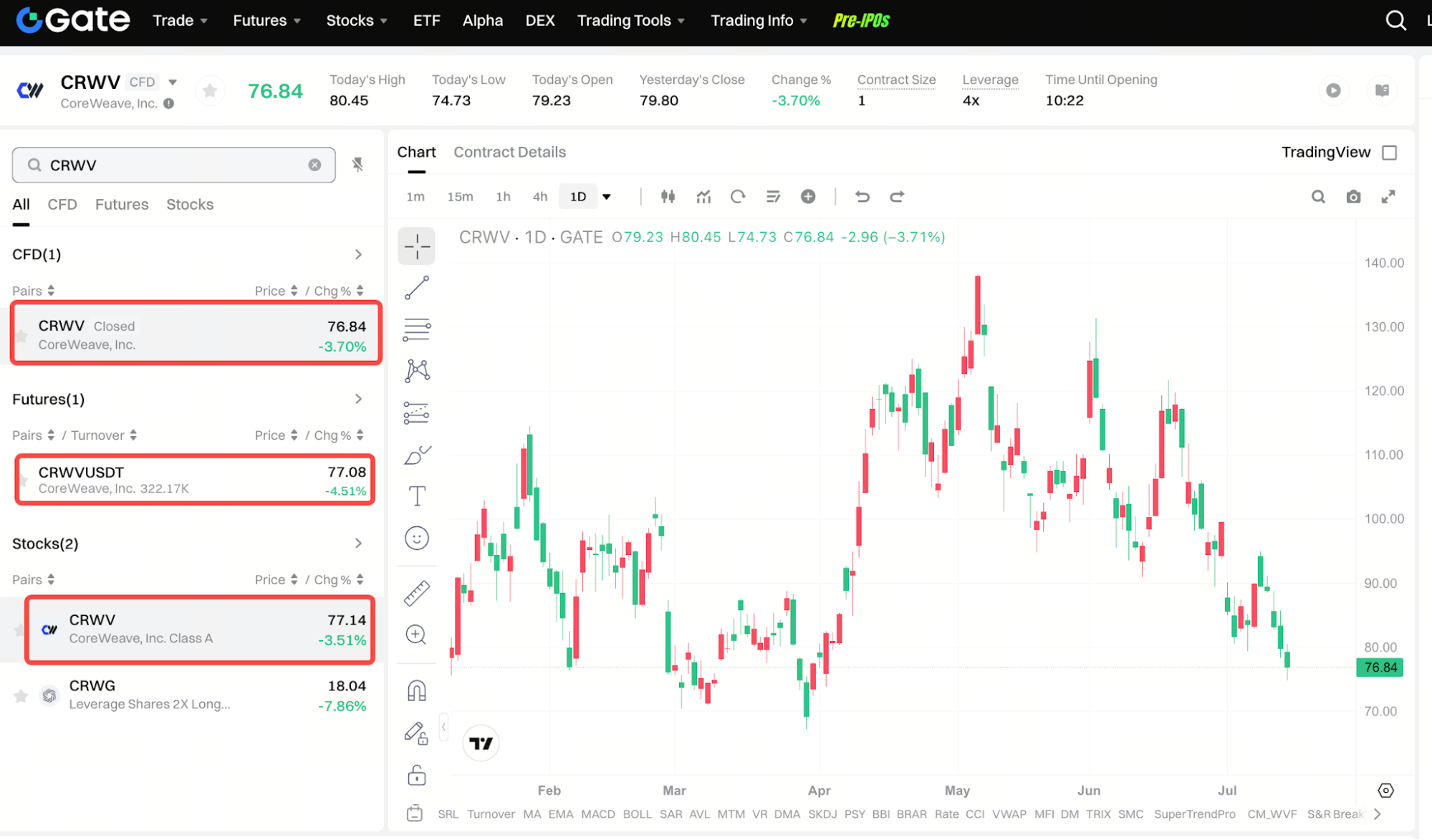
On the Gate APP, searching for CRWV displays a suite of CoreWeave-related products, including:
- CRWV Stock
- CRWV CFD
- CRWVUSDT Perpetual Futures
- CRWVUSDT Futures Grid and other strategy tools
Once you enter a product page, you can view real-time pricing, trading rules, historical charts, and related information.
Each trading entry leads to a unique trading mechanism. For instance, the stock page displays CoreWeave Class A stock details, while the perpetual futures page shows CRWVUSDT contract prices and parameters.
Always verify you’re on the correct product page before trading to avoid confusion between stocks, CFDs, and futures.
Trading CRWV Stock on Gate
Gate’s stock trading interface provides direct access to CoreWeave (CRWV) shares. On the stock page, you can monitor CRWV prices and place buy or sell orders in accordance with standard equity trading rules.
Stock trading closely mirrors traditional securities markets—users gain exposure to CoreWeave’s listed equity. Share prices are influenced by company performance, market dynamics, AI industry trends, and investor sentiment.
Key considerations when trading CRWV stock on Gate:
| Item |
Details |
| Stock Name |
CoreWeave Class A Stock |
| Ticker |
CRWV |
| Market Price |
Fluctuates with market conditions |
| Position Details |
View current share holdings |
| Order History |
Track past transactions |
The core distinction between stock trading and derivatives (CFDs, futures) is asset ownership. Stock trading confers actual equity, while derivatives are purely price-based instruments.
Before trading, confirm the platform’s stock product rules—trading hours, fees, settlement processes, and more.
Using USDT to Trade CRWV CFDs or Perpetual Futures
Gate enables users to trade select CRWV derivatives—CFDs and CRWVUSDT perpetual futures—using USDT as margin. Unlike stock trading, these products are margin-based, allowing users to open and close positions based on price movements.
The essence of CFD and futures trading is to profit or lose from price predictions, not from owning CoreWeave shares.
| Comparison |
CRWV CFD |
CRWVUSDT Perpetual Futures |
| Product Type |
Contract for Difference |
Perpetual Futures |
| Trading Funds |
Margin (per product rules) |
USDT margin |
| Position Direction |
Supports long and short |
Supports long and short |
| PnL Source |
Entry/exit price difference |
Contract price changes |
| Stock Ownership |
No |
No |
When trading CRWV derivatives with USDT, pay close attention to margin ratios, leverage settings, funding rates, and liquidation protocols.
Because derivatives entail more complex risk management, ensure you understand all product rules before trading.
Viewing CRWV Positions and Order History
After trading CRWV on Gate, you can monitor your positions and order history via your trading account.
Viewing methods by product:
- Stock: Track share quantity, purchase price, and order history.
- CFD: Monitor active positions, entry price, and PnL.
- Perpetual Futures: Review margin, leverage, unrealized PnL, and historical orders.
Effective position management is essential. Regularly review your holdings to assess asset changes and risk exposure.
For USDT-margined products, closely monitor your account balance and margin utilization to mitigate the impact of market volatility on your positions.
Key Differences: CRWV Stock, CFD, and Perpetual Futures on Gate
Although all three product types are linked to CRWV price, they differ substantially in trading mechanism and asset structure.
| Comparison |
CRWV Stock |
CRWV CFD |
CRWVUSDT Perpetual Futures |
| Product Type |
Equity Asset |
Contract for Difference |
Perpetual Futures |
| Stock Ownership |
Yes |
No |
No |
| Trading Direction |
Buy and hold |
Long/short |
Long/short |
| Margin Mechanism |
Typically unleveraged |
As specified |
Margin trading |
| PnL Source |
Stock price movement |
Price differential |
Contract price movement |
| Best For |
Long-term investing |
Swing trading |
Short-term trading |
Your choice should align with your preferred asset exposure, trading horizon, and risk management approach.
Stocks suit traditional investment strategies, while CFDs and perpetual futures are ideal for capturing price volatility. Understanding the nuances between products is critical before trading CRWV.
Summary
Gate offers diverse trading channels for CoreWeave (CRWV), including stocks, CFDs, and perpetual futures. While all are tied to CRWV’s price, each product category features distinct asset structures, trading mechanisms, and risk profiles.
Stock trading reflects direct ownership of CoreWeave equity, whereas CFDs and futures are derivatives that do not confer shareholder rights. Select the product that best matches your investment objectives.
A thorough understanding of product rules, funding methods, and risk protocols is essential for effective CRWV trading.
FAQ
What CRWV trading products are available on Gate?
Gate supports multiple CRWV trading products, including stocks, CFDs, and CRWVUSDT perpetual futures. Users can choose the most suitable trading method based on product mechanics.
What’s the difference between CRWV stock and CFD on Gate?
CRWV stock represents actual company equity, while a CFD is a derivative contract based on price movements. The key differences are asset ownership and trading structure.
Can I use USDT to trade CRWV?
Yes, select CRWV derivatives on Gate support USDT as margin. Refer to the specific product page for detailed rules and eligibility.
Does trading CRWV perpetual futures mean I own CoreWeave stock?
No, CRWV perpetual futures trading is based solely on contract price movements and does not confer CoreWeave shareholder rights.
How do I check my CRWV trading records on Gate?
Access your trading account to view CRWV positions, order history, trade records, and current PnL.
Which is better for long-term investing: CRWV stock or perpetual futures?
CRWV stock aligns with traditional, long-term investment strategies, while perpetual futures are best suited for trading price volatility. Choose based on your investment goals and risk tolerance.