This is aimed at sophisticated retail crypto traders and investors, as well as institutional users, who are comfortable with leveraged forex CFDs and want GBP exposure inside the Gate.com ecosystem without holding physical pounds. Before opening a position, users need an eligible Gate account, sufficient USDT, and access to TradFi CFD services in their region. After funds are transferred to the TradFi account, the balance may be displayed in USDx, Gate’s internal accounting unit for margin, fees, floating profit and loss, and account equity.
The basic process is to enter the forex CFD market, choose a GBP-related currency pair, decide whether to take a long or short position, review the contract size, leverage, margin, spread, and possible overnight charges, and then manage or close the position through the account’s position records. The rest of this guide explains how order types and execution work, how to read margin and profit or loss, when liquidity and trading hours matter, what fees and leverage risks to watch, and how Gate’s crypto-funded forex setup differs from a traditional fiat broker.
Before trading GBP on Gate, users should distinguish between currency conversion tools, forex CFDs, and other GBP-linked products. A page showing a USDT-to-GBP conversion rate or GBP calculator is a reference page for checking the current value, not a market where users can open a leveraged GBP position. As an example, 1 GBP = 1.3392 USDT and 1 USDT = about 0.7468 GBP as of July 22, 2026. The latest exchange rate fluctuates with market conditions and can vary slightly across exchanges. On platforms where Gate trading usually means CFDs, users who want direct conversion can use fiat purchase methods to buy crypto by turning traditional money like GBP into USDT, including P2P, where they buy directly from other users. KYC verification is typically required before using P2P or fiat buy features.
GBP/USD and EUR/GBP also represent different forms of exposure. Buying GBP/USD normally expresses the view that the British pound will strengthen against the US dollar. Buying EUR/GBP instead expresses the view that the euro will strengthen against the pound.
| Product or tool |
Primary purpose |
Direct ownership of GBP |
Margin required |
| USDT/GBP converter |
Displays a reference conversion value |
No |
No |
| GBP/USD CFD |
Trades movements in GBP against USD |
No |
Yes |
| EUR/GBP CFD |
Trades movements in EUR against GBP |
No |
Yes |
| Direct GBP exchange |
Converts funds into actual British pounds |
Yes |
Usually no |
Forex CFDs are derivative products. They provide exposure to exchange-rate movements but do not give users ownership of British-pound bank deposits, physical currency, or the interest that might apply to a conventional GBP savings account.
What Role Does USDT Play in GBP Trading?
USDT acts as the funding source for GBP-related TradFi positions on Gate. When USDT is transferred into the relevant TradFi account, users may first need to move funds from a Funding Account to a Spot Wallet, depending on the workflow shown on Gate, and the system can display the balance as USDx for internal accounting purposes.
USDx is not a separate cryptocurrency that users need to purchase. It is used for the internal calculation of available balance, margin, fees, unrealized profit and loss, and account equity. The accounting display does not mean users have exchanged USDT for a new externally transferable token. In this setup, USDT is the crypto asset being used within Gate’s broader environment for managing digital assets.
USDT also does not determine the direction of GBP/USD or EUR/GBP. Those markets continue to reflect global foreign-exchange conditions, including Bank of England policy, UK inflation and growth data, US dollar movements, interest-rate expectations, and market liquidity.
Gate’s GBP-related forex CFDs are priced with reference to the underlying foreign-exchange market. The current rate shown for GBP-related pricing is a market reference and is not always identical to a direct fiat conversion quote. GBP/USD measures the value of one British pound in US dollars, while EUR/GBP measures the value of one euro in British pounds.
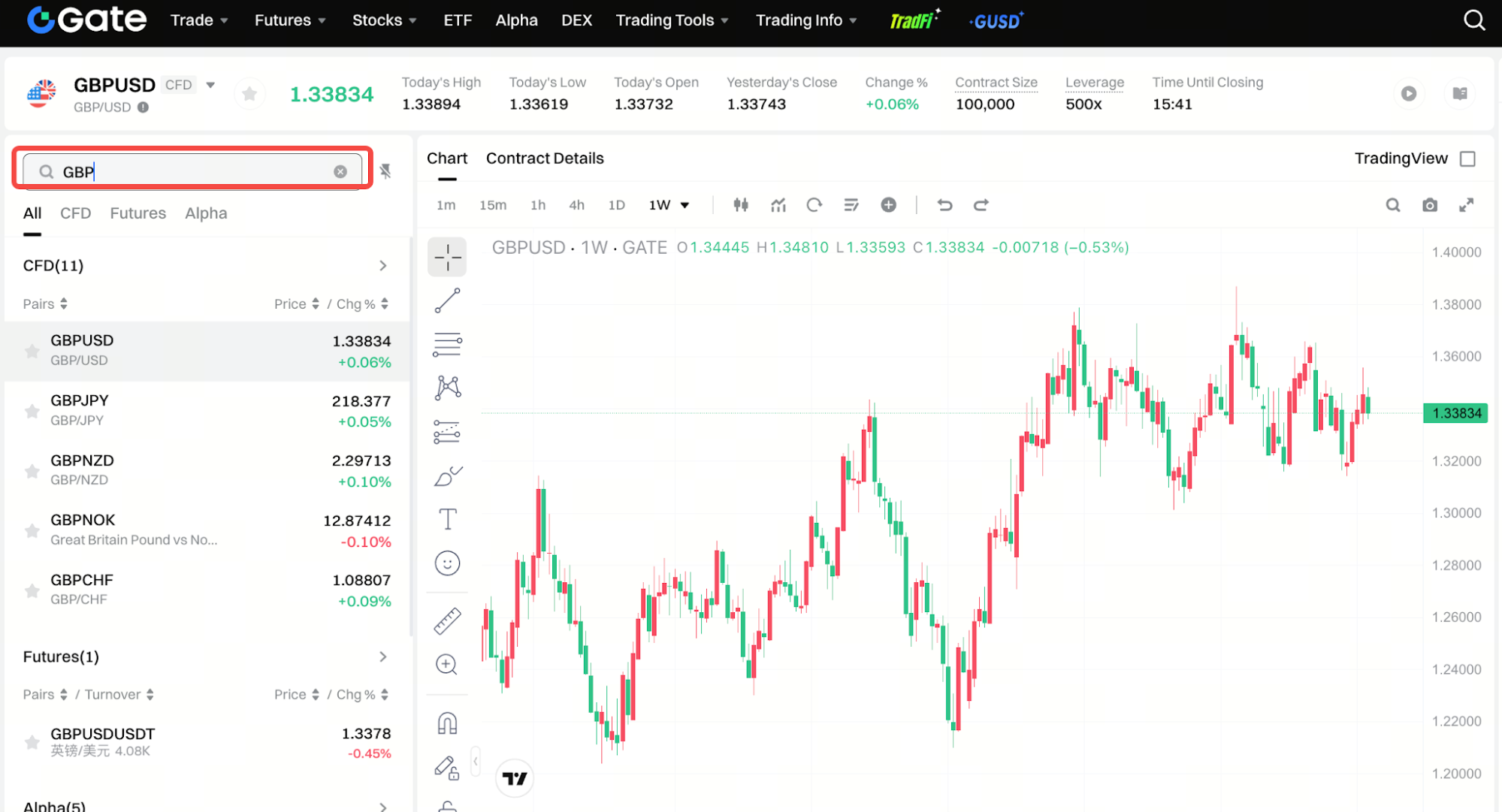
Because the quote direction differs, the same change in sterling can produce opposite-looking charts. A stronger pound generally pushes GBP/USD higher but may push EUR/GBP lower, assuming the other currency remains unchanged.
CFD trading does not require delivery of either currency. A user opens a long or short contract and later closes it, with the result determined by the opening price, closing price, position size, spread, and applicable fees.
Displayed CFD prices may differ slightly from the latest exchange rate used to convert tether in a converter or calculator tool. The executable price includes a bid-ask spread, which may widen around major economic releases, market reopenings, or periods of reduced liquidity.
How Do Market and Conditional Orders Affect GBP Execution?
A market order prioritizes execution speed. It is submitted at the currently available counterparty price, but the final fill can differ from the price visible when the order was placed, especially during fast-moving markets with elevated market volatility.
Conditional or trigger orders allow users to specify a market level that activates an order. However, the trigger price is not necessarily the final execution price. Once triggered, the order may fill at the next available price.
| Order type |
Main purpose |
Key consideration |
| Market order |
Opens or closes a position immediately |
May experience slippage |
| Trigger order |
Submits an order after a condition is met |
Trigger price does not guarantee fill price |
| Take-profit order |
Closes a position after a target is reached |
Gaps can cause price deviation |
| Stop-loss order |
Limits further losses |
Cannot eliminate slippage in volatile markets |
Users should not automatically treat a trigger order as equivalent to a traditional limit order on an order-book exchange. The available order types and execution mechanics should be checked directly on the relevant GBP contract page, since limit orders can help control costs during volatile conditions when they are available there.
How Should Users Read GBP Positions, Margin, and Profit and Loss?
A GBP CFD position normally records the trading direction, opening price, position size, margin used, and unrealized profit or loss. Each transaction may be maintained as a separate position rather than being merged into a single average-cost holding.
Margin is the amount of USDx reserved to support a leveraged position. It is not the full notional value of the trade. A relatively small amount of margin can therefore control a much larger exposure to GBP/USD or another currency pair.
| Position record |
Meaning |
| Position direction |
Long or short exposure |
| Opening price |
Price at which the position was established |
| Position size |
Contract amount or number of lots |
| Margin used |
USDx allocated to support the position |
| Unrealized P&L |
Floating result before closing |
| Realized P&L |
Confirmed result after closing |
| Available balance |
Funds available for new positions or volatility |
| Margin level |
Indicator of the account’s capacity to absorb losses |
Leverage magnifies both gains and losses, although these GBP CFDs have their own margin rules and users elsewhere on Gate may see futures offering up to 125x leverage. If account equity falls below the required threshold, the platform may reduce or close positions automatically. Users should therefore evaluate the full notional exposure rather than looking only at the initial margin requirement. Before switching between conversion and trading functions, compare total costs, including exchange rates, fees, and your investment amount; Gate spot trading is listed at 0.10%, so check that against CFD spreads, withdrawal charges, and any hidden fees instead of assuming one route is cheaper.
How Do Trading Hours and Liquidity Affect Execution?
GBP forex CFDs do not trade in the same way as cryptocurrency spot markets that run 24 hours a day. They generally follow scheduled foreign-exchange trading hours and may close during weekends, holidays, or platform maintenance periods.
GBP/USD usually has relatively deep liquidity during active London and New York trading hours. Higher trading volume typically supports tighter execution, while thinner periods can widen spreads. However, spreads may widen around Bank of England decisions, UK inflation releases, US employment data, market reopenings, or other high-impact events, which is why traders monitor execution conditions closely during sharp market fluctuations.
Orders placed during thin liquidity can experience larger slippage. Stop-loss instructions may also fill away from their trigger price if the market gaps or moves too quickly for execution at the selected level.
Positions held beyond the daily financing cutoff may incur swap or overnight charges. Certain settlement days may include multiple days of financing to account for weekends, so holding costs should be reviewed before keeping a position open for an extended period, especially because these fees can quietly reduce the amount committed to a leveraged position compared with keeping cash on the sidelines over time.
How Is Gate GBP Trading Different From a Traditional Forex Broker for Fiat Currencies?
The main difference is the funding and account structure. Because USDT is one of the market’s largest stablecoins, with Tether’s market cap around £142 billion, Gate users often use it for funding and can move it from an existing digital-asset account into the TradFi environment, while a traditional forex broker usually requires depositing funds in fiat currencies such as USD, GBP, or EUR.
| Comparison |
Gate GBP forex CFDs |
Traditional forex platform |
| Funding method |
USDT |
Bank transfer, debit card, or fiat deposit |
| Account display |
USDx internal accounting |
Usually USD, GBP, or another fiat base currency |
| Main products |
GBP/USD, EUR/GBP, and other CFDs |
Spot forex, rolling forex, or CFDs |
| Ownership of GBP |
No for CFDs |
Depends on product; CFDs also provide no ownership |
| Position model |
May keep trades as separate positions |
Netting or hedging, depending on broker |
| Order types |
Market, trigger, take-profit, stop-loss |
Varies by broker |
| Trading schedule |
Product-specific forex hours |
Generally follows the global forex market |
| Overnight costs |
Based on Gate contract rules |
Based on broker swap rules |
| Asset management |
Integrated with a digital assets account |
Held in a separate forex account |
Gate provides a bridge between a crypto-funded account and traditional-market price exposure. Users may fund GBP exposure from a new account, but limits and available features can differ until verification is completed. That convenience does not remove the need to understand leverage, CFD mechanics, settlement rules, spreads, and overnight financing. Some users improve trading efficiency with automated tools linked through API keys, provided they set account permissions to match the intended workflow.
What Risks, Including Hidden Fees, Should Users Consider When Trading GBP Products?
The first major risk is leverage. Users, whether traders or investors, can open positions with a notional value greater than the margin deposited, which means relatively small GBP movements can create disproportionately large changes in account equity.
The second risk comes from spread, slippage, and overnight financing. CFDs are not the only option for crypto market exposure on Gate, but GBP-linked products still carry their own pricing and leverage risks. Major central-bank decisions, inflation reports, political developments, and unexpected global events can cause GBP markets to move quickly or reopen at a different price, so users need to monitor conditions and make informed decisions before entering or holding positions.
Common mistakes include:
-
Treating a long GBP/USD CFD as direct ownership of British pounds.
-
Misreading EUR/GBP and assuming a higher price always means a stronger pound.
-
Mistaking USDx for a withdrawable stablecoin or US dollar balance.
-
Evaluating only the required margin instead of the full position size.
-
Ignoring trading-hour closures, widening spreads, and overnight fees.
-
Assuming a trigger price guarantees the same execution price.
Product availability, leverage limits, trading hours, fees, and regional eligibility may change. Users should verify the live contract details and applicable account rules before opening a position. Fee comparisons should also be checked against broader industry standards, especially for active users whose trading volume may affect discounts on other products. Gate.com presents itself as a regulatory-compliant digital asset trading service. As a platform-level trust consideration, it also emphasizes security through a 100% reserve policy and proof-of-reserves to help protect and verify user digital assets. Gate.com says its Proof of Reserves has been audited quarterly since 2024 and uses zk-SNARK technology for asset verification. It also references independent audits multiple times a year, two-factor authentication for user accounts, verification code checks as part of 2FA, and no hack in the last five years.
Summary
Trading GBP with USDT on Gate generally involves forex CFDs such as GBP/USD or EUR/GBP rather than direct ownership of British pounds, and while this guide focuses on GBP use cases, Gate is also a broader digital-asset platform with a wide variety of coins, support for other cryptocurrencies, and nine types of trading bots for users. USDT provides the funding source, while USDx may be used as the internal account display for margin and settlement calculations.
The direction of a GBP position depends on the currency pair. A long GBP/USD position expresses a different market view from a long EUR/GBP position, so users must identify the base and quote currencies before trading.
Order execution, leverage, margin, spreads, market hours, and overnight financing all affect the final result. Gate connects digital-asset funding with foreign-exchange exposure, but GBP CFDs remain leveraged derivatives with mechanics that differ from ordinary spot conversion or a longer-term investment approach such as dollar cost averaging for other crypto products on Gate.
FAQ
No. USDx is an internal accounting unit used in the TradFi CFD account. Users generally need to transfer the underlying balance back to their Gate account before they can sell, manage, or withdraw it as USDT, though withdrawal or conversion choices should be checked separately from spot trading fees, which are listed at 0.10%.
Does holding long and short GBP/USD positions eliminate all risk?
No. Opposing positions may reduce directional exposure, but spreads, fees, financing charges, and unequal position sizes can still affect account equity.
Why can GBP/USD positions incur fees while the market is closed?
Overnight financing reflects the cost of maintaining a leveraged CFD position. Weekend financing may be applied through a multi-day swap charge on a designated settlement day.
Should users trade GBP/USD or EUR/GBP?
The choice depends on the desired exposure. GBP/USD compares sterling with the US dollar, while EUR/GBP compares the euro with sterling; experienced users may compare this choice with margin trading or futures elsewhere on Gate, and users comparing markets across crypto exchanges may also see a wide variety of altcoins and over 100 futures contracts on Gate, but those are separate products from GBP CFD exposure. Their chart directions and underlying drivers are different.
Why can a triggered order fill at a different price?
A trigger only activates the order. If the market is moving quickly or liquidity is limited, the order may execute at the next available price rather than the exact trigger level. On the Gate.com website, some users rely on automation as a supplementary service to monitor execution, including nine trading bot types and bot setups connected through API keys, which can improve trading efficiency but still do not guarantee a specific fill price.
Can GBP CFDs be held for the long term?
They may not have a fixed expiry, but long-term holding can accumulate financing costs and increase exposure to leverage and margin risk; unlike futures trading products, these GBP CFDs are separate from Gate.com's broader derivatives lineup, which includes over 100 futures contracts and perpetual futures. The absence of an expiry date does not make a CFD equivalent to holding actual GBP.