TeraWulf (WULF) is a stock tied to the Bitcoin mining industry chain. For optimal accuracy, it’s best to align the stock ticker, market attributes, and trading fields within a unified verification framework before trading. Establish a foundational understanding of the company and stock context via the TeraWulf (WULF) Stock Panorama Analysis before proceeding to Gate Stocks’ USDT trading path to minimize confusion between fundamental analysis and platform execution. While the stock trading process is straightforward, each step depends on the accuracy of the preceding data. Gate Stocks streamlines asset identification, order entry, and transaction review into a repeatable workflow.
What Should You Prepare Before Trading WULF Stock on Gate Stocks?
When trading WULF stock with USDT, the primary task is to confirm both account and information requirements. Account conditions include available balance, trading permission status, and visibility of key fields on the order entry interface. Information conditions cover the stock ticker, company name, trading page path, and basic risk disclosures. Any inconsistencies during preparation may lead to errors in searching and order placement.
Use the following table as a standardized checklist for the preparation phase:
| Checklist Item |
Content to Confirm |
Completion Standard |
| Fund status |
USDT available balance and frozen balance |
Available balance meets planned order size |
| Asset identification |
Ticker WULF matches TeraWulf name |
Page ticker and name match the intended stock |
| Page access |
Is the stock page path correct |
Use the dedicated WULF stock page |
| Execution parameters |
Order type, quantity, and price fields available |
All order parameters can be fully entered |
This checklist separates “order eligibility” from “order accuracy.” Confirm each field before proceeding with operations to reduce execution errors from misreading tickers or missing inputs. Once all preparation items are checked, move on to funding and search.
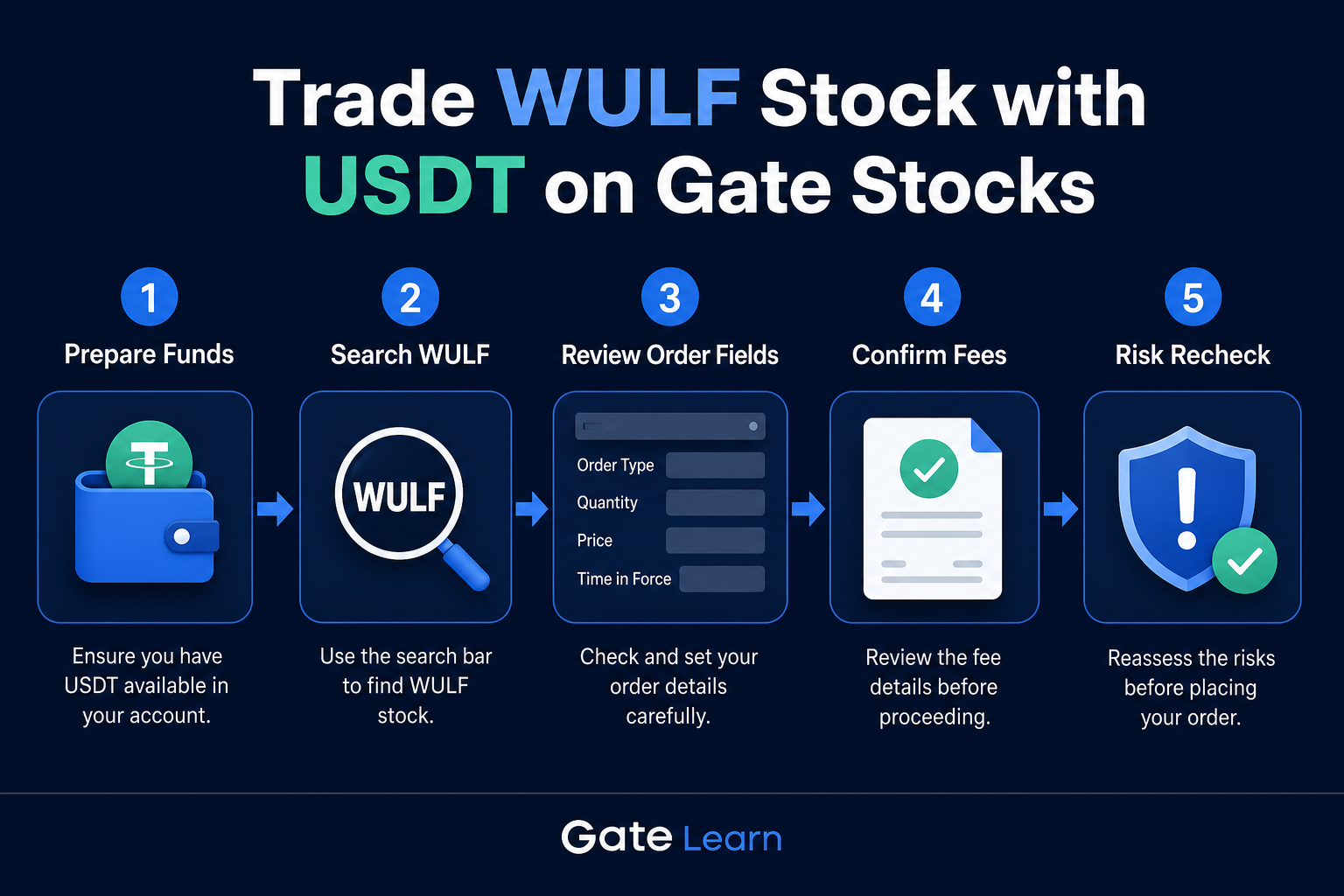
Preparation, search, order placement, and review workflow for trading WULF stock with USDT on Gate Stocks.
Step 1: How to Prepare USDT and Your Stock Trading Account?
Preparing USDT focuses on whether your settlement assets are available for stock trading—don’t rely solely on the total account balance. The trading interface requires the available balance to cover the order amount and any associated fees. If your account contains frozen funds or unsettled assets, the actual available balance may be lower than expected. Before executing, verify that your available funds match the intended order amount, and reserve space for fees in the calculation.
You must also ensure that the trading page’s essential parameters can be entered: order type selection, quantity input precision, price input format, and confirmation button status. Process-driven checks emphasize “verifying interface conditions before entering orders,” since most input errors arise from misunderstanding parameters rather than from the click action itself. Once this step is complete, proceed to ticker search and asset identification.
Step 2: How to Search for TeraWulf (WULF) Stock Ticker and Verify the Trading Page?
For ticker search, use a “ticker first, name verification” approach. Enter WULF, confirm the name is TeraWulf, and ensure the page is set for stock trading—not another asset class. The goal is to guarantee a one-to-one match between your search and the target stock, avoiding errors from similar names.
On the trading page, conduct a three-tier verification: first, check ticker and name; second, confirm completeness of fields in the order area; third, ensure accessibility of risk disclosures and fee information. If all three checks pass, proceed confidently to order placement. For process audits, consider this step as “pre-trade identity verification”—confirm the trading target before discussing quantity and price.
Step 3: How to Place an Order for WULF Stock on Gate Stocks?
Order placement follows a sequence: select order type → enter price and quantity → review order summary → submit. Order type determines execution method and price control; quantity and price together define the nominal value. The order summary page before submission is a critical checkpoint—reconfirm ticker, side, quantity, and price, and ensure units and precision match your inputs.
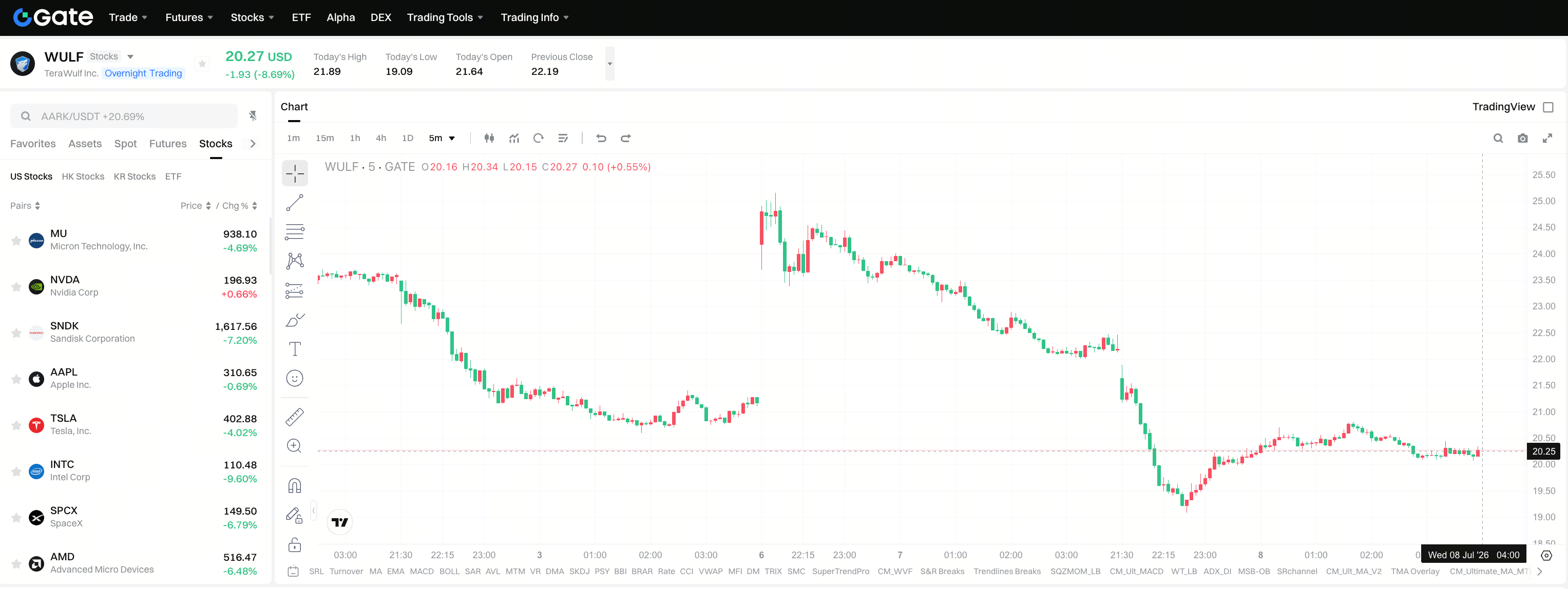
A typical execution sequence:
| Process Step |
Operation |
Review Focus |
| 1 |
Select order type |
Type matches execution intent |
| 2 |
Enter price and quantity |
Numeric format correct, quantity units clear |
| 3 |
Review order summary |
Ticker WULF, amount, side accurate |
| 4 |
Submit and await matching |
Monitor order status and execution feedback |
This process ensures “visible output at every stage.” The summary page centralizes input results; execution feedback centralizes outcome. Reviewing both reduces errors from incorrect field entry. After placing an order, return to your portfolio or order list to verify executed quantity and remaining orders.
What Fees and Order Rules Must Be Confirmed When Trading WULF Stock?
Fee and rule checks are often overlooked. In stock trading, fee structure, minimum order unit, order validity, and trading hours directly impact execution. Even with correct asset identification, neglecting fee and rule verification can cause discrepancies between expectations and actual results.
Key information to confirm includes: how fees are calculated into transaction costs; minimum order quantity and precision limits; order handling in various states; trading hours and matching availability. Rely on page-disclosed fields and cross-check with order summary before submitting. Including fee standards in your checklist helps distinguish “price fluctuation” from “cost standard differences” during post-trade review.
What Risk Checks Are Needed Before Buying or Trading WULF Stock?
Risk checks for WULF stock cover three layers: industry risk, execution risk, and rule risk. Industry risk stems from Bitcoin cycles, global hashrate changes, electricity costs, and policy variables; execution risk arises from liquidity, spreads, and order input errors; rule risk comes from fee standards, settlement rules, and trading hour constraints. Recording these separately makes it easier to pinpoint issues and avoids mistaking company volatility for interface problems.
Reference WULF risk, cycles, and liquidity factors and WULF vs. MARA, RIOT stock comparison for deeper insight into cycle-based differences among similar stocks. In practice: check risk variables in your checklist before placing an order, and verify that execution results match preset parameters afterward. Risk checks aim to identify uncertainty sources—not predict returns.
Summary
Trading TeraWulf (WULF) stock with USDT follows a clear path: preparation, ticker search, order execution, fee and rule confirmation, and risk check. Each stage has observable fields, making the process suitable for repeatable checklist execution. Prioritizing workflow discipline before trading actions improves consistency and auditability, providing clear benchmarks for post-trade review.
FAQ
When trading WULF stock with USDT, should you check the ticker or company name first?
Check the ticker WULF first, then verify with the company name TeraWulf. Ticker matching enables quick identification; name matching prevents selection errors. Both steps together ensure reliable asset identification.
What order details are most critical to confirm before placing a WULF stock order?
Focus on order type, price, quantity, and ticker consistency in the order summary. Before submission, recheck side and nominal value. If summary fields differ from expectations, revise them before submitting.
Why should fee rules be checked separately when trading WULF stock?
Fees directly affect actual transaction costs and outcome evaluation. Ignoring fees and focusing only on price can lead to unexpected results. Reviewing fee rules alongside order parameters is more prudent.
What dimensions should WULF stock risk checks cover?
Include industry cycles, liquidity, platform rules, and company operational variables. Industry cycles influence valuation elasticity, liquidity affects execution quality, and rules plus operational variables impact result interpretation. Layered checks help prevent misjudging a single factor.
What similarities exist between Gate Stocks’ process review and traditional brokerage workflows?
Both require prior confirmation of asset identification, order parameters, and fee rules. The difference lies in interface fields and settlement asset standards. The core process remains “verify first, execute later, then review.”