As consumers increasingly move from purely offline purchases to a seamless blend of online search, in-store experiences, and integrated multi-channel fulfillment, omnichannel capabilities have become a defining competitive edge for retail organizations. Walmart leverages its global store footprint, supply chain strength, and advanced digital technologies to enhance the customer experience through Walmart+, its e-commerce platform, and the Walmart Connect advertising business, while also exploring new avenues for revenue growth.
What Is Omnichannel Retail?
Walmart, a global leader in retail, has implemented an omnichannel strategy that connects physical stores, e-commerce platforms, mobile apps, logistics infrastructure, and consumer data. This creates a holistic retail ecosystem encompassing shopping, delivery, membership services, and commercial marketing.
Omnichannel retail means businesses no longer treat online and offline sales as isolated operations. Instead, they integrate multiple channels using technology and data. For example, consumers can browse products online, place orders via a mobile app, and choose either in-store pickup or home delivery. Alternatively, they can experience products in-store and finalize purchases through digital platforms.
Unlike traditional retail models that focus on a single transaction, omnichannel retail prioritizes the entire customer journey. Retailers must use data analytics to understand consumer needs and deliver a consistent shopping experience across all touchpoints.
For Walmart, the omnichannel approach is particularly significant. With an extensive network of physical stores, a robust supply chain, and a massive customer base, Walmart is uniquely positioned to leverage offline resources to enhance its e-commerce competitiveness and simultaneously use digital tools to maximize store value.
How Walmart+ Increases Customer Loyalty
Walmart+ is Walmart’s proprietary membership program and a key pillar in building its consumer ecosystem.
While traditional retailers primarily generate revenue through product sales, the membership model drives higher customer retention and repeat purchases by fostering long-term relationships. Walmart+ is designed to drive platform engagement and increase customer dependence through a suite of exclusive member benefits.
Walmart+ offers services such as delivery, fuel discounts, mobile payments, and other perks. These benefits are intended to encourage consumers to use Walmart’s platform habitually, not just for occasional purchases.
Membership programs are critical in omnichannel retail. Whether shopping online, in-store, or using delivery services, members generate valuable behavioral data. Walmart leverages this data to optimize product recommendations, inventory management, and marketing strategies.
Walmart+ also boosts Walmart’s competitiveness against Amazon Prime. While Amazon relies on its e-commerce and cloud ecosystem, Walmart differentiates its membership experience with physical stores, grocery offerings, and local delivery capabilities.
Sustaining Walmart’s E-Commerce Growth
As shopping habits evolve, e-commerce has become central to Walmart’s omnichannel strategy.
Historically, Walmart’s strength lay in its physical retail network. However, facing rapid growth from platforms like Amazon, Walmart has expanded its digital presence through Walmart.com, mobile apps, and online delivery services.
A defining feature of Walmart’s e-commerce strategy is its use of physical stores as the backbone for online operations. The vast store network supports product storage, order fulfillment, and last-mile delivery, enabling Walmart to meet local consumer demand with greater speed and efficiency.
This approach contrasts with pure-play e-commerce platforms. Amazon must build extensive logistics centers, while Walmart leverages its existing retail footprint to shorten delivery times and increase operational efficiency.
Walmart has also broadened its online assortment, including electronics, home goods, apparel, and third-party marketplace products. By adopting a platform model, Walmart continues to scale its e-commerce ecosystem.
Additionally, AI-powered innovations are enhancing Walmart’s digital experience. Intelligent recommendations, search optimization, and automated customer support help shoppers quickly find the products they need.
Why Walmart Connect Is a New Growth Engine
Beyond product sales and membership programs, advertising has emerged as a significant growth driver in Walmart’s omnichannel ecosystem.
Walmart Connect, the company’s retail media platform, utilizes consumer shopping data to offer brands highly targeted marketing solutions.
Traditional advertising measures results by impressions, but retail media links ads directly to consumer purchases. Brands can not only showcase products, but also refine ad targeting based on search, browsing, and purchase data.
For Walmart, advertising is strategically important. The company’s vast trove of transaction data enables brands to better understand market demand, while advertising delivers higher profit margins, boosting overall business efficiency.
Increasingly, retailers such as Amazon (Amazon Ads) and Target (Roundel) are building retail media businesses. As consumer data becomes a critical asset, advertising allows retailers to further monetize data value.
Looking ahead, Walmart Connect is likely to expand its advertising technology and deepen integration with e-commerce, membership, and physical store operations.
Achieving Synergy Between Stores and Online Business
Walmart’s omnichannel ecosystem is anchored by the synergy between its physical stores and digital operations.
Traditionally, brick-and-mortar stores were seen as competitors to e-commerce. Walmart takes a different approach, positioning stores as an integral part of its digital business.
For example, customers can order online and pick up in-store, or use stores as rapid delivery hubs. Stores function as sales points, warehouses, and distribution centers.
This model maximizes asset utilization. The extensive store network reduces the need for additional logistics facilities and accelerates delivery.
Moreover, integrating online and offline channels gives Walmart a 360-degree view of consumer behavior. Online search patterns, purchase histories, and in-store shopping habits all inform product placement and marketing strategies.
The essence of omnichannel retail is enabling consumers to shop anytime, anywhere, through any channel, while retailers use data and supply chain capabilities for efficient operations.
How Walmart, Costco, and Amazon Differ in Business Model
Walmart, Costco, and Amazon are all global retail powerhouses, but their business models are distinctly different.
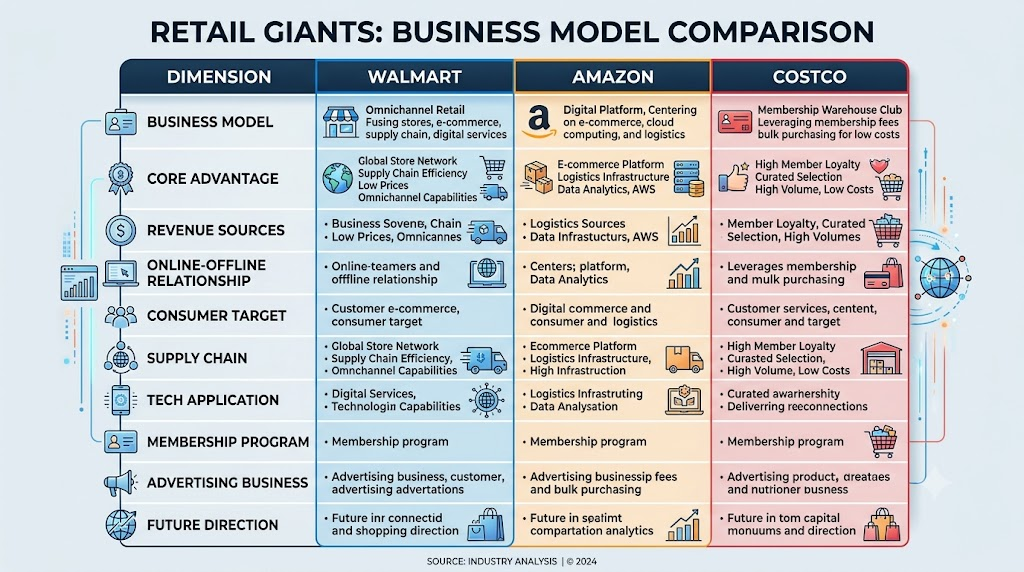
Amazon’s strengths lie in its e-commerce platform, logistics infrastructure, and cloud computing. Its model is digital-first, connecting consumers and products through online traffic and technology.
Costco’s competitive edge comes from its membership-based warehouse model, relying on membership fees, high sales volumes, and a curated product selection. It offers fewer SKUs but higher sales per item.
Walmart’s model blends physical retail with digital capabilities. Compared to Costco, Walmart offers a broader product selection; compared to Amazon, Walmart’s vast store network enables localized services.
These three companies represent distinct retail paradigms:
- Amazon: digital platform retail
- Costco: membership warehouse retail
- Walmart: omnichannel retail, integrating physical and digital assets
Challenges Facing Omnichannel Retail
While omnichannel strategies enhance competitiveness, they also introduce new challenges.
Omnichannel operations require significant technology investment. Retailers must build data platforms, logistics networks, inventory management systems, and digital marketing tools—demanding ongoing capital.
Integrating online and offline channels increases operational complexity. Managing store inventory, e-commerce orders, and delivery systems is a major challenge for large retailers.
Data privacy and security are also critical concerns. As retailers collect more consumer information, protecting data and complying with privacy regulations are top industry priorities.
Competition remains intense. Amazon, Costco, Target, and others are all advancing digital capabilities, shifting the competitive landscape from price to technology and ecosystem strength.
Future Trends in Walmart’s Retail Ecosystem
Looking ahead, Walmart’s omnichannel strategy is likely to evolve along three key vectors:
- Accelerating AI-driven retail capabilities. AI will optimize inventory forecasting, product recommendations, supply chain management, and customer service, driving greater efficiency.
- Expanding digital revenue streams. Beyond merchandise sales, membership, advertising, and data services are set to become major growth drivers.
- Deepening online-offline integration. As consumers demand more convenience, rapid delivery, smart shopping assistants, and personalized services will be crucial differentiators.
Over the long term, retail’s core competitive advantage is shifting from “store count” to “how effectively data and technology are leveraged for efficiency.” Walmart’s strength is its physical foundation, and digital transformation is unlocking new value from these assets.
Summary
Walmart’s omnichannel strategy fundamentally leverages its physical network, digital technologies, and consumer data to build a next-generation retail ecosystem.
By deepening customer relationships through Walmart+ memberships, expanding digital reach with its e-commerce platform, generating advertising revenue via Walmart Connect, and boosting delivery efficiency with its store and supply chain infrastructure, Walmart is evolving from a traditional retailer into a digital business platform.
As AI, automation, and data technologies continue to advance, omnichannel retail is set to become a dominant trend in the global retail sector, and Walmart’s digital transformation will remain central to its long-term competitive strength.