As the BTCFi narrative develops rapidly, the market is once again turning its attention to on-chain financial infrastructure for Bitcoin. In the past, large amounts of BTC remained idle for long periods and could not directly participate in DeFi activity. With the development of Layer2 and smart contract technologies, Bitcoin is now beginning to support more advanced financial functions.
Zest Protocol is one of the important BTCFi protocols that has emerged in this context. Its lending system aims to build an on-chain capital market that is closer to the native Bitcoin ecosystem, while improving the capital efficiency of BTC in DeFi use cases.
What Is Zest Protocol’s Lending Model?
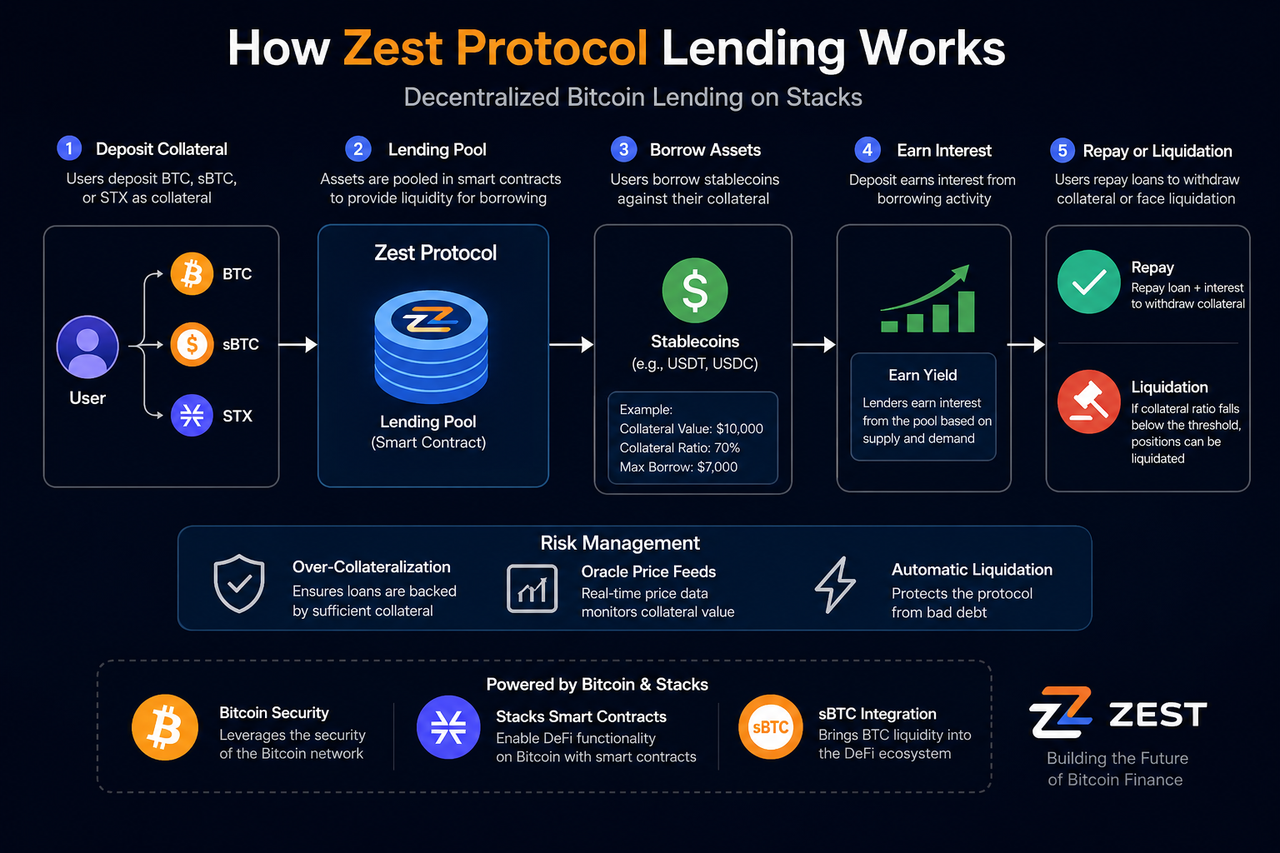
Zest Protocol uses an overcollateralized lending model. This model is relatively common in DeFi, and its core logic is straightforward: users must first deposit collateral worth more than the amount they want to borrow before they can borrow other assets.
In Zest Protocol, users can deposit assets such as BTC, sBTC, or STX as collateral. The protocol calculates each user’s borrowing capacity based on asset prices, risk parameters, and market liquidity. The overall process mainly includes collateral deposits, borrowing capacity calculation, loan execution, interest settlement, and risk liquidation.
Because crypto asset prices can be highly volatile, the protocol usually requires users to maintain a relatively high collateral ratio to reduce the risk of bad debt. This is also the core mechanism most on-chain lending protocols use to protect funds.
How Do Users Deposit Assets into Zest Protocol?
Before lending or borrowing can begin, users first need to connect a wallet and deposit assets into the protocol’s liquidity pool.
Since Zest Protocol primarily runs on the Stacks network, users typically need a wallet that supports Stacks and the relevant ecosystem assets. After users deposit assets, the protocol creates the corresponding deposit position and begins calculating yield.
If the user deposits BTC-related assets, those funds usually enter a BTCFi liquidity pool and provide liquidity support for the borrowing market. This structure is similar to the liquidity pool model in Ethereum DeFi. However, because the Bitcoin mainnet itself does not support complex smart contracts, Zest Protocol relies more heavily on Layer2 infrastructure and pegged asset structures.
How Does Zest Protocol Calculate Borrowing Capacity?
Borrowing capacity is mainly determined by the collateral ratio.
After a user deposits assets, the protocol determines how much the user can borrow based on market prices and risk parameters. For example, if a user deposits BTC worth $10,000 and the protocol sets the collateral ratio at 70%, the user could theoretically borrow up to around $7,000 worth of assets.
The core purpose of this mechanism is to ensure that, even if market prices fluctuate, the protocol still has enough collateral to cover outstanding debt.
If the market price of BTC falls, the user’s collateral ratio will gradually decline. Once the collateral ratio drops below the safety threshold set by the system, the protocol may automatically trigger liquidation.
How Does Zest Protocol’s Interest Rate Mechanism Work?
Zest Protocol’s interest rates are mainly determined by market supply and demand.
When borrowing demand rises and liquidity in the pool decreases, borrowing rates usually increase. When market liquidity is relatively abundant, rates may fall. Together, these dynamics form an on-chain market for capital supply and demand.
For depositors, assets in the liquidity pool can continuously generate interest income. Borrowers, meanwhile, need to pay the corresponding borrowing costs in order to obtain liquidity.
One of the key values of BTCFi lending is that users can obtain stablecoins or other on-chain asset liquidity without selling their BTC. This model allows BTC holders to participate in financial activity while maintaining their asset exposure.
How Is Zest Protocol’s Liquidation Mechanism Triggered?
The liquidation mechanism is the core risk control system in DeFi lending protocols.
Because BTC and other crypto assets can experience significant price volatility, the protocol may face bad debt risk if the value of a user’s collateral continues to fall. As a result, when a user’s collateral ratio drops below the minimum safety threshold, the system automatically triggers liquidation.
The process usually includes the following stages:
-
The market price of BTC falls
-
The user’s collateral ratio declines
-
The system liquidation threshold is reached
-
A liquidator repays part of the debt
-
The liquidator receives discounted collateral as a reward
This mechanism helps the protocol maintain overall solvency and is an important part of keeping the DeFi lending market stable.
How Do Stacks and sBTC Support the Lending Process?
The Bitcoin mainnet itself does not support complex smart contracts, so Zest Protocol mainly uses the Stacks network to execute its lending logic.
Stacks is a Layer2 network built on Bitcoin that supports smart contracts and DeFi applications. sBTC is an asset pegged to BTC, designed to bring BTC into a smart contract environment.
In Zest Protocol, Stacks is responsible for executing on-chain lending logic, while sBTC provides an entry point for BTC liquidity. Smart contracts manage lending relationships, interest rate calculations, and risk liquidations.
This structure allows Bitcoin to gradually develop financial capabilities similar to those found in Ethereum DeFi, while also helping the BTCFi market form a more complete on-chain financial system.
How Is Zest Protocol Different from Traditional DeFi Lending?
Although Zest Protocol and protocols such as Aave and Compound all use an overcollateralized model, their underlying ecosystems and asset structures are clearly different.
| Comparison Dimension |
Zest Protocol |
Ethereum DeFi |
| Core Assets |
BTC, sBTC |
ETH, USDC |
| Underlying Network |
Bitcoin + Stacks |
Ethereum |
| Smart Contract Environment |
Layer2 |
Native EVM |
| Market Maturity |
Early-stage BTCFi |
Mature DeFi |
| Main Goal |
Financialization of BTC |
General on-chain finance |
The defining feature of Bitcoin DeFi is that it builds financial markets around native BTC assets, rather than simply copying Ethereum DeFi’s structure. For this reason, BTCFi places greater emphasis on Bitcoin security, native BTC liquidity, and non-custodial financial models.
Conclusion
As a decentralized lending protocol in the Bitcoin DeFi ecosystem, Zest Protocol’s core goal is to improve BTC capital efficiency and help Bitcoin build a native on-chain financial market.
Through an overcollateralized model, Stacks smart contracts, and the sBTC liquidity structure, Zest Protocol allows users to borrow, lend, and earn yield with BTC-related assets.
FAQs
Which collateral assets does Zest Protocol support?
Zest Protocol currently mainly includes BTC-related assets, sBTC, and Stacks ecosystem assets such as STX.
What is overcollateralized lending?
Overcollateralized lending means users provide collateral worth more than the amount they borrow, reducing the protocol’s bad debt risk.
How does Zest Protocol control risk?
The protocol reduces market risk through collateral ratio management, real-time price monitoring, and automatic liquidation mechanisms.
What role does sBTC play in the lending process?
sBTC is a BTC-pegged asset that allows Bitcoin to enter a smart contract environment and participate in the BTCFi lending market.
How is Zest Protocol different from Aave?
Zest Protocol is focused on the Bitcoin DeFi market, while Aave mainly operates within the Ethereum DeFi ecosystem. Their asset structures and underlying networks are clearly different.