Moving averages are among the most widely used Technical Indicators because they help traders reduce market noise and identify directional bias. In crypto markets, where price can move sharply within short timeframes, delayed signals may reduce the usefulness of standard averages. Hull MA became important because it attempts to balance two competing needs: smoothness and speed. It does not remove uncertainty from trading, but it can help traders read short-term market structure more clearly when used with confirmation tools.
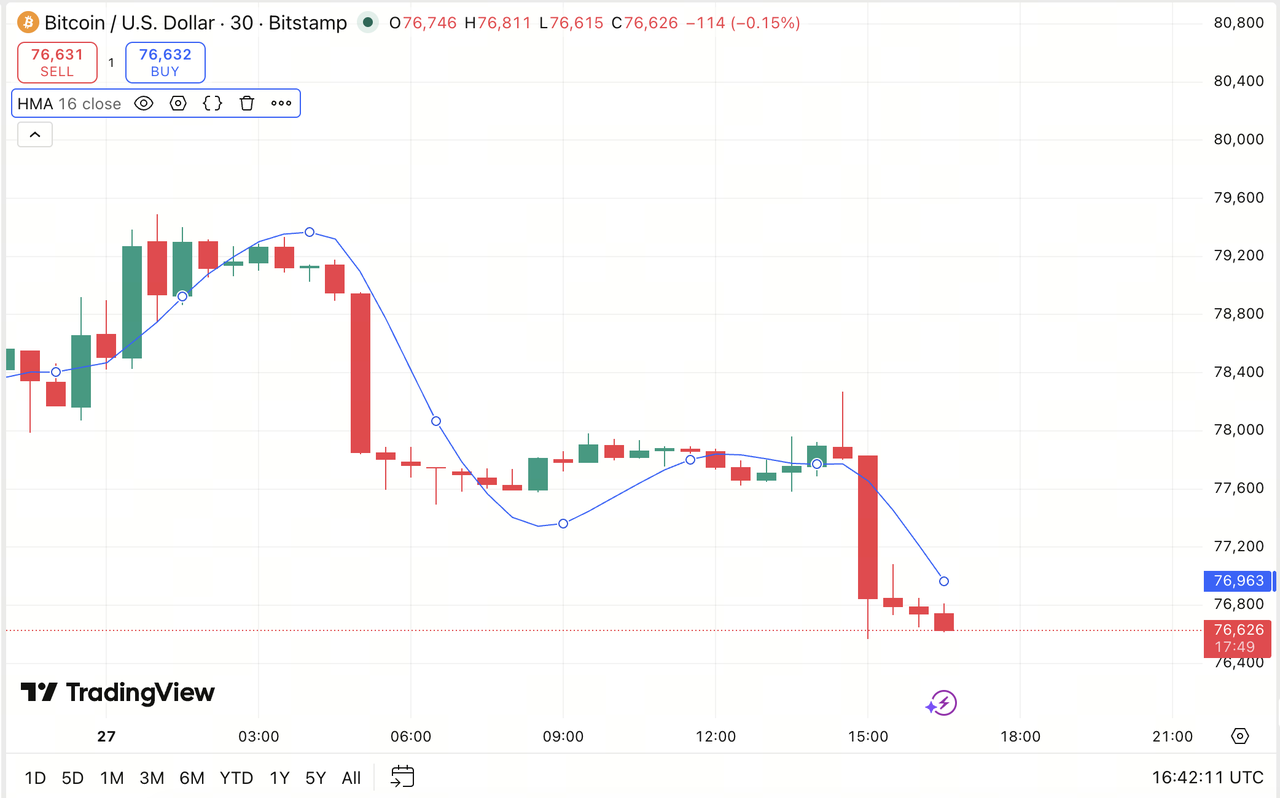
Source: TradingView
What Hull MA Is
Hull MA does not function as a standalone price prediction tool. It is a trend-following technical indicator that uses weighted moving averages to create a smoother and more responsive moving average line.
Rather than treating all price data equally, Hull MA places greater importance on recent prices through weighted calculations. This makes it different from a Simple Moving Average, which assigns the same weight to every price within the selected period.
The main problem Hull MA tries to solve is lag. Traditional moving averages often react after price has already moved. This delay can be acceptable in slower markets, but in crypto trading, where trends can shift quickly, lag may lead to late entries, delayed exits, or unclear trend interpretation.
Hull MA is commonly used to identify:
-
Short-term trend direction
-
Possible trend reversals
-
Changes in market momentum
-
Dynamic support or resistance areas
A rising Hull MA often suggests upward momentum, while a falling Hull MA may suggest downward momentum. When the line flattens, it may indicate uncertainty, consolidation, or a weakening trend.
How Hull MA Is Calculated
Hull MA is calculated through a sequence of weighted moving averages. The formula may look technical at first, but the principle is straightforward: it compares shorter-term weighted movement with longer-term weighted movement, then smooths the result.
The general calculation structure is:
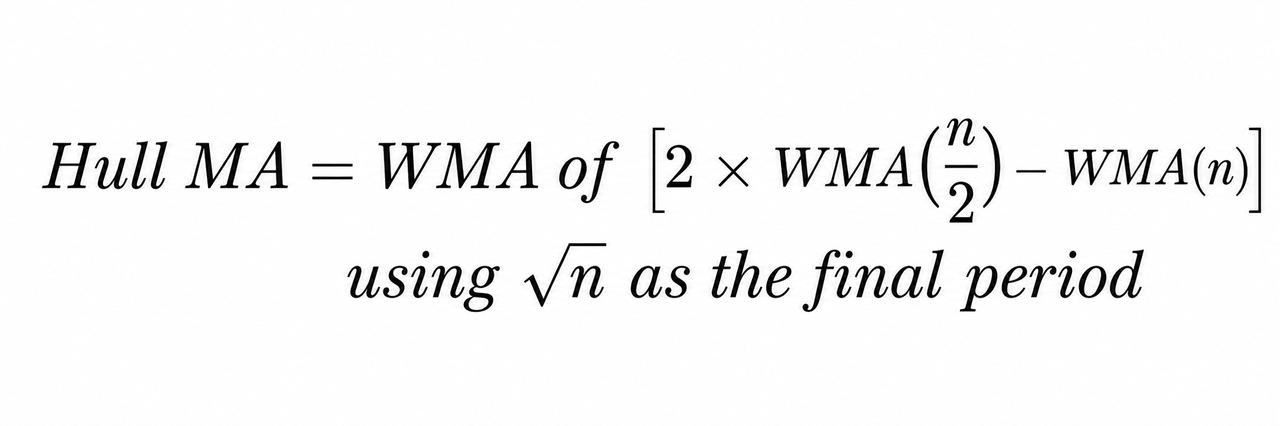
Where:
-
WMA means Weighted Moving Average
-
n is the selected period
-
n/2 is half of the selected period
-
√n is the square root of the selected period
For example, if a trader uses a 16-period Hull MA, the calculation uses:
The first part of the formula gives stronger emphasis to recent price action. The second part subtracts the slower average to reduce delay. The final square-root smoothing step helps keep the line from becoming too erratic.
This structure explains why Hull MA often appears smoother than very fast moving averages but more responsive than many standard averages.
How Hull MA Reduces Lag Compared to EMA and SMA
Hull MA reduces lag by combining weighted calculations with a smoothing method that emphasizes recent price movement without fully abandoning trend stability.
A Simple Moving Average (SMA) calculates the average of prices over a fixed period and gives each data point equal weight. This makes SMA easy to understand, but it also means older prices can slow the indicator’s response.
An Exponential Moving Average (EMA) reacts faster than SMA because it gives more weight to recent prices. However, EMA can still lag during sharp reversals, especially if the selected period is relatively long.
Hull MA goes a step further by using Weighted Moving Averages and a difference calculation that adjusts for delay. The final square-root smoothing period then helps reduce excess noise.
| Indicator |
Calculation Style |
Response Speed |
Smoothness |
Common Use |
| SMA |
Equal-weight average |
Slow |
High |
Long-term trend reading |
| EMA |
Recent-price weighted average |
Medium to fast |
Medium |
Trend and momentum tracking |
| Hull MA |
Weighted average with lag-reduction structure |
Fast |
Medium to high |
Short-term trend analysis |
In practical chart reading, Hull MA may turn upward or downward earlier than SMA or EMA. This can help traders identify a possible trend shift sooner.
However, faster reaction does not mean higher certainty. In choppy markets, early signals can also become false signals. This is why Hull MA is usually more useful when combined with volume, support and resistance, market structure, or other Technical Indicators.
Hull MA for Short-Term Trend Analysis in Crypto
Hull MA is often used in crypto trading because digital asset markets can move quickly and trade continuously. A tool that responds faster than standard averages may help traders interpret short-term changes more efficiently.
One common use is trend direction. When price stays above a rising Hull MA, traders may interpret the market as having short-term bullish momentum. When price remains below a falling Hull MA, the market may be viewed as having short-term bearish momentum.
Another use is trend transition. A Hull MA that changes slope from downward to upward may suggest improving momentum. A shift from upward to downward may suggest weakening demand or increasing selling pressure.
Some traders also observe price interaction with the Hull MA. During an uptrend, price may pull back toward Hull MA before continuing higher. During a downtrend, price may rebound toward Hull MA before continuing lower. These interactions are not guarantees, but they can help organize chart reading.
In crypto markets, Hull MA may be applied to:
-
Intraday charts, such as 5-minute, 15-minute, or 1-hour timeframes
-
Swing trading charts, such as 4-hour or daily timeframes
-
Trend-following systems that need faster confirmation
-
Momentum analysis during high-volatility periods
For example, a trader watching Bitcoin or Ethereum on a short-term chart may use a Hull MA to identify whether price momentum is strengthening or fading. If Hull MA is rising and price remains above it, the chart may show short-term trend support. If the line turns flat while price begins moving sideways, the trend may be losing strength.
Hull MA can also be paired with other indicators. A trader may use Relative Strength Index (RSI) to assess momentum conditions, volume to confirm participation, or support and resistance levels to identify important reaction zones.
Limitations of Hull MA
Hull MA is useful, but it is not a complete trading system. Its main advantage is responsiveness, and that same advantage can become a weakness in unstable market conditions.
The first limitation is false signals. In sideways markets, Hull MA may change direction frequently as price moves within a narrow range. These small turns can appear meaningful but may not lead to sustained trends.
The second limitation is sensitivity to settings. A shorter Hull MA period reacts quickly but may produce more noise. A longer period is smoother but may lose some of the speed that makes Hull MA attractive. Traders need to choose settings based on timeframe, market condition, and trading style.
The third limitation is that Hull MA is based on past price data. Like all Moving Averages, it does not predict the future. It organizes historical price movement into a clearer visual structure, but it cannot confirm future direction by itself.
Another limitation is overreliance. Traders may treat every slope change or price crossover as a signal. This can lead to poor decisions if market context is ignored. A Hull MA signal near major resistance, during low volume, or within a flat range may require more caution than the same signal in a clear trend.
Hull MA should be understood as a trend interpretation tool rather than a standalone decision-maker. It works best when supported by broader market analysis.
Conclusion
Hull Moving Average (Hull MA) is a moving average indicator designed to reduce lag while keeping price trends relatively smooth. It uses weighted moving averages and a square-root smoothing step to react faster than many traditional Moving Averages.
For crypto traders, Hull MA can be helpful because digital asset markets often move quickly. A responsive trend indicator may make it easier to identify short-term direction, spot possible momentum shifts, and organize chart analysis.
Its value comes from clarity, not certainty. Hull MA can show when price behavior is changing, but it cannot prove that a trend will continue or reverse. In practical use, it is often strongest when combined with market structure, volume analysis, support and resistance, or other Technical Indicators.
The best way to understand Hull MA is to see it as a faster trend lens. It helps smooth the chart while staying close enough to price action to capture short-term changes.
FAQs
What is the Hull Moving Average?
The Hull Moving Average is a technical indicator that uses weighted moving averages to create a smoother and faster-moving trend line. It is designed to reduce lag compared with standard moving averages.
How is Hull MA different from SMA and EMA?
Hull MA reacts faster than SMA and EMA by weighting recent prices more and reducing lag. This can help spot trend changes earlier, but it may also create false signals in sideways markets.
What period is commonly used for Hull MA?
There is no universal best period. Shorter settings may suit intraday analysis, while longer settings may fit swing trading or broader trend reading. Traders often test different periods based on the asset and timeframe.
Can Hull MA be used for crypto trading, and does it predict price movement?
Yes. Hull MA can help crypto traders read short-term trend direction, but it does not predict future price. It is based on historical price data and should not be used alone.
What are the main risks of using Hull MA?
The main risks include false signals in sideways markets, overreliance on slope changes, and poor setting selection. Hull MA should be combined with broader analysis before making trading decisions.







