Huntington Bank's financial services ecosystem is built on diversification and comprehensiveness, integrating traditional retail banking, wealth management, corporate finance, and digital platforms to cover the full spectrum of customer needs. This integrated ecosystem not only boosts customer loyalty but also drives steady revenue growth and long-term competitive advantages for the bank.
Why Banking Services Are Essential Infrastructure for the Modern Economy
Banking services serve as the core infrastructure linking capital supply and demand in the modern economy, operating at three levels: payment and settlement, credit creation, and capital allocation. In daily economic activities, banks facilitate efficient capital flows through account systems and support corporate investment and personal consumption via credit mechanisms, thereby fueling economic cycles.
Within this framework, HBAN acts as a regional financial hub, delivering financial services to customers across the Midwest through its branch network and digital channels. Whether through personal savings, corporate loans, or payment and settlement, Huntington Bank provides critical support for local economic activity, while also driving regional development through small business financing and consumer banking services.
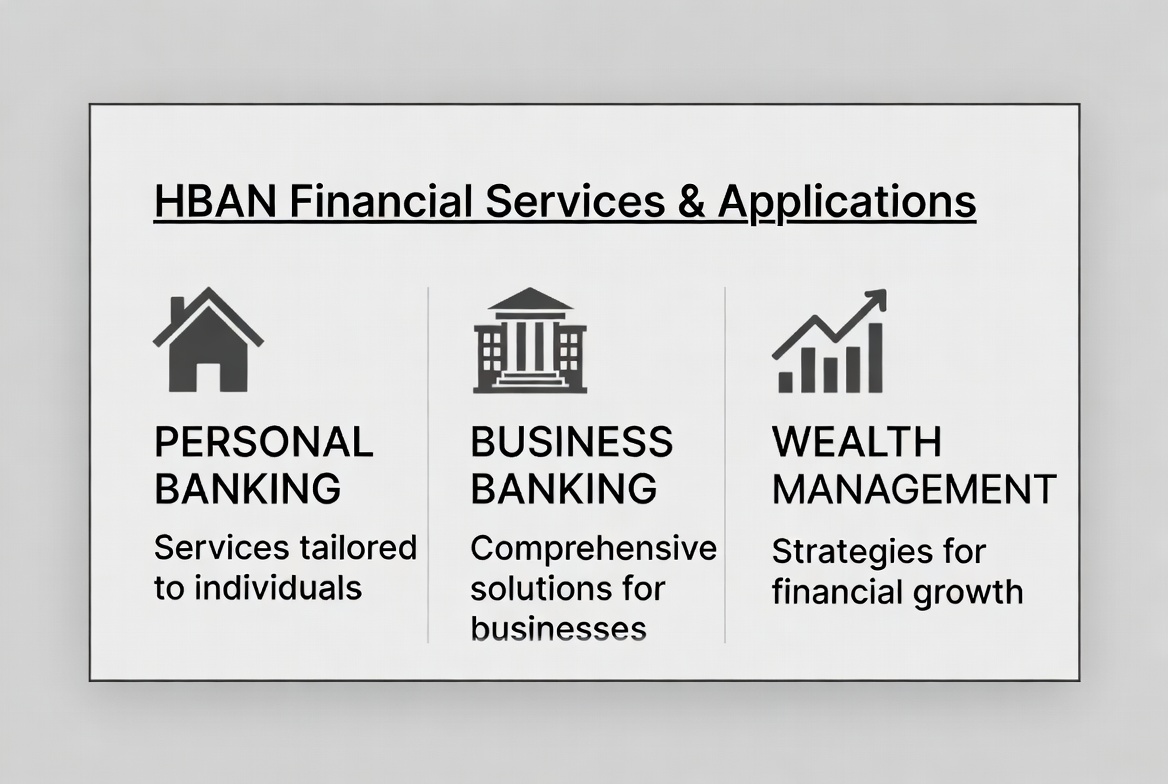
Applications of HBAN's Personal Banking Services
HBAN's personal banking services encompass savings accounts, checking accounts, credit cards, mortgages, personal loans, and basic wealth management products, forming a standard retail banking framework. The primary goal of this framework is to meet individual customers' daily cash management and medium-to-long-term financial planning needs, positioning the bank as the foundational entry point for personal financial life.
In practice, customers can implement tiered financial management through different products. For instance, savings accounts are for storing funds, credit cards for daily spending, mortgages for home financing, and personal loans for education, medical expenses, or other large outlays. This product mix creates a complete personal financial loop.
With the rise of digital services, HBAN has expanded its service scope through mobile banking apps, enabling customers to manage accounts, transfer funds, pay bills, and apply for loans online, significantly enhancing the convenience and accessibility of financial services.
How Wealth Management Services Meet Asset Allocation Needs
HBAN's wealth management services focus on individual and family clients, offering portfolio management, retirement planning, education fund planning, and tax optimization to help clients achieve long-term asset growth and risk diversification. This system essentially represents the extension of retail banking into "asset management."
At the asset allocation level, wealth management services reduce the risk of single-asset volatility by distributing client funds across stocks, bonds, and other financial instruments, while optimizing the overall return structure. For clients with varying risk appetites, the bank provides tailored investment strategies to align with their financial goals.
From the bank's perspective, the wealth management business not only strengthens its ability to manage client asset sizes but also generates stable non-interest income through management and advisory fees, thereby enhancing the diversity and stability of its overall earnings structure.
How Enterprise Customers Use HBAN's Financial Services
HBAN offers enterprise customers a comprehensive suite of financial services, including commercial loans, credit lines, cash management, payment and settlement, and trade finance, primarily targeting small and medium-sized enterprises and regional institutions. The core objective is to optimize corporate liquidity and support business expansion.
In day-to-day operations, HBAN's lending and credit services provide the working capital companies need, while its cash management system enables centralized fund management and efficient allocation across multiple accounts, improving capital efficiency and reducing operating costs.
Additionally, enterprise customers can leverage HBAN's payment and settlement and trade finance services to support routine transactions and cross-regional business growth, enabling them to scale with stable financial backing, while also strengthening the bank's long-term partnerships with corporate clients.
What Are the Application Scenarios for Digital Banking and Mobile Finance?
As financial digitization advances, HBAN has actively developed mobile banking and online financial platforms, allowing customers to perform most basic banking operations through digital channels. These services include account inquiries, transfers and payments, loan applications, investment management, and bill reminders.
The core value of digital banking is breaking down time and location barriers, enabling customers to handle the vast majority of financial transactions without visiting a physical branch. At the same time, mobile apps provide real-time transaction alerts and risk monitoring, enhancing financial security and transparency.
For the bank, digital channels not only improve operational efficiency and reduce service costs but also expand customer reach, allowing HBAN to serve a wider user base at lower marginal costs.
Why a Comprehensive Financial Ecosystem Becomes a Growth Driver
By integrating retail banking, corporate finance, wealth management, and digital banking services, HBAN has built a fully integrated financial ecosystem that creates synergies across its business lines. This model allows customers to satisfy multiple financial needs within a single banking platform.
At the operational level, the integrated ecosystem enhances customer retention. When customers use savings, loans, investments, and business services together, their switching costs rise significantly, improving the bank's customer stickiness and cross-selling opportunities.
From a growth perspective, this ecosystem structure enables HBAN to remain stable amid interest rate fluctuations, achieving revenue diversification through a blend of interest and non-interest income, thereby strengthening overall risk resilience and long-term growth potential.
Summary
HBAN (Huntington Bank)'s financial services framework covers personal banking, wealth management, corporate finance, and digital banking, addressing diverse customer needs through a multi-layered product portfolio. Its core value lies in building a comprehensive financial ecosystem that unifies cash management, credit support, and asset allocation into a single system, enhancing both customer experience and the bank's operational stability.
Structurally, HBAN does not rely solely on traditional deposit-loan interest margins; it also expands non-interest income sources through wealth management and corporate finance services. At the same time, digital transformation has further improved service efficiency, allowing the bank to maintain a strong competitive edge in the U.S. regional banking market.
FAQ
What main personal financial services does HBAN offer?
Savings accounts, checking accounts, credit cards, mortgages, personal loans, and wealth management services.
How can enterprise customers use HBAN's financial services?
Through commercial loans, cash management, payment and settlement, and trade finance to optimize business operations and cash flow.
What are the advantages of HBAN's digital banking services?
Mobile banking and online platforms provide real-time transactions, account management, automated financial advice, and cross-channel services for convenience and security.
What does a comprehensive financial ecosystem mean for HBAN?
Integrating retail banking, corporate finance, wealth management, and digital services enhances customer stickiness, revenue stability, and long-term growth potential.