As a globally recognized asset manager, Invesco provides individual and institutional investors with diversified investment options through its ETF lineup spanning equities, fixed income, sector themes, and international markets.
Invesco's influence in the global ETF space stems largely from its broad product coverage and long-standing brand strength. Flagship products like the Invesco QQQ have made the firm a key player in global tech and index investing. Understanding how Invesco ETFs are used helps clarify why ETFs have become an essential component of modern portfolios.
ETFs (Exchange Traded Funds) combine the features of traditional funds and stock trading. Investors gain the diversification benefits of holding a basket of assets while also being able to buy and sell ETF shares in real time on the exchange, just like stocks.
A key driver of ETF growth is the lower barrier to entry. In the past, individual investors seeking exposure to dozens or even hundreds of companies needed significant capital and faced high transaction costs. By tracking an index or a specific portfolio, ETFs provide broad market exposure in a single trade.
ETFs also offer high transparency, relatively low fees, and strong liquidity. For long-term investors, they help build stable asset allocation portfolios. For institutions, ETFs serve as vital tools for managing liquidity and adjusting strategies.
With the global rise of passive investing, ETFs have evolved from simple index trackers into a versatile product category covering equities, fixed income, commodities, sector themes, and cross-market strategies.
How Is Invesco's ETF Product System Structured?
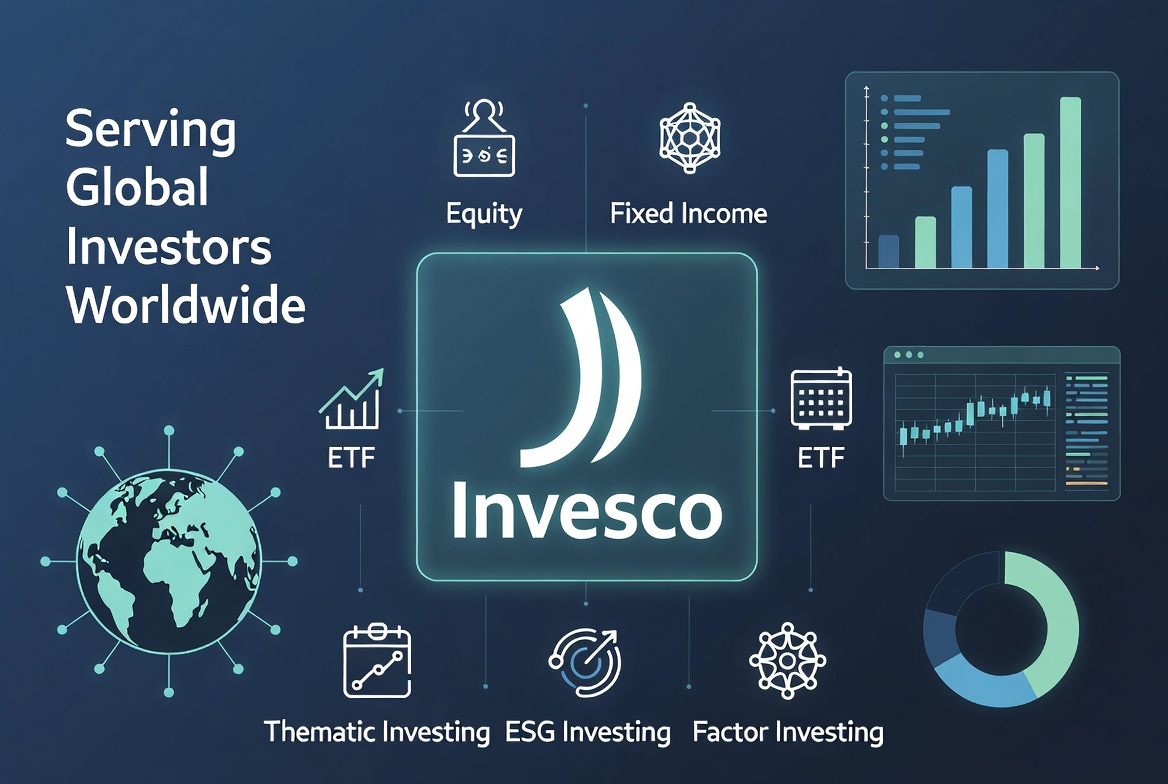
Invesco operates one of the world's leading ETF platforms, with products spanning multiple asset classes and investment themes.
Its most iconic ETF is the Invesco QQQ, which tracks the Nasdaq 100 Index and is heavily concentrated in large-cap U.S. technology and growth stocks. For years, it has been a global investor favorite. QQQ is not only Invesco's flagship product but also a landmark ETF in global tech investing.
Beyond QQQ, Invesco issues a wide range of equity, bond, sector, and thematic ETFs. Some focus on the U.S. large-cap market, while others target emerging markets, fixed income, or specific industries.
From a business standpoint, Invesco's ETF lineup can be broken down as follows:
| Product Category |
Key Coverage Areas |
| Equity ETFs |
U.S. Market, International Markets, Growth Stocks, Value Stocks |
| Bond ETFs |
Treasuries, Investment-Grade Bonds, High-Yield Bonds |
| Sector ETFs |
Technology, Financials, Energy, Healthcare, etc. |
| Thematic ETFs |
Artificial Intelligence, Innovative Technology, Sustainable Investing, etc. |
| International ETFs |
European, Asian, and Emerging Market Assets |
This multi-tiered product structure allows Invesco to meet the needs of clients with varying risk tolerances and investment goals.
How Do Investors Use Equity ETFs for Asset Allocation?
Equity ETFs are one of the most important parts of Invesco's ETF ecosystem and are often the first choice for investors entering the capital markets.
Equity ETFs typically track an index or a specific market segment. For example, QQQ reflects the performance of large U.S. tech companies, while broad-market ETFs cover a wider range of U.S. stocks. By buying equity ETFs, investors achieve diversification without having to pick individual stocks.
For long-term investors, equity ETFs are often used for core portfolio holdings. Many retirement funds, pensions, and long-term accounts rely on equity ETFs as a foundation because they effectively capture overall market returns.
At the same time, some investors use sector ETFs for thematic allocation. For instance, if an investor is bullish on AI, cloud computing, or semiconductors, they can gain exposure through a sector ETF without investing in a single company.
This flexibility makes equity ETFs a powerful tool for modern portfolio management.
What Are the Use Cases for Bond ETFs?
While equity ETFs get more attention, bond ETFs are also a crucial part of the global asset management landscape.
Bond ETFs invest primarily in government bonds, corporate bonds, or other fixed income assets. Their main role is to provide a relatively stable income stream and reduce portfolio volatility. For lower-risk investors, bond ETFs complement equity holdings well.
Institutional investors use bond ETFs extensively for liquidity management and asset allocation adjustments. For example, pension funds and insurers often need to hold a certain percentage of fixed income to meet long-term liability obligations. Bond ETFs provide a convenient way to quickly build or adjust bond exposure.
In times of market stress, bond ETFs are also frequently used for hedging and defensive positioning. As a result, they have become an indispensable part of the modern asset allocation framework.
How Do Sector and Thematic ETFs Meet Diverse Needs?
As investment needs become more specialized, sector and thematic ETFs are among the fastest-growing segments of the ETF market.
Sector ETFs focus on specific industries such as technology, healthcare, financial services, or energy. They allow investors to allocate around industry themes while avoiding the concentration risk of individual stocks.
Thematic ETFs go a step further by targeting long-term structural trends. Themes like artificial intelligence, robotics, digital economy, clean energy, and cybersecurity have attracted significant capital in recent years. By bundling multiple related companies into one portfolio, thematic ETFs make it easier for investors to participate in emerging growth areas.
For Invesco, sector and thematic ETFs not only enrich the product lineup but also help capture a broader investor base. As global investors increasingly look to long-term growth stories, thematic investing has become a key growth driver for the ETF industry.
Why Is the ETF Ecosystem a Key Competitive Advantage for Invesco?
The ETF ecosystem now stands as one of Invesco's most important competitive moats.
The ETF business generates recurring management fees while steadily expanding Invesco's assets under management. As more investors choose its ETFs, the firm benefits from more stable capital flows and a broader client base.
Take QQQ as an example. The brand power of this product far exceeds that of a single fund. Many investors first come to know Invesco through QQQ. The visibility of this flagship product then helps drive adoption of other ETFs, creating a virtuous ecosystem.
The ETF business also benefits from strong economies of scale. As product size grows, fixed costs are spread over more assets, boosting profitability. So the ETF ecosystem is not just a major revenue source—it's a foundation for Invesco's long-term competitive edge.
In the global asset management industry, firms with a mature ETF ecosystem are better positioned for sustained growth. That's exactly the area Invesco has been strengthening in recent years.
How to Buy IVZ (Invesco) Stock
IVZ is the ticker symbol for Invesco Ltd. on U.S. stock exchanges. Traditionally, investors can buy IVZ shares through a brokerage account that supports U.S. stocks, thereby gaining exposure to the global asset management industry.
Because Invesco's performance is closely tied to ETF asset flows and global capital market activity, many view IVZ as a bellwether for the ETF and asset management sectors.
As digital asset markets converge with traditional finance, new trading tools linked to stock prices have emerged. Some platforms offer CFDs tied to U.S. stocks, allowing users to trade on price movements without holding the underlying shares.
Gate TradFi is steadily expanding its coverage of traditional financial assets. Users can trade digital assets, U.S. stocks, ETFs, indices, and commodities from a single account. Some markets also offer Gate CFDs, providing additional options for cross-market allocation and observation.
Regardless of the method chosen, investors should fully understand the product structure, trading rules, and applicable regulations in their jurisdiction.
Summary
ETFs have become a core infrastructure of modern investing, and Invesco is a key player in the global ETF market. With a complete lineup spanning equity, bond, sector, and thematic ETFs, Invesco serves a wide range of investor needs. From flagship products like QQQ to diversified asset allocation solutions, the ETF ecosystem drives asset growth and forms a major competitive advantage for Invesco.
FAQ
What is Invesco's most well-known ETF?
Invesco's most well-known ETF is the Invesco QQQ, which tracks the Nasdaq 100 Index and is one of the largest tech-focused ETFs in the world.
What is the difference between equity ETFs and bond ETFs?
Equity ETFs invest mainly in stocks, targeting capital appreciation. Bond ETFs invest in fixed income assets, focusing on stable income and risk control.
Why are ETFs so popular with investors?
ETFs offer diversification, low fees, high transparency, and trading convenience, making them widely used by both retail and institutional investors.
What types of ETFs does Invesco primarily offer?
Invesco offers equity ETFs, bond ETFs, sector ETFs, thematic ETFs, and international ETFs, covering multiple asset classes and investment themes.
Is QQQ an actively managed fund?
No. QQQ is an index ETF that tracks the Nasdaq 100 Index and does not rely on active stock selection.
Why is the ETF business so important to Invesco?
The ETF business generates recurring fee income, expands assets under management, and broadens the client base, making it a key growth driver for Invesco.