The asset management industry is defined by a direct correlation between revenue and the scale of client assets. As more capital flows into the platforms managed by Invesco, the company collects higher management fees. Consequently, investment performance, product competitiveness, and client capital flows directly shape Invesco's financial results.
Against the backdrop of rapid global ETF market expansion and sustained long-term investment demand, Invesco (IVZ) has built a comprehensive business system encompassing active management, passive investment, multi-asset allocation, and institutional services. Core products such as the QQQ ETF have become key growth drivers.
IVZ Stock: Key Facts
IVZ is the ticker symbol for Invesco Ltd., listed on the New York Stock Exchange. Headquartered in Atlanta, Georgia, Invesco is one of the world's largest independent asset managers.
Founded in 1935, Invesco has grown over decades into a global network covering equity, fixed income, ETFs, multi-asset management, and alternative investments. Its client base includes individual investors, pension funds, insurers, sovereign wealth funds, and corporations.
Unlike banks that profit from interest on loans, Invesco is a pure-play asset manager. Its focus is not on holding large financial assets for direct investment but on earning management fees by overseeing client assets. As such, the market closely watches Invesco's assets under management (AUM), capital inflows, and product competitiveness.
From an industry perspective, IVZ belongs to the global asset management sector and is one of the representative asset management firms in U.S. capital markets.
Invesco's Revenue Streams
Invesco's revenue structure revolves around its asset management business. Because client funds are distributed across various investment products, revenue flows from multiple segments.
The table below summarizes Invesco's primary revenue sources:
| Revenue Source |
Description |
| Asset Management Fees |
Income from mutual funds and portfolio management |
| ETF Management Fees |
Income from ETF operation and management |
| Active Investment Business |
Revenue from actively managed funds |
| Institutional Investment Services |
Solutions for pension funds and institutional clients |
| Advisory and Other Services |
Investment advisory and related financial services |
Management fees are the cornerstone. Whether clients invest in equity funds, bond funds, or ETFs, as long as assets remain under Invesco's management, the company charges a percentage-based management fee.
This model allows Invesco to generate steady revenue from long-term asset management needs, rather than relying on short-term trading activity.
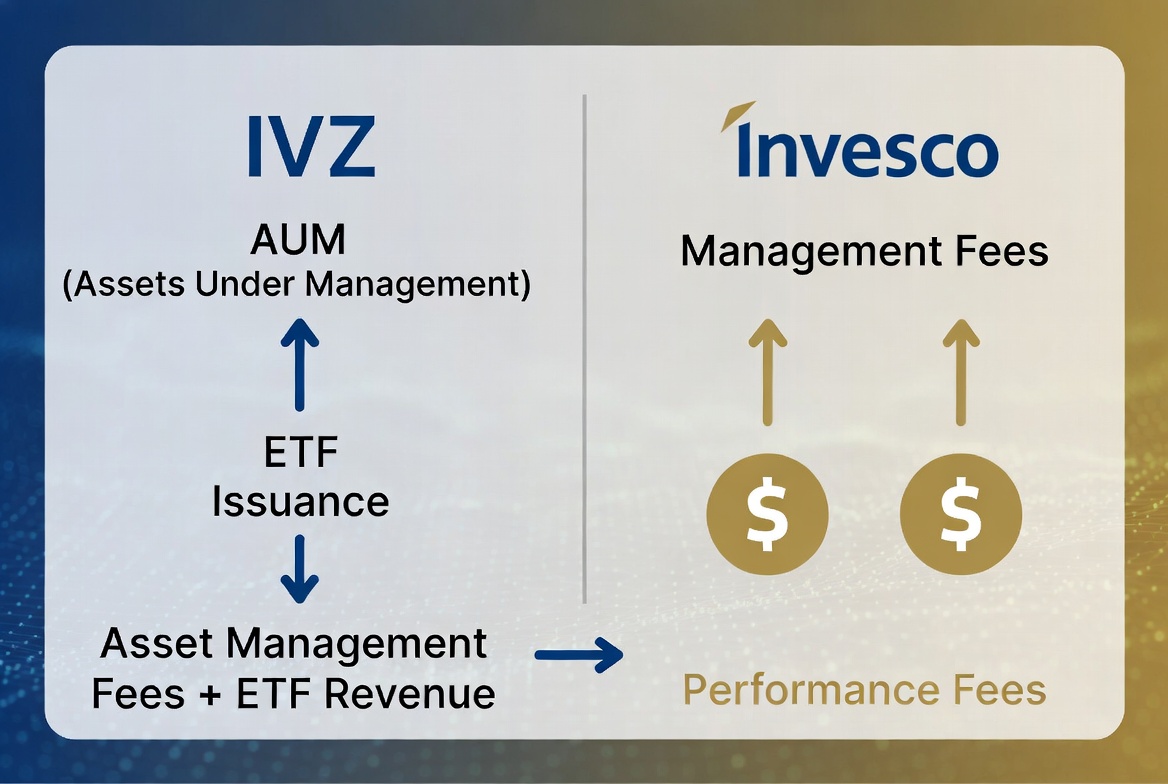
How Does the Asset Management Business Generate Revenue?
Asset management is Invesco's most critical revenue source and the core of its business model.
When investors buy Invesco funds, their capital enters managed portfolios overseen by professional investment teams. These teams research markets, allocate assets, and execute strategies to achieve fund objectives.
In return, Invesco charges management fees based on the fund's asset size. Since fees are typically a percentage of AUM, larger managed assets translate to higher revenue.
For example, a fund with hundreds of billions in assets can generate significant income even with a modest fee rate. Thus, the core competition in asset management revolves around capturing and retaining client capital.
For Invesco, consistently attracting inflows and maintaining product competitiveness are the foundations of long-term revenue growth.
How Does the ETF Product Suite Drive Growth?
ETFs have become one of Invesco's most important growth engines in recent years.
ETFs combine the diversification of mutual funds with the trading flexibility of stocks, making them widely popular among global investors. As passive investing gains traction, massive capital flows into ETFs have driven industry expansion.
Invesco's flagship ETF is the Invesco QQQ, which tracks the Nasdaq 100 Index and covers many large tech companies, making it one of the world's most widely followed ETFs.
Beyond QQQ, Invesco offers a broad range of ETFs spanning equities, bonds, sector themes, and international markets. This diverse product lineup allows the company to address varied investment needs and attract more capital into its management system.
For an asset manager, the ETF business not only generates fee income but also enhances brand influence and client reach. The ETF ecosystem has therefore become a vital component of Invesco's business model.
How Does Active Management Boost Profitability?
Despite rapid ETF growth, active management remains a key pillar of Invesco's revenue structure.
Actively managed funds rely on portfolio managers for asset selection and investment decisions, aiming to outperform market benchmarks while managing risk. Because these funds require dedicated research teams, their management fees are typically higher than those of ETFs.
From a revenue perspective, active management helps Invesco sustain higher profitability. Even smaller funds can generate substantial income through higher fee rates.
Furthermore, active strategies cover areas difficult to access through index investing, such as high-yield bonds, emerging market equities, and niche sectors. This differentiation enriches Invesco's product lineup and meets diverse client needs.
Thus, active management is not only a revenue source but also a key competitive advantage.
Why Does AUM Growth Impact Revenue?
For asset managers, assets under management (AUM) is the single most important metric.
Most of Invesco's revenue is directly tied to AUM. As more investors buy Invesco products, total AUM rises, generating higher management fees.
AUM growth typically comes from two channels.
First, net capital inflows: when investors continuously commit capital to Invesco products, AUM expands. Second, market appreciation: if stocks and bonds rise overall, AUM can increase even without new inflows.
This model gives the asset management industry strong economies of scale. As AUM grows, the company can spread operating costs over a larger base, improving overall profitability.
Therefore, the market closely tracks Invesco's capital flows and AUM trends, as these indicators often signal future revenue growth potential.
How to Buy IVZ (Invesco) Stock
IVZ is the ticker symbol for Invesco traded on U.S. stock exchanges. Traditionally, investors can buy IVZ stock through a brokerage account that supports U.S. equities, thereby gaining exposure to the global asset management industry.
Because Invesco's performance is closely linked to AUM, ETF inflows, and global capital market activity, many investors view it as a bellwether for the asset management sector.
As digital assets increasingly converge with traditional markets, new trading instruments tied to U.S. stock price movements have emerged. For example, some platforms offer CFDs linked to stock prices, allowing users to trade price movements without directly owning the underlying shares.
Gate TradFi is expanding its coverage of traditional financial assets, enabling users to monitor digital assets, U.S. stocks, ETFs, indices, and commodities from a single account. Select markets also offer Gate CFD products, providing additional options for cross-market allocation and price observation.
Regardless of the method, investors should fully understand the product structure, trading mechanics, and regulatory requirements in their jurisdiction.
Summary
Invesco's business model is built on long-term asset management demand. The company earns management fees by overseeing mutual funds, ETFs, multi-asset portfolios, and institutional solutions, with asset management fees and ETF income as core profit drivers. As passive investing expands and global demand for investment grows, ETFs have become a key growth engine, while active management supports higher margins. The continuous rise in AUM also enables significant economies of scale and a lasting competitive edge.
FAQ
What is IVZ's main source of revenue?
IVZ primarily earns revenue from asset management fees, ETF management fees, active investment business, and institutional services. Asset management fees are the largest and most core source.
What is Invesco's most important ETF?
Invesco's flagship ETF is the Invesco QQQ, which tracks the Nasdaq 100 Index and is one of the largest technology-themed ETFs globally.
Why is assets under management so important for Invesco?
Because most of Invesco's revenue is calculated as a percentage of AUM. The more assets it manages, the more management fees it typically earns.
Why does the ETF business drive Invesco's growth?
ETFs are widely popular, and sustained capital inflows expand Invesco's AUM, generating long-term fee income.
How is active management different from ETFs?
Active management relies on fund managers' decisions and generally charges higher fees. ETFs typically track indices with lower fees but larger scale.
Is Invesco in the same industry as BlackRock?
Yes. Both Invesco and BlackRock are global asset managers, though they differ in product mix, market size, and strategic focus.