À medida que o setor da criptomoeda entra numa era de desenvolvimento multi-cadeia, multi-comunidade e multi-plataforma, o ruído informativo cresce a um ritmo muito superior ao do conhecimento relevante acumulado. A pesquisa tradicional por palavras-chave já não consegue gerir ambiguidades semânticas, repetições entre plataformas ou conteúdos de "elevado tráfego e baixa qualidade". O valor técnico da KAITO reside em ir além da agregação de informação, utilizando classificação baseada em IA, avaliação de reputação e incentivos auditáveis on-chain para redefinir de forma estrutural a lógica de distribuição informativa. Assim, estabelece-se uma base mais sistemática para avaliar "quais as perspetivas com maior profundidade e que sinais são mais preditivos".
Com base em atualizações públicas recentes — como as alterações ao mecanismo Yaps, o lançamento do Kaito Studio e as iterações do Kaito Connect — esta análise organiza-se por camadas técnicas: começa pela arquitetura baseada em IA, segue para os mecanismos de partilha de informação e transparência, analisa a integração com Web3, privacidade e governança descentralizada, e termina com a discussão sobre inovação técnica futura e potenciais desafios.
Arquitetura técnica baseada em IA da KAITO
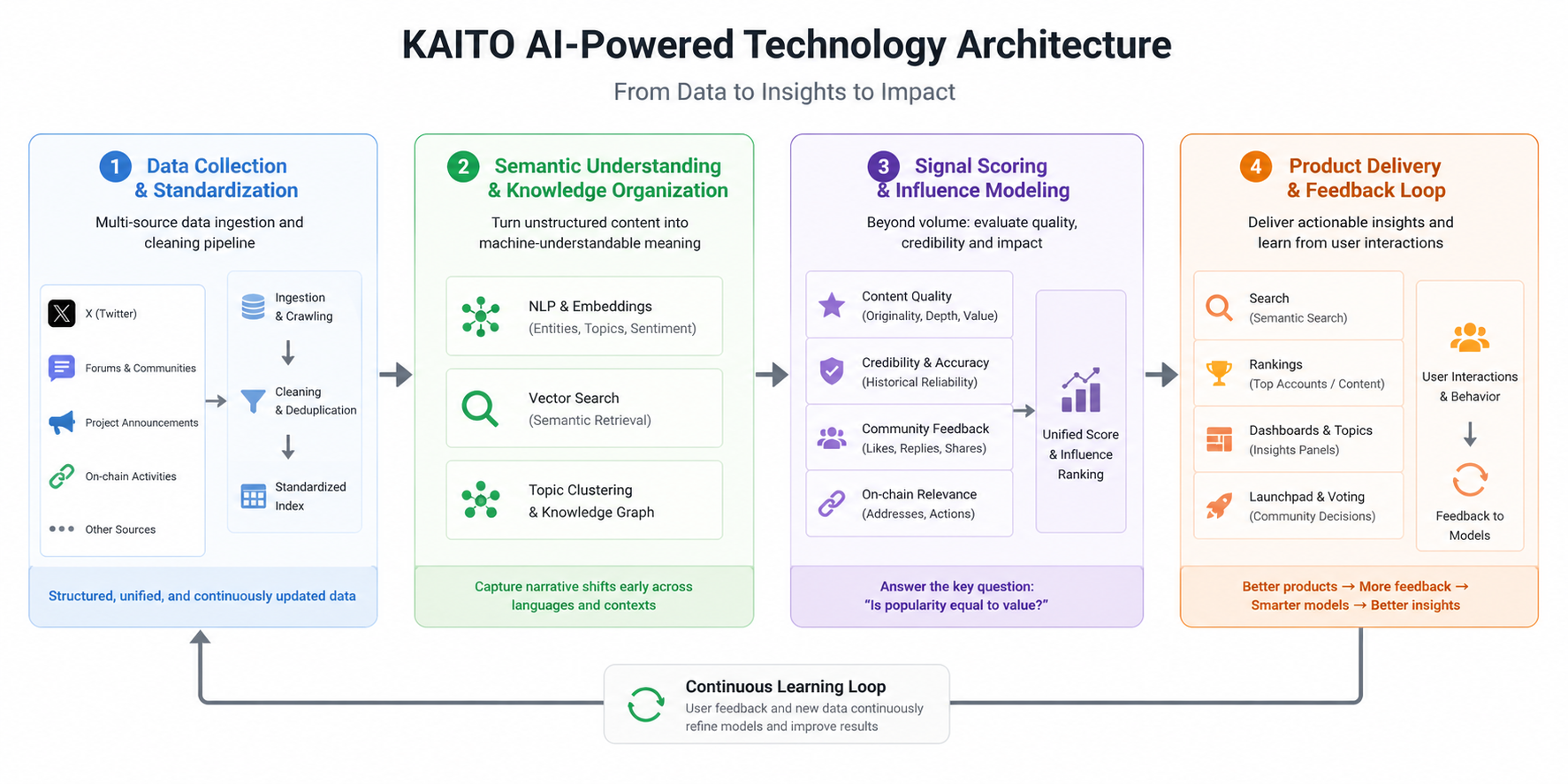
Do ponto de vista de engenharia, a arquitetura central da KAITO assenta em quatro camadas: aquisição de dados, compreensão semântica, avaliação de sinais e entrega de produto.
- Aquisição e normalização de dados. A plataforma recolhe e limpa continuamente dados provenientes de múltiplas fontes — X, fóruns comunitários, anúncios de projetos e atividade on-chain — mapeando informação heterogénea (texto, carimbos de data/hora, relações de interação, comportamentos de endereços) numa estrutura de índice unificada. Este passo define o desempenho máximo do modelo: cobertura insuficiente gera pontos cegos; limpeza inadequada amplifica o ruído.
- Compreensão semântica e organização do conhecimento. A KAITO recorre a NLP, pesquisa vetorial e agrupamento temático para converter conteúdo fragmentado em unidades semânticas "comparáveis por máquina". Ao contrário da pesquisa tradicional, baseada em palavras-chave, a pesquisa semântica integra sinónimos, discussões multilíngues e extensões contextuais nos resultados, permitindo a deteção precoce de mudanças narrativas.
- Avaliação de sinais e modelação de influência. A plataforma ultrapassa a contagem de interações, modelando em conjunto qualidade do conteúdo, contribuições sustentadas, precisão histórica, feedback da comunidade e comportamentos on-chain. Esta camada responde diretamente à questão "popularidade é valor?". Em InfoFi, a ausência de avaliação de qualidade permite que manipulações de volume de curto prazo dominem a atenção.
- Entrega de produto e ciclo de feedback. Produtos como pesquisa, tabelas de classificação, painéis temáticos e votação em Launchpad convertem os resultados do modelo em interfaces práticas. O comportamento dos utilizadores serve como amostra de treino, otimizando continuamente os parâmetros do modelo. A evolução recente, de publicações frequentes e incentivadas para uma estrutura centrada na qualidade dos criadores e em colaborações de marca, reflete um equilíbrio entre distribuição escalável e controlo de qualidade ao nível da arquitetura.
A abordagem da KAITO à partilha de informação vai além da mera agregação, utilizando IA para estruturar eventos de forma interpretável para diferentes perfis de utilizador.
- Entrada semântica unificada. Permite acompanhar narrativas de projetos, perspetivas de mercado e desenvolvimentos on-chain num único caminho de pesquisa, reduzindo a fragmentação cognitiva provocada pela alternância entre plataformas. Para instituições, diminui o custo de descoberta informativa; para utilizadores comuns, reduz a barreira de acesso a ferramentas profissionais.
- Apresentação comparável de sinais. Ao exibir destaque temático, rankings de contribuidores e cronologias de discussão, a plataforma converte "perceções difusas" em "indicadores mensuráveis". Transparência real não significa colocar todos os dados on-chain, mas sim tornar a lógica de avaliação e os resultados auditáveis e verificáveis.
- Redução multidimensional de ruído. Ordenar apenas por republicações e gostos amplifica conteúdo alimentado por sentimento. A KAITO introduz profundidade semântica, contribuição sustentada e participação no ecossistema para dar visibilidade à informação de qualidade. Em períodos de volatilidade, isto reduz o impacto de conteúdos enganosos no juízo coletivo.
- Transparência orientada pela governança. Alocação de recursos, parâmetros de incentivo e alterações de mecanismos são parcialmente decididos por votos da comunidade, criando um espaço público para discutir "como e porquê as regras mudam". Ao integrar sistemas técnicos e de governança, a transparência de dados evolui da camada de apresentação para a institucional.
A diferença fundamental da KAITO em relação às plataformas Web2 reside na integração do valor informativo com incentivos on-chain, ponderação de governança e colaboração no ecossistema num só mecanismo.
Distribuição programável de valor. Plataformas Web2 centralizam tráfego e receita, oferecendo pouca transparência ou partilha verificável a criadores e utilizadores. A KAITO permite mapeamento claro de capital através de incentivos tokenizados e distribuição por regras.
Colaboração reforçada entre protocolos. O ecossistema Web3 é, por natureza, multi-projeto. Se a camada de informação da KAITO se ligar a Launchpad, propostas de governança, identidade on-chain ou sistemas de reputação, pode criar um percurso contínuo da descoberta de informação até à formação de consenso e execução colaborativa.
Aceleração da iteração comunitária. O setor cripto exige feedback rápido e baixa tolerância ao erro, requerendo arquitetura adaptável. A transição recente da KAITO de dependência de um único percurso para um portfólio multi-produto (Studio e Connect) é paradigmática: perante mudanças em políticas externas, o sistema mantém o output central através de reconfiguração arquitetónica.
Ciclo de feedback positivo entre narrativa e dados. Projetos Web3 dependem da difusão narrativa, mas narrativas de qualidade exigem bases informativas robustas. A KAITO usa IA para estruturar a disseminação narrativa e mecanismos on-chain para reter contribuidores de elevado valor, criando um ciclo de melhoria da qualidade informativa, maior participação no ecossistema e recolha de melhores amostras.
Proteção da privacidade dos dados e gestão descentralizada
Conciliar colaboração aberta e proteção de privacidade na convergência IA-Web3 é um desafio central. A abordagem da KAITO inclui geralmente quatro camadas:
- Governação de dados em camadas. Dados públicos suportam modelação macro, enquanto comportamentos sensíveis e dados de identidade são minimizados rigorosamente, evitando exposição desnecessária. Visualizações externas focam métricas agregadas e sinais por intervalo, não detalhes individuais.
- Separação de responsabilidades on-chain e off-chain. Nem todos os dados pertencem on-chain: processamento textual de alta frequência e inferência de modelos são geridos off-chain, enquanto regras-chave, resultados de incentivos e decisões de governança ficam on-chain ou em ambientes auditáveis. Assim, preserva-se desempenho e reforça-se a verificabilidade.
- Mecanismos de permissão e auditoria. Interfaces para clientes empresariais ou parceiros do ecossistema requerem controlo granular de permissões, com registos de acesso, invocação e alteração para garantir rastreabilidade. Para reputação da plataforma, auditabilidade e explicabilidade são mais eficazes do que divulgação total.
- Descentralização gradual. Projetos em fase inicial requerem controlo reforçado, transferindo gradualmente para maior governação comunitária com a maturidade do ecossistema. A evolução da governança da KAITO reflete isso: caminhos técnicos e alterações de parâmetros são abertos à participação alargada, equilibrando eficiência e descentralização.
Futuro e inovação tecnológica da KAITO
O potencial técnico da KAITO destaca-se em cinco áreas:
Compreensão multimodal de informação. Discussões cripto abrangem texto, vídeo, transmissões em direto e imagens. Uma integração semântica multimodal mais forte reforça a capacidade de captar sinais precoces.
Avaliação granular de reputação e contribuição. Métricas de interação não sustentam qualidade a longo prazo. Desenvolvimentos futuros podem trazer curvas de contribuição histórica, consistência cross-plataforma e avaliação de comportamento on-chain para mitigar especulação de curto prazo.
Colaboração entre Agente de IA e execução on-chain. Se análises acionarem alertas automáticos de governança, subscrições de estratégia ou avisos de risco via Agente de IA, a KAITO evolui para infraestrutura central de decisão.
Interfaces padronizadas entre ecossistemas. Ao ligar mais Carteiras, plataformas de investigação, negociação e ferramentas de governança via API e padrões de dados, a camada InfoFi torna-se modular, promovendo um ecossistema de middleware ao nível da indústria.
Avanço paralelo de conformidade e transparência. Com o reforço regulatório global sobre incentivos em tokens, responsabilidade de plataformas e qualidade de conteúdos, a inovação técnica deve andar a par da divulgação de regras, controlo de risco e mecanismos de recurso para garantir sustentabilidade.
Resumo
A arquitetura técnica da KAITO é valiosa por resolver três problemas centrais nas redes informativas cripto: filtrar ruído, distribuir valor e evoluir regras.
Atualmente, a KAITO integra pesquisa semântica, modelação de sinais, incentivos e processos de governança num sistema iterativo. Mudanças em políticas externas trouxeram desafios, mas também impulsionaram a evolução de funções singulares para combinações robustas de produto e arquitetura. Para o setor, a competitividade a longo prazo avalia-se pela melhoria contínua da qualidade informativa, correção eficaz dos mecanismos de governança e geração de efeitos de rede reutilizáveis pela colaboração no ecossistema.
Se estes três pilares forem alcançados, a KAITO vai afirmar-se no espaço IA + Web3 como muito mais do que uma ferramenta de agregação de informação — será uma camada de infraestrutura InfoFi modular, verificável e evolutiva de forma sustentável.