KAS is the native token of the Kaspa network, serving as both the medium for trading fee payments and the mechanism for distributing block rewards. The entire supply is gradually released through Proof-of-Work (PoW) mining. To fully understand KAS tokenomics, it’s essential to view it within the context of the Kaspa (KAS) blockDAG architecture—where blocks are produced in parallel at approximately 10 blocks per second. The GHOSTDAG consensus protocol orders these parallel blocks into a single ledger, and the token emission schedule is closely linked to this high-frequency block production model.
Kaspa adopted a fair launch, with its mainnet going live in November 2021—no premine, no ICO, and no hidden allocations. This design aligns with the core distinctions between Kaspa and Bitcoin, emphasizing open, competitive issuance. The emission curve and KHeavyHash mining algorithm are uniquely tailored to Kaspa’s high-frequency blockDAG structure.
What Is the Total Supply and Emission Curve for KAS?
KAS has a hard-capped total supply, with the most frequently cited estimate at approximately 28.7 billion (28,704,026,601 KAS), and a code-level maximum of about 29 billion. Actual emissions may vary slightly due to DAA score scheduling, early random reward sub-phases, and rounding from parallel block production, but the total will not exceed the hard cap. Roughly 36 years after mainnet launch, block rewards will drop below 1 sompi (0.00000001 KAS), effectively ending new issuance.
Kaspa’s monetary policy is divided into two phases. The first is the pre-deflationary phase (November 2021 to May 2022): for the first two weeks after mainnet launch, block rewards ranged from 1 to 1,000 KAS as pseudo-random values, then were fixed at 500 KAS per second after the first hard fork (at a block rate of about 1 block per second). The second is the chromatic phase: starting in May 2022, the initial block reward was 440 KAS, with the total annual amount halving each year but decreasing smoothly on a monthly basis—each month’s reward is multiplied by (1/2)^(1/12), similar to the ratio of a musical semitone, a process known as chromatic halving.
Monetary policy is set by coins issued per second, not per block; if the block production rate changes in the future, the per-block reward will adjust to maintain the emission rate. KAS serves two core functions in the ecosystem: users pay trading fees, and miners receive block rewards and fees as incentives for block production.
| Token Mechanism |
Description |
| Total Supply Cap |
Approx. 28.7 billion KAS (estimate: 28,704,026,601) |
| Launch Method |
Fair launch, no premine or hidden allocation |
| Emission Path |
100% released via PoW mining |
| Pre-deflation Phase |
2021.11—2022.05, peak ~500 KAS/sec |
| Chromatic Phase |
From 2022.05, initial 440 KAS/block, smooth monthly decrease |
| Trading Fee |
Typical transaction from 0.000023 KAS, increases during congestion |
The table above summarizes the supply structure and emission schedule for KAS. Chromatic scheduling results in a smoother emission curve than Bitcoin’s four-year halving, with a higher proportion of early release, complementing Kaspa’s high-frequency blockDAG design.
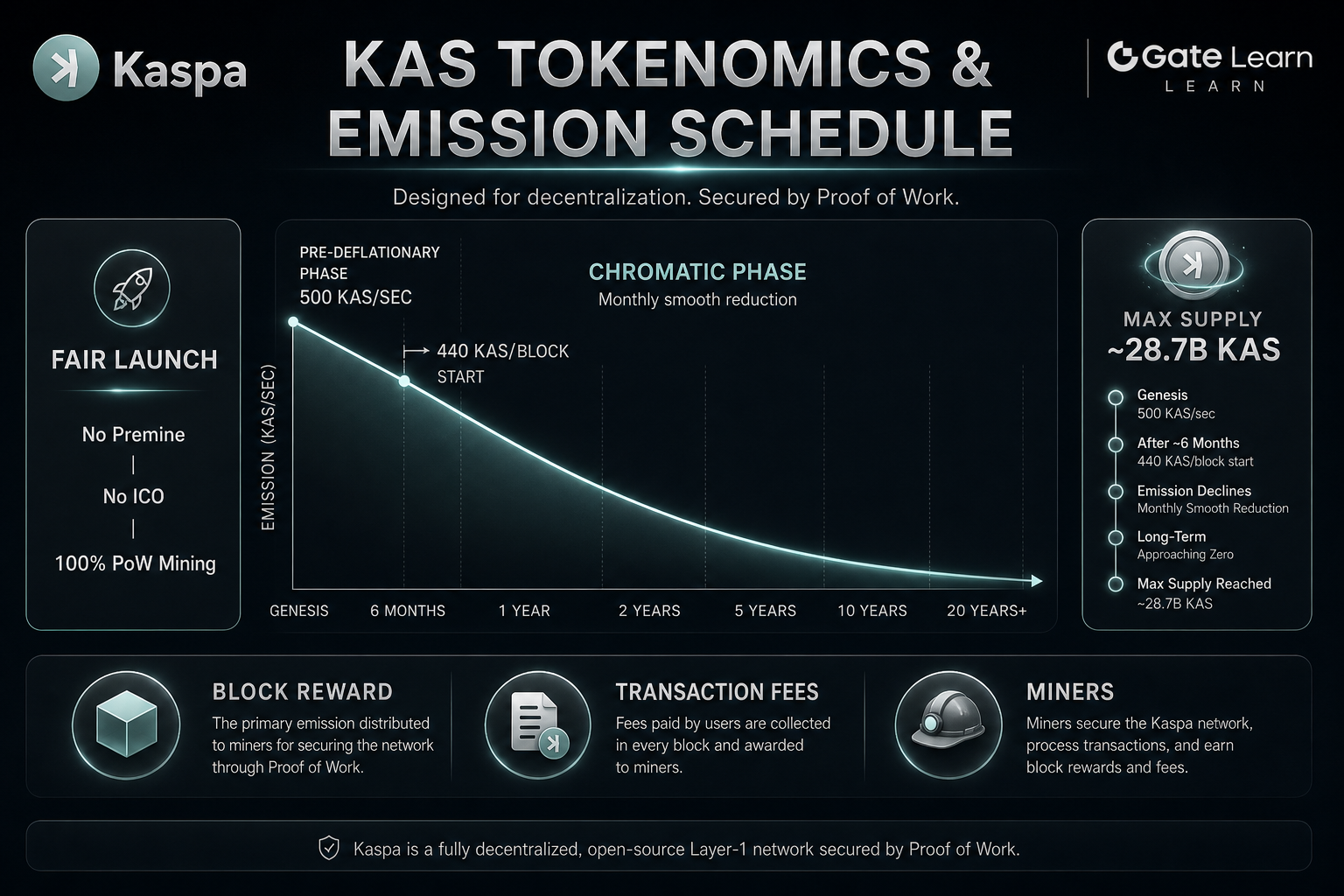
Figure 1. KAS tokenomics and emission curve: fair launch, no premine, chromatic phase block reward smooth decay, and total supply cap.
How Is Fair Launch Verified?
A fair launch means that after the mainnet genesis block, there was no premine, private sale, or team reserve; all tokens are released exclusively through open mining. Kaspa’s mainnet launched on November 7, 2021, with the launch plan publicly disclosed—no premine, no ICO, no vesting—fully aligning with this model.
Fair launch can be verified through on-chain data: genesis blocks and early rewards can be traced in the explorer, with no pre-allocated addresses or lock-up contracts, and circulating supply grows in sync with mining output. DAGLabs, the original research group, was dissolved around mainnet launch, and the project transitioned to a community-driven open-source model. Chromatic emission uses DAA scores as switch anchors, with rules embedded in the protocol. The absence of premine ensures KAS distribution is entirely determined by hashrate competition, eliminating information asymmetry in token allocation.
How Does KHeavyHash Mining Work?
KHeavyHash is Kaspa’s PoW mining algorithm, combining memory and computational intensity. Its core process alternates standard Keccak hashing (a SHA-3 family function) with matrix multiplication—specifically, one matrix multiplication is sandwiched between two Keccak operations, making mining dependent on both processing power and memory bandwidth.
Miners run KHeavyHash mining software, continually adjusting the nonce in the block header and calculating hashes, broadcasting new blocks to the network once the difficulty target is met. Since Kaspa uses a blockDAG instead of a single-chain structure, blockDAG and GHOSTDAG allow multiple parallel blocks to be ordered; losing blocks are not simply discarded as orphans, resulting in higher hashrate utilization compared to traditional single-chain PoW.
KHeavyHash supports dual-mining, allowing some machines to mine Kaspa while running other memory-intensive algorithms. The hardware ecosystem has expanded from GPUs to specialized ASICs.
| Mining Element |
KHeavyHash |
Bitcoin SHA-256 (comparison) |
| Algorithm Type |
Keccak + matrix multiplication |
Double SHA-256 |
| Hardware |
GPU, dedicated ASIC |
Dedicated ASIC |
| Block Frequency |
~10 blocks/sec |
~10 min/block |
| Orphan Block Handling |
blockDAG ordering |
Losers usually discarded |
| Dual-mining Compatible |
Supported |
Not common |
The table above highlights the key differences between KHeavyHash and Bitcoin mining algorithms. Kaspa’s high block frequency allows miners to earn block rewards more frequently, with lower rewards per block than Bitcoin but a much higher number of blocks.
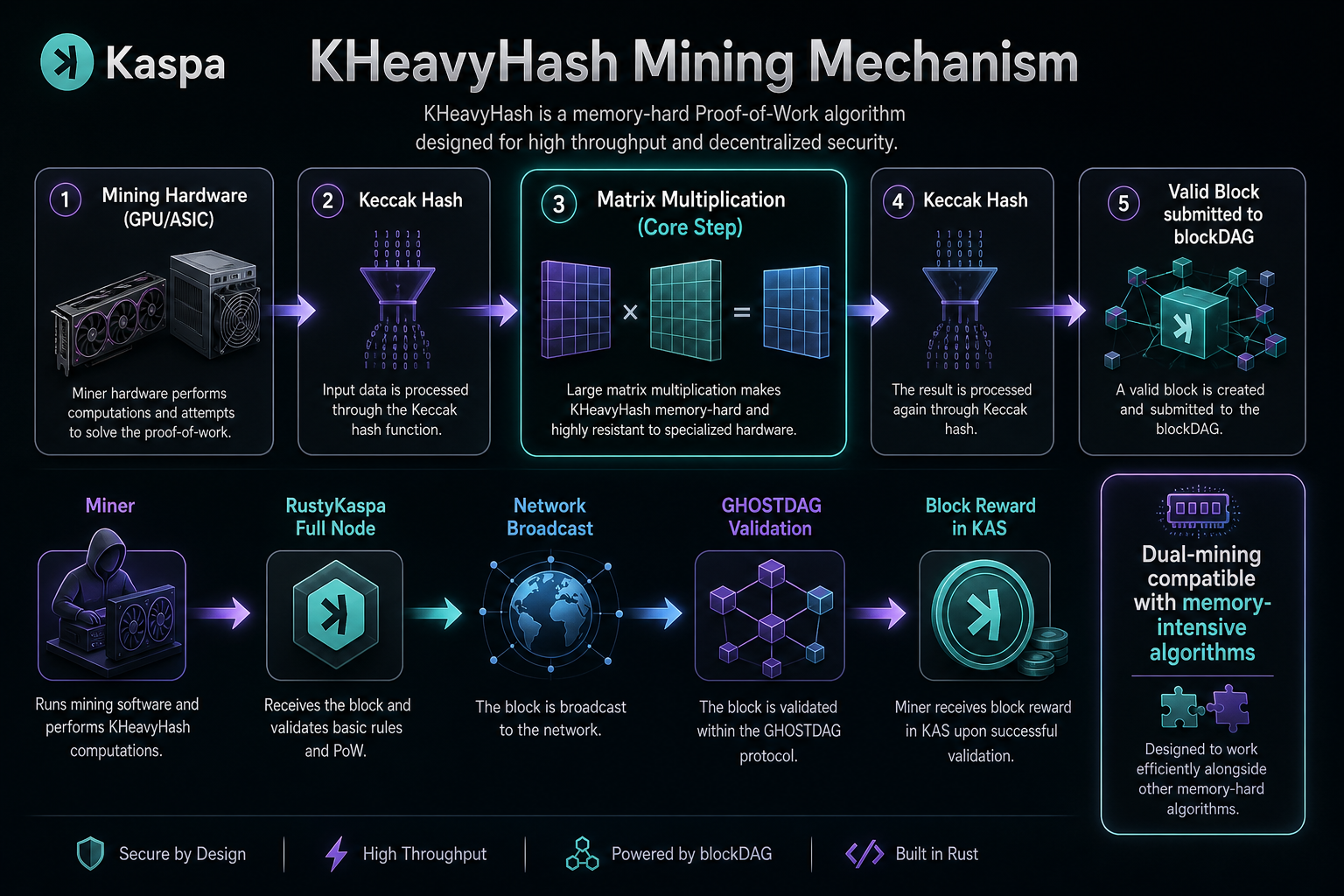
Figure 2. KHeavyHash mining mechanism: Keccak hash and matrix multiplication are core steps; miners earn KAS block rewards after submitting valid blocks.
How Do Miners, Nodes, and Network Security Interact?
Kaspa’s network security is maintained through a three-layer collaboration: miner hashrate, full node validation, and P2P propagation. Miners use KHeavyHash to compete for block production and broadcast new blocks to the network; full nodes (primarily RustyKaspa) receive blocks, enforce GHOSTDAG validation, maintain the full blockDAG state, and relay valid data; light nodes and wallets rely on full nodes for balances and transaction history, handling key management and signature broadcasting.
Full nodes validate transactions and blocks according to GHOSTDAG rules, rejecting non-compliant data; miners compete for block production, and nodes enforce protocol rules—both are indispensable. RustyKaspa supports the mainnet’s ~10 blocks/sec rate and is the backbone for synchronization and validation. Block rewards and trading fees make up miner revenue; high block frequency reduces variance per block, but hashrate concentration and 51% attack risk remain structural security considerations.
What Are the Costs and Limitations of Mining?
Mining Kaspa involves direct costs: hardware (GPU or KHeavyHash ASIC), electricity, cooling and maintenance, and mining pool fees (if using a pool). The matrix multiplication stage in KHeavyHash requires high GPU or ASIC memory bandwidth, making hardware selection crucial for efficiency and energy consumption. Solo miners must run a RustyKaspa full node for chain synchronization, which also requires ongoing bandwidth and storage.
Limitations include: as block rewards decrease, network security will increasingly depend on trading fees, which are currently very low; high block frequency accelerates on-chain data growth, increasing storage demands for full nodes compared to traditional single-chain PoW; ASIC adoption may shift hashrate distribution; parallel block production relies on low-latency propagation, and extreme conditions could cause reorganization delays. These are objective protocol-level constraints.
Summary
KAS is issued via fair launch with no premine, capped at approximately 28.7 billion, and released entirely through KHeavyHash PoW mining. The chromatic monetary policy ensures block rewards decrease smoothly each month, with the emission schedule aligned to Kaspa’s high-frequency blockDAG model. KHeavyHash combines Keccak hashing and matrix multiplication, with miners and RustyKaspa full nodes working in tandem—hashrate competes for block production, and nodes enforce GHOSTDAG validation. Understanding KAS tokenomics requires grasping the emission curve, fair launch verification, mining process, and network roles, while considering the long-term evolution of the trading fee market in security assessments.
FAQ
What Is the Total Supply of KAS?
KAS has a total supply cap of approximately 28.7 billion, with an estimated value of 28,704,026,601 KAS. The code-level cap is about 29 billion; actual total emission may vary slightly due to DAA score scheduling and the early random reward phase, but will not exceed the hard cap. All KAS is released via PoW mining, with no premine or hidden allocation.
Does Kaspa Have a Premine?
Kaspa adopted a fair launch—no premine, no ICO, and no team allocations. The mainnet launched on November 7, 2021, and every KAS after genesis is mined through open competition, with on-chain data independently verifiable.
How Do You Mine Kaspa (KAS)?
To mine Kaspa (KAS), you need hardware that supports KHeavyHash (GPU or dedicated ASIC), run KHeavyHash mining software, and connect to a RustyKaspa full node or mining pool. Miners broadcast block header hashes that meet the difficulty target to the network, and blocks validated by GHOSTDAG are eligible for KAS block rewards and trading fees.
What Is the Utility of the KAS Token?
KAS serves two core functions on the Kaspa network: users pay trading fees to incentivize miners to process transactions, and miners receive block rewards and fees as compensation for block production. KAS is the network’s native value token, with issuance fully driven by PoW mining.
What Are the Main Costs of KHeavyHash Mining?
The primary costs of KHeavyHash mining are hardware (GPU or ASIC), electricity and cooling, mining pool fees, and bandwidth and storage for running a full node. Block rewards decrease steadily under chromatic scheduling; over time, hashrate incentives will rely more on the trading fee market, though current fees are extremely low.
How Do Miners and Full Nodes Secure Kaspa Together?
Miners use KHeavyHash hashrate to compete for block production and broadcast blocks to the network, while full nodes (RustyKaspa) validate blocks and transactions under GHOSTDAG rules and maintain the blockDAG state. Hashrate provides block production competition, full nodes enforce protocol rules and data integrity—together, they form Kaspa’s PoW security model.







