In veCRV-style governance models, protocols typically shift decision-making power toward long-term lockers and liquidity providers to reduce interference from short-term speculative voting on the ecosystem's direction. Treasure DAO follows a similar logic: MAGIC serves as the utility and value medium circulating within the ecosystem, while gMAGIC—a governance weight credential—is tied to staking and LP positions, requiring users to make a meaningful capital or liquidity commitment before participating in governance.
From a user's perspective, if the goal is to use Agents, play games, or transfer tokens, you need to hold and spend liquid MAGIC. If the goal is to influence emission policies, protocol upgrades, or treasury usage, you must convert MAGIC into gMAGIC and vote via Snapshot on the Arbitrum network. Understanding this distinction is essential to engaging correctly with the Treasure ecosystem.
What Is MAGIC?
MAGIC is the native token of the Treasure Network, deployed on Arbitrum One as an ERC-20 standard asset with a hard cap of 347,714,007 tokens. Launched via a fair launch mechanism in 2021, MAGIC currently serves the "utility layer" within two core functions: paying for compute power and on-chain services for Neurochimp AI Agents, acting as an economic medium in applications like Smolworld and Bridgeworld Canopy, and participating in mining and consumption mechanisms such as Atlas Mine and Harvester in Bridgeworld.
As a liquid asset, MAGIC can be transferred between wallets, traded on exchanges or DEXs, used to continuously power Agents in Agent Creator, and bridged across Ethereum, Arbitrum One, and Treasure L2 via the Treasure Bridge. Circulating MAGIC does not automatically confer governance rights: liquid MAGIC that is not staked or placed into designated LPs carries zero weight in Snapshot voting.
| Dimension |
MAGIC Characteristics |
| Asset Form |
Liquid ERC-20 Token |
| Primary Function |
Agent Compute, Game Economy, On-Chain Transfers |
| Transferability |
Freely Transferable and Tradable |
| Governance Voting |
No Direct Snapshot Voting Power |
| Typical Use Cases |
Powering Agents, Participating in Bridgeworld, Daily Holding & Trading |
MAGIC is the "universal medium" for value flow in the ecosystem, but DAO decision-making power must be obtained separately through gMAGIC.
What Is gMAGIC?
gMAGIC (Governance MAGIC) is the unit of measurement for Treasure DAO governance voting power. Modeled after veCRV, it tilts governance influence toward stakers and liquidity providers who commit to long-term ecosystem support. gMAGIC is not a separate tradable token distinct from MAGIC—rather, it is a governance weight indicator derived from MAGIC staking or LP positions, used solely to measure voting power during the Snapshot phase.
According to the official Treasure developer documentation, only gMAGIC holders have voting rights on Snapshot; liquid, unstaked MAGIC not deposited into designated LPs is excluded from governance weight. gMAGIC adjusts automatically as staking and LP positions are added or withdrawn—users do not need to independently "claim" gMAGIC tokens. When connecting to Snapshot, the system reads on-chain positions and displays the corresponding gMAGIC balance.
| Dimension |
gMAGIC Characteristics |
| Asset Form |
Governance Weight Measurement (Not a Freely Circulating Token) |
| Primary Function |
Snapshot Voting on TIP Proposals |
| Transferability |
Tied to Underlying Staking/LP Positions, Not Separately Tradable |
| Prerequisites for Acquisition |
Must Stake MAGIC or Provide Designated Liquidity |
| Typical Use Cases |
Voting on Emission Policies, Protocol Upgrades, Treasury Usage |
gMAGIC addresses who has a voice in governance, not who spends MAGIC in the ecosystem. The two roles are clearly separated within the same tokenomics.
How to Obtain gMAGIC?
gMAGIC is derived from MAGIC positions through two paths with different conversion ratios:
Path (A)—gMAGIC Calculated at 1:1:
- MAGIC staked in Bridgeworld Harvesters
- MAGIC staked in the TreasureDAO Governance Staking contract
- Holding Sushiswap MAGIC-ETH SLP on Arbitrum One
Path (B)—gMAGIC Calculated at 50% of MAGIC Amount:
- Holding any LP tokens listed on Magicswap
- Staking in Beefy's mooSushiMAGIC-ETH vault
- Staking in Balancer's 50% MAGIC / 50% USDC weighted pool
Path (A) targets core staking in Bridgeworld and the official governance staking contract, plus mainstream MAGIC-ETH liquidity. Path (B) targets Magicswap ecosystem LPs, third-party yield aggregators, and Balancer pools. When users add or withdraw from these positions, gMAGIC recalculates automatically—no additional on-chain action is needed.
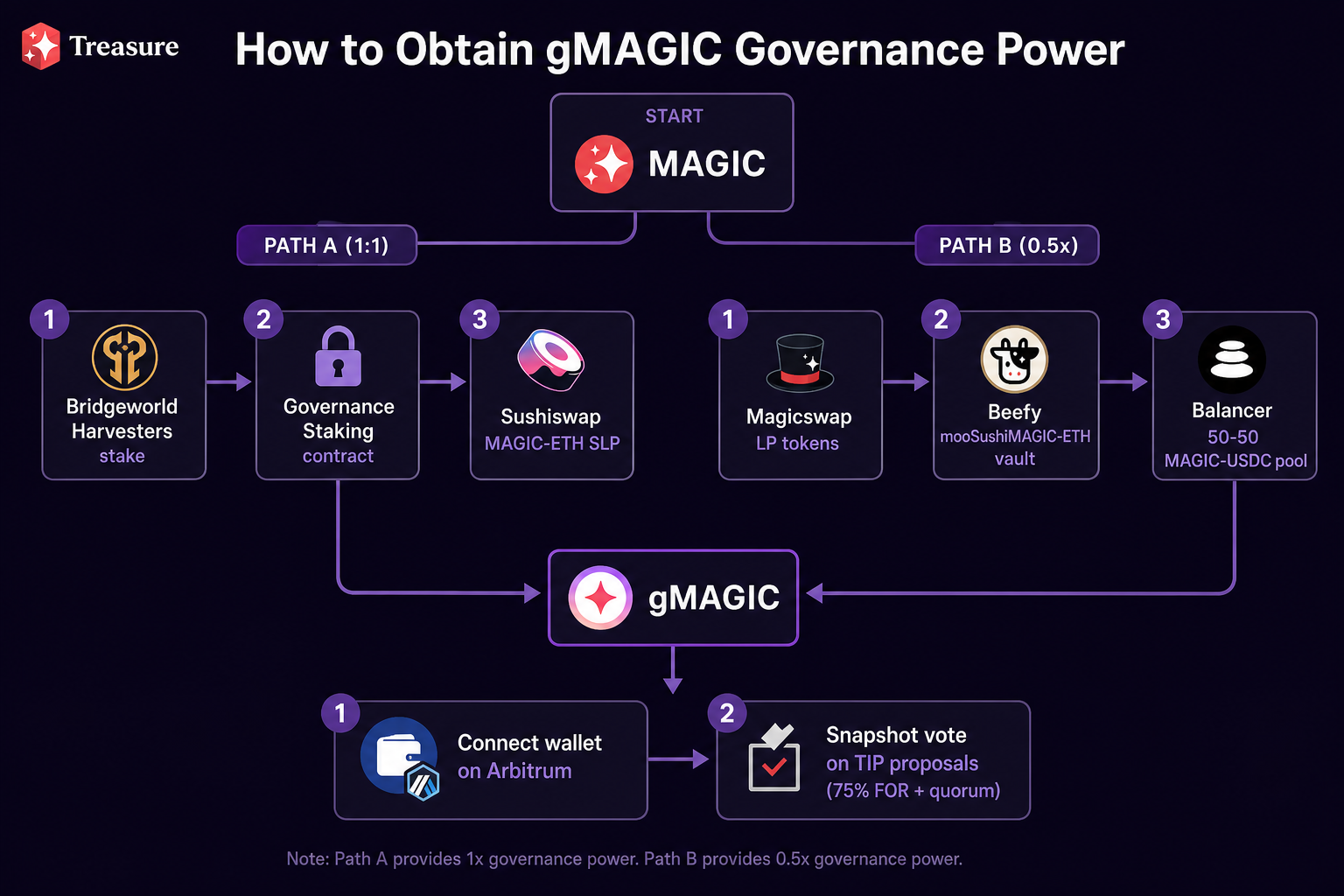 Figure 1. gMAGIC derivation paths: 1:1 staking routes (A) and 0.5x LP routes (B) leading to Snapshot voting.
When selecting a path, weigh liquidity locking against voting power: Path (A) offers a higher conversion ratio but locks funds into Harvester or governance staking; Path (B) converts at 50% but lets you earn trading fees or aggregated yields via LPs. Both paths can be held simultaneously—Snapshot aggregates and displays the total gMAGIC.
How Does Governance Voting Work?
Treasure DAO governance advances through TIPs (Treasure DAO Improvement Proposals). Proposals first undergo discussion and a temperature check in the governance forum. After sufficient positive feedback and engagement, they proceed to formal Snapshot voting. Voting typically lasts 24–48 hours, though the exact duration varies by proposal.
Three conditions must be met to participate in Snapshot voting: hold gMAGIC (i.e., have staked MAGIC or provided designated LPs); connect your wallet on the Arbitrum network to the Snapshot interface; and cast a "For" or "Against" vote. A proposal passes when quorum is reached and "For" votes account for ≥75%, after which it is executed by the DAO multisig and core contributor team.
gMAGIC is used exclusively for Snapshot voting and does not replace MAGIC's utility consumption in Agents or games. Users can hold both liquid MAGIC (for ecosystem spending) and staking positions that generate gMAGIC (for governance) in the same wallet—the two balances are measured independently.
How Do Use Cases Differ Between Liquid MAGIC and Staked MAGIC?
Liquid MAGIC is suitable for scenarios requiring immediate transfer or spending: powering Agents in Agent Creator, engaging with application economies in Smolworld or Bridgeworld Canopy, trading on DEXs or bridging across chains, and paying for on-chain gas-related operations. These scenarios emphasize the token's transferability and immediate availability.
Staked or LP-form MAGIC is suitable for scenarios where users are willing to lock liquidity in exchange for governance influence: voting on long-term matters such as MAGIC emission policies, protocol parameter upgrades, and the direction of ecosystem fund usage; obtaining governance weight while participating in Bridgeworld mining through Harvester; and providing liquidity in pools like MAGIC-ETH while also accruing gMAGIC voting power.
| Objective |
Should You Use MAGIC or gMAGIC? |
Operation |
| Power an AI Agent |
Liquid MAGIC |
Maintain wallet balance, top up the Agent |
| Participate in Snapshot Voting |
gMAGIC |
Stake or provide designated LPs |
| Buy/Sell on a DEX |
Liquid MAGIC |
Regular trade, excluding staked positions |
| Influence Emissions and Protocol Upgrades |
gMAGIC |
Choose Path (A) or (B) to obtain voting power |
| Bridgeworld Mining |
Depends on mechanism |
Harvester staking also generates gMAGIC |
If a user holds only liquid MAGIC without staking, they can fully participate in ecosystem consumption but cannot influence DAO decisions during the Snapshot phase. If a user stakes all their MAGIC to obtain gMAGIC, they must reserve an unstaked balance to meet utility needs like powering Agents.
At-a-Glance Table: Core Differences Between MAGIC and gMAGIC
The table below summarizes the fundamental differences between MAGIC and gMAGIC across eight dimensions for quick reference.
| Comparison Dimension |
MAGIC |
gMAGIC |
| Nature |
Native ERC-20 Utility Token |
Governance Voting Power Measurement Unit |
| Independently Tradable |
Yes |
No (Bound to Staking/LP Positions) |
| Primary Function |
Agent Compute, Game Economy, Transfers |
Snapshot Voting |
| Acquisition Method |
Mining, Buying, Bridging, Incentives |
Derived from Staking or Designated LPs |
| Voting Power |
None (when liquid) |
Yes (during Snapshot phase) |
| Conversion Ratio |
— |
Path (A) 1:1; Path (B) 0.5x |
| Network |
Arbitrum One, etc. |
Voting requires connecting to Snapshot on Arbitrum |
| Relation to veCRV |
Similar to CRV (utility + governance source) |
Similar to veCRV (governance rights after locking) |
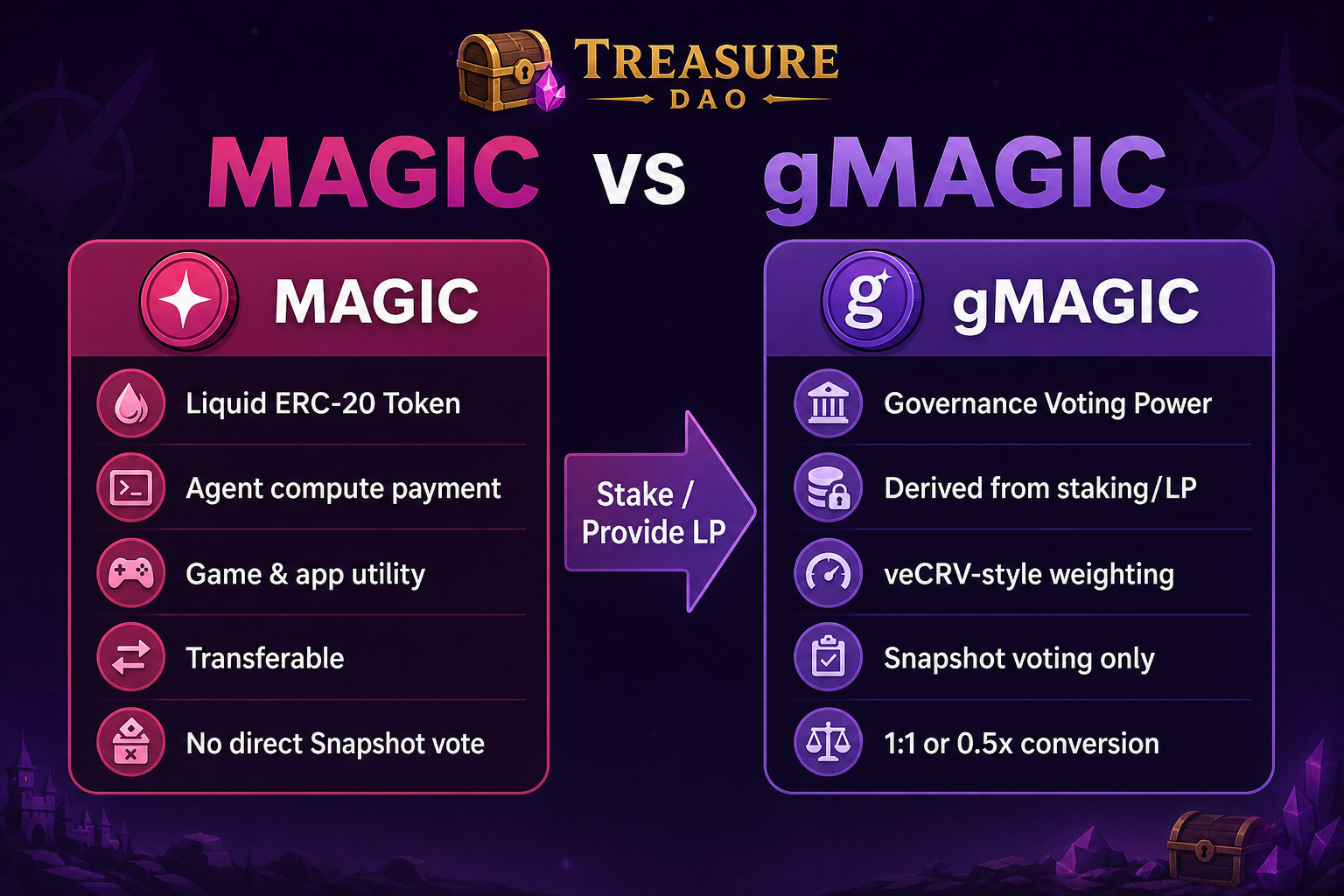 Figure 2. Side-by-side comparison: MAGIC as liquid utility token vs gMAGIC as governance voting power derived from staking and LP.
The table shows that MAGIC and gMAGIC are not two competing tokens but rather a division of labor between "utility circulation" and "governance weight" within the same ecosystem. MAGIC tokenomics explains the sources and consumption of MAGIC through supply, halving, and Bridgeworld emissions. This article focuses on how MAGIC converts to gMAGIC and participates in DAO decision-making.
What Mechanism Boundaries Should You Be Aware Of?
The separation between MAGIC and gMAGIC entails several mechanism boundaries to note. First, liquid MAGIC has no voting power—users who mistakenly assume "holding MAGIC equals governance" may miss the Snapshot voting window; positions must be staked or LP'd in advance. Second, gMAGIC changes with position adjustments—withdrawing from Harvester staking or redeeming LPs proportionally reduces gMAGIC and voting power. Third, the conversion ratios differ between Path (A) and Path (B); the same amount of MAGIC yields different voting power on different paths, so users must choose according to their liquidity needs.
Related risks include: smart contract risks in staking and LP contracts, additional contract-layer risks from third-party aggregators (Beefy, Balancer), governance concentration potentially favoring large long-term stakers, and potential asset loss from counterfeit MAGIC or fake staking interfaces. Users should verify operations against Treasure developer documentation and official contract addresses. The above explanations are mechanism-level analysis and do not constitute investment advice.
Summary
MAGIC is the circulating utility token of the Treasure Network, serving Agent compute, application economies, and on-chain transfers. gMAGIC is a governance voting power measurement unit derived solely through Bridgeworld Harvester staking, Governance Staking, MAGIC-ETH SLP, or designated Magicswap LPs. Liquid MAGIC cannot directly participate in Snapshot voting; MAGIC must first be locked into Path (A) or Path (B) positions. Understanding the division of functions, acquisition paths, and applicable use cases is the foundation for correctly engaging with Treasure ecosystem consumption and DAO governance.
FAQ
What is the core difference between MAGIC and gMAGIC?
MAGIC is the native ERC-20 utility token of the Treasure ecosystem, used for Agent compute, game economy, and on-chain transfers. gMAGIC is a governance voting power measurement unit derived from staking MAGIC or providing designated LPs, used exclusively for voting on TIP proposals in Snapshot. Holding liquid MAGIC does not automatically grant governance rights.
Can I vote just by holding MAGIC?
No. Only gMAGIC holders have voting rights during the Snapshot phase. Liquid, unstaked MAGIC not deposited into designated LPs is excluded from governance weight. You must first stake MAGIC in Harvester, the Governance Staking contract, or provide designated liquidity for gMAGIC to appear on Snapshot and enable voting.
How is gMAGIC calculated?
Path (A)—Harvester staking, Governance Staking, Sushiswap MAGIC-ETH SLP—calculates gMAGIC at a 1:1 ratio. Path (B)—Magicswap LPs, Beefy's mooSushiMAGIC-ETH vault, Balancer's MAGIC/USDC pool—calculates gMAGIC at 50% of the MAGIC amount. gMAGIC adjusts automatically when positions change.
What are the passing conditions for Snapshot voting?
A TIP proposal must achieve quorum during Snapshot voting and receive "For" votes of ≥75% to pass. Voting typically lasts 24–48 hours. To participate, connect your wallet on the Arbitrum network; the system reads your gMAGIC balance as voting power.
Can gMAGIC be bought or sold separately?
No. gMAGIC is not an independently circulating token—it is a governance weight indicator tied directly to staking or LP positions. When you withdraw staking or redeem LPs, the corresponding gMAGIC disappears. gMAGIC cannot be traded separately from MAGIC on the secondary market.
What do I need to prepare separately for governance participation and using Agents?
To use Agents, you need liquid MAGIC to continuously power them. To participate in governance, you need to stake a portion of MAGIC or deposit it into designated LPs to obtain gMAGIC. In practice, most participants maintain both a liquid balance (for utility) and a staked position (for governance)—the two functions cannot be interchanged.