With the rapid growth of the Sui DeFi ecosystem, decentralized exchanges have become critical hubs for on-chain liquidity. Among the various protocols, Cetus and Magma Finance stand out as the two most representative projects. Not only do they facilitate asset trading, but they also drive the ecosystem's liquidity buildup and capital efficiency improvements.
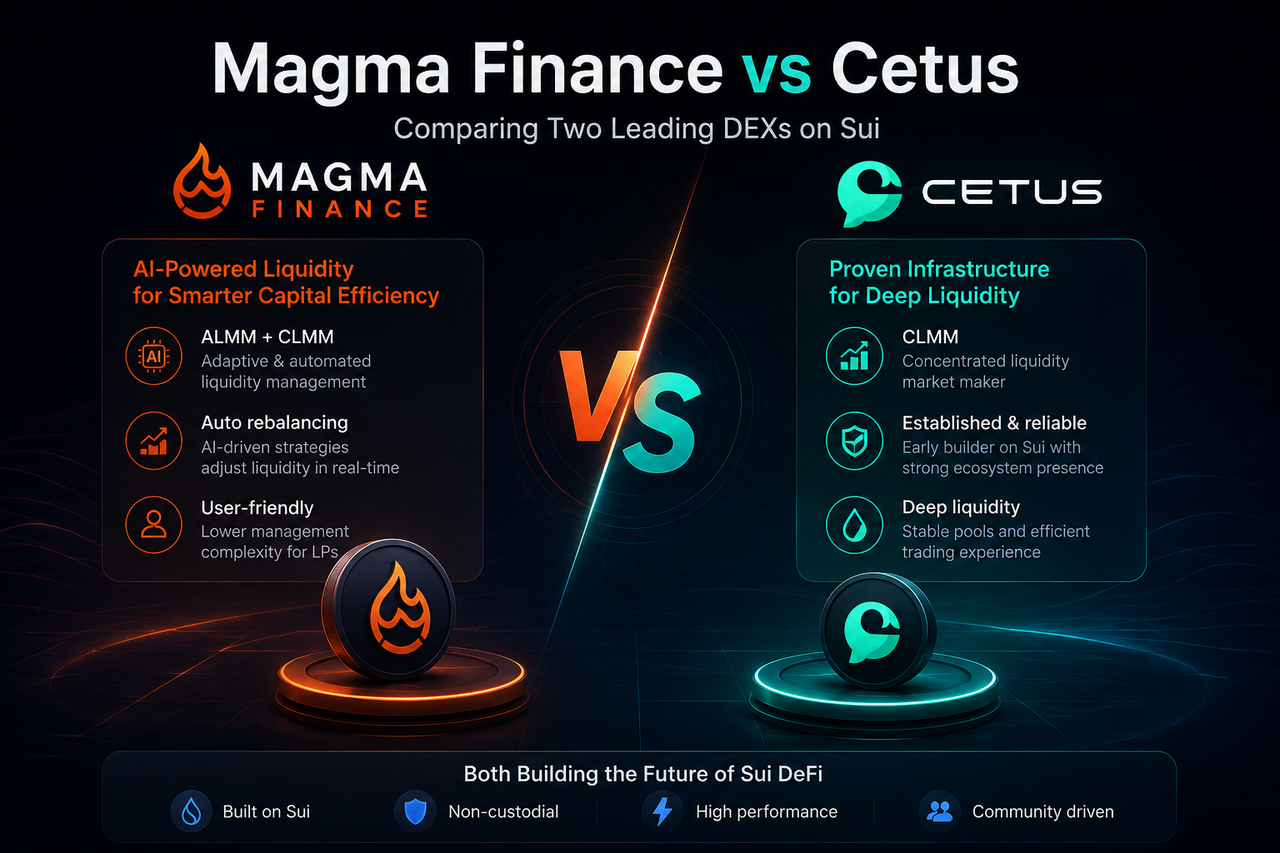
Although both are major DEXs within the Sui ecosystem, their product design philosophies and development paths diverge significantly. Cetus leans toward being a mature concentrated liquidity infrastructure, while Magma Finance aims to build a next-generation liquidity protocol powered by AI and automated liquidity management.
What Is Cetus?
Cetus is one of the earliest major liquidity protocols on Sui and currently ranks among the most influential CLMM DEXs. Its core architecture revolves around the Concentrated Liquidity Market Maker (CLMM) model, which enables liquidity providers to set their own price ranges, thereby concentrating capital in more active market regions for better capital efficiency.
By entering the market early and accumulating substantial liquidity, Cetus has become a go-to platform for Sui projects launching trading pairs and establishing liquidity pools. Beyond asset swapping, Cetus also functions as an ecosystem liquidity infrastructure, supporting a wide range of DeFi applications and new projects.
What Is Magma Finance?
Magma Finance is also built on the Sui blockchain, but its product focus is on intelligent liquidity management. In addition to supporting the traditional CLMM model, the protocol introduces an ALMM (Adaptive Liquidity Market Maker) mechanism, which dynamically optimizes liquidity allocation through automatic rebalancing and AI-driven strategies.
This design addresses the pain point of CLMM users having to frequently manage their positions, lowering the barrier to entry while maintaining high capital efficiency. For users seeking a simpler liquidity management experience, Magma Finance offers a different approach compared to traditional DEXs.
Although both are decentralized trading platforms, their ecosystem roles are not identical. Cetus is more of an infrastructure protocol, focused on building a stable, efficient, and broad liquidity network that provides foundational support for the entire Sui DeFi ecosystem.
Magma Finance, on the other hand, prioritizes liquidity management innovation. The protocol leverages automation and AI to optimize capital allocation, delivering higher-quality liquidity services while reducing operational complexity. So, Magma emphasizes product innovation, while Cetus stresses ecosystem infrastructure.
What Are the Differences in Liquidity Models?
The liquidity model is one of the most critical differences. Cetus's main strength lies in the CLMM model, where users can independently set their liquidity deployment range and flexibly adjust price ranges based on market movements. This model significantly boosts capital utilization but requires a certain level of market judgment.
Magma Finance adopts a dual-model architecture combining CLMM and ALMM. In addition to standard concentrated liquidity, ALMM automatically adjusts liquidity positions based on market conditions, reducing the need for frequent manual rebalancing.
At their core, both aim for high capital efficiency but through different means. Cetus relies on active user management, while Magma Finance leans on automated management mechanisms.
What Are the Differences in User Experience?
User experience is one of the most noticeable distinctions. In Cetus, liquidity providers must set their own price ranges and continuously monitor market movements. If the price moves out of the effective range, users typically need to re-adjust their positions to maintain liquidity earnings.
Magma Finance automates part of the liquidity management through ALMM. The protocol dynamically optimizes capital allocation in response to market changes, sparing users from frequent manual adjustments.
For professional market makers, Cetus offers greater control; for everyday users, Magma Finance provides a lower learning curve and simpler operation.
What Role Does AI Play in Magma Finance?
AI is one of the most significant differentiators between Magma Finance and Cetus. Cetus's liquidity mechanism relies mainly on user decisions and protocol rules, with no AI as a core feature.
Magma Finance, however, uses AI to analyze data such as trading volume, market volatility, capital utilization, and liquidity demand, then optimizes liquidity deployment through automated strategies. The primary goal of AI is not to predict market prices but to improve liquidity allocation efficiency and capital utilization.
This intelligent management approach is a key direction for Magma Finance to build a competitive edge.
For liquidity providers, the two platforms cater to different needs. If you have strong market analysis skills and prefer active market-making with flexible position adjustments, Cetus's CLMM model gives you greater control.
If you value convenience and want to avoid the management cost of frequent rebalancing, Magma Finance's ALMM model is more appealing. Its automated mechanism lets you stay in high-capital-efficiency markets without constant price monitoring.
So, there’s no absolute winner—each serves different types of liquidity providers.
Magma Finance vs Cetus Comparison
| Dimension |
Magma Finance |
Cetus |
| Ecosystem |
Sui |
Sui |
| Core Positioning |
Smart Liquidity Protocol |
Liquidity Infrastructure |
| Liquidity Model |
ALMM + CLMM |
CLMM |
| AI Strategy |
Supported |
Non-core feature |
| Auto Rebalancing |
Supported |
Not supported |
| User Control |
Medium |
High |
| Operational Complexity |
Low |
High |
| Target Users |
General users & LPs |
Advanced LPs & professional market makers |
Conclusion
Magma Finance and Cetus are both core DEXs in the Sui ecosystem, but they represent two different development paths. Cetus, with its mature CLMM architecture and extensive ecosystem partnerships, has become a key liquidity infrastructure for Sui DeFi. Magma Finance, through ALMM and AI-driven strategies, explores a new model of automated liquidity management.
From a capital efficiency standpoint, both are highly competitive. In terms of product experience, Magma Finance emphasizes automation and ease of use, while Cetus is better suited for professional users who prefer active liquidity management.
FAQs
What’s the biggest difference between Magma Finance and Cetus?
The biggest difference is in liquidity management. Cetus primarily uses the CLMM model, while Magma Finance adds an ALMM automated liquidity management mechanism on top of CLMM.
Which platform has higher capital efficiency?
Both have high capital efficiency. Cetus improves capital utilization through concentrated liquidity, while Magma Finance further optimizes liquidity management with ALMM and dynamic allocation.
Is AI unique to Magma Finance?
Yes, AI-driven liquidity management is a core feature of Magma Finance and a key innovation that sets it apart from traditional DEXs.
Is Cetus or Magma Finance better for beginners?
For users who want to minimize management complexity, Magma Finance is generally easier to use. For those familiar with liquidity strategies and seeking active position control, Cetus offers more freedom.







