In a modular blockchain architecture, the execution layer and the identity layer are often difficult for a single chain to optimally accommodate simultaneously: application deployment requires EVM compatibility and low-cost DA, while compliant identity requires private addresses and verifiable credentials. Manta Network positions Pacific as a ZK application execution side on Ethereum and Atlantic as an identity credential side on Polkadot, creating a complementary "scaling execution + privacy compliance" structure.
From the developer and user perspective, the Pacific side lowers ZK dApp deployment costs through Universal Circuits and Celestia DA; the Atlantic side enables selective disclosure via zkAddress and Prove Key, allowing DeFi, social, and gaming scenarios to complete verification without exposing original identities. Understanding the boundaries of the two chains is essential for reading Manta Network technical documentation.
What Is Manta Pacific?
Manta Pacific is a modular Layer 2 (L2) network deployed by Manta Network on the Ethereum ecosystem, designed as a scalable, low-cost on-chain execution environment for ZK decentralized applications. Pacific decouples transaction execution, settlement, and data availability (DA). It uses Celestia as the DA layer to reduce on-chain data costs through Data Availability Sampling (DAS) and Namespaced Merkle Trees (NMT). The execution layer evolves along the EVM-compatible path, with the target architecture being a zkEVM Validium based on Polygon CDK.
Gas on the Pacific network is denominated in ETH. Developers can deploy Solidity contracts in an EVM-compatible environment and add zero-knowledge functionality to applications through Universal Circuits. Fast finality employs a dual-layer verification framework of Symbiotic Restaking and Babylon, compressing finality time to minutes. The Pacific ecosystem has gathered over 200 application projects, covering DeFi, on-chain gaming, social, and identity verification scenarios.
| Technical Layer |
Pacific Component |
Core Function |
| Data Availability Layer |
Celestia |
Reduce DA cost, support modular scaling |
| Execution Layer |
EVM / zkEVM Validium |
Compatible with Ethereum contracts, support ZK verification |
| Settlement Layer |
Ethereum Mainnet |
State root anchoring and final security assurance |
| Development Tools |
Universal Circuits |
ZK-as-a-Service, lower the barrier to ZK integration |
The table above shows that Pacific's technical focus is on "modular scaling + EVM compatibility + ZK application deployment," not on-chain identity credential infrastructure. Sequencer revenue and DA cost savings are partly recycled back into ecosystem development. MANTA on the Pacific side is primarily used for governance, ecosystem incentives, and Restaking for fast finality.
What Is Manta Atlantic?
Manta Atlantic is a ZK Layer 1 (L1) network deployed by Manta Network on the Polkadot ecosystem, positioned as modular on-chain compliant identity infrastructure. Atlantic prioritizes building a zero-knowledge compliant credential layer, enabling other projects to integrate interoperable identities without handling complex cryptographic implementations themselves. zkAddress and zkSBT form the core toolset of the Atlantic identity layer, providing UTXO-style private addresses and non-transferable on-chain credentials respectively.
Network fees on Atlantic are denominated in MANTA, with security maintained by collators. The network fee distribution structure allocates 72% to ecosystem projects, 18% to the treasury, and 10% to collator rewards. Atlantic supports governance voting and collator staking delegation, with zkSBT and zkKYC credential purchases and verifications using MANTA as the medium. Atlantic's technical lineage traces back to Polkadot privacy parachain practices, providing a unified credential standard for cross-project identity verification under an interoperable architecture.
| Identity Component |
Functional Positioning |
Typical Use Cases |
| zkAddress |
UTXO-style private address, supports Prove Key selective disclosure |
Privacy identity management, selective credential disclosure |
| zkSBT |
Non-transferable zero-knowledge soulbound token |
Decentralized KYC, compliance eligibility verification |
| Collator Network |
Block production and state maintenance |
Network security and transaction ordering |
| MANTA Fee Distribution |
72% ecosystem / 18% treasury / 10% collator |
Incentivize ecosystem projects and network maintenance |
The core value of Atlantic lies in "programmable compliant identity," not high-throughput application execution. zkSBT is non-transferable, with its core use being privacy verification rather than asset trading or circulation; zkAddress is designed for selective disclosure of compliant identities, fundamentally different in mechanism and purpose from coin-mixing privacy tools.
How Do the Two Chains Divide Labor and Coordinate?
Manta Network adopts a dual-chain division architecture, splitting heterogeneous requirements across two independent networks: Pacific handles large-scale deployment of ZK applications and modular scaling on the Ethereum ecosystem, while Atlantic handles on-chain compliant identity and credential infrastructure on the Polkadot ecosystem. The two chains achieve cross-chain locking and unlocking of MANTA via the Celer bridge, sharing a genesis total of 1 billion tokens, but each independently maintains its own block production, consensus, and security model.
The architecture division follows the complementary logic of "application execution + identity compliance." Pacific solves the problem of "how to run ZK applications at low cost on the Ethereum ecosystem"; Atlantic solves the problem of "how to complete compliant identity verification on-chain without exposing sensitive information." Universal Circuits provides ZK development capabilities only on the Pacific side; the core implementation and credential standards of zkAddress and zkSBT are anchored on Atlantic, and Pacific applications can coordinate with the Atlantic identity layer through credential standards.
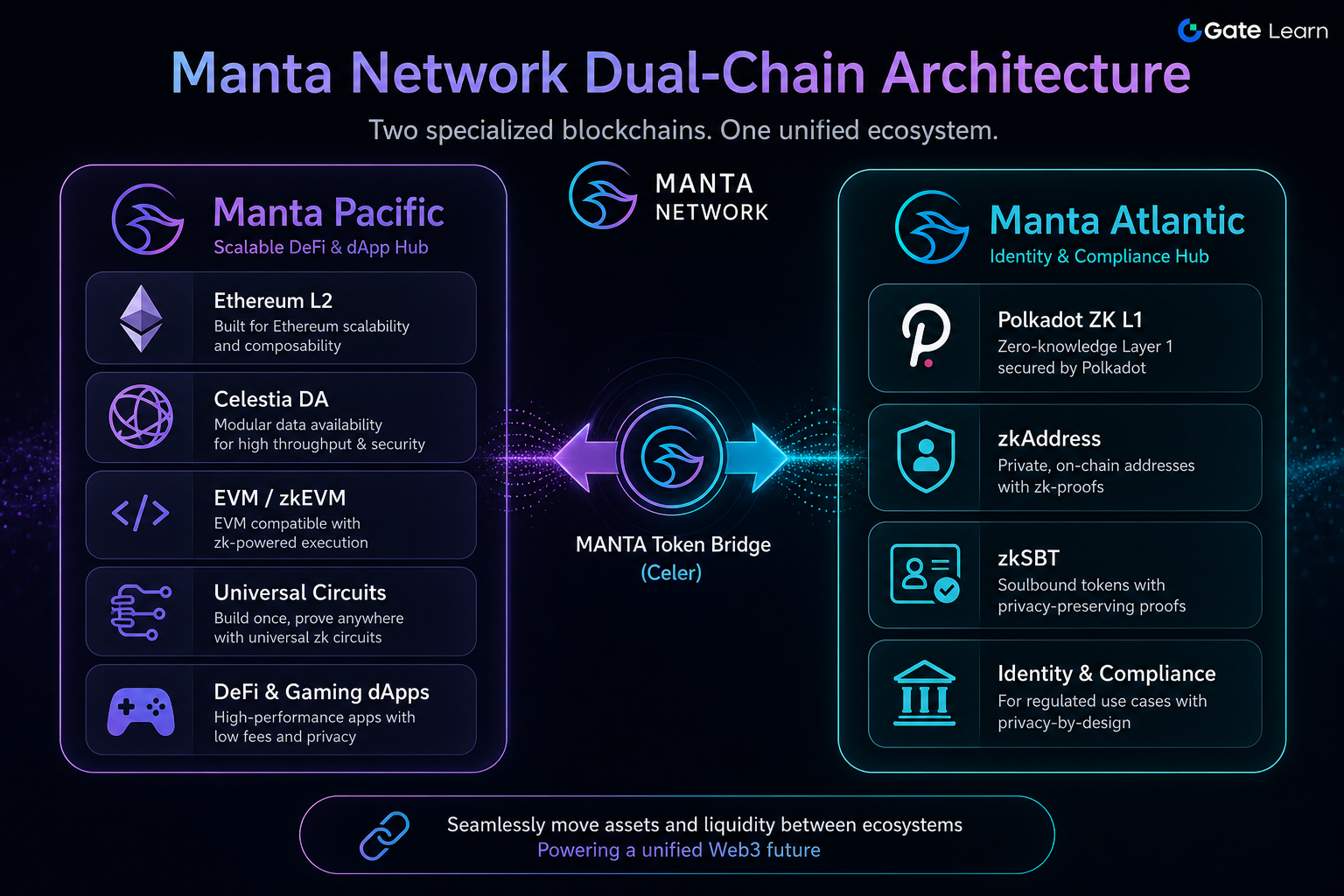 Figure 1. Manta Pacific (Ethereum modular L2) and Manta Atlantic (Polkadot ZK L1) architecture division connected via MANTA token bridge.
Pacific has technical dependencies on Celestia, Polygon zkEVM, and the Ethereum settlement layer; Atlantic's interoperability is constrained by the Polkadot parachain architecture. Cross-chain circulation of MANTA between the two chains depends on the security and liquidity of the Celer bridge. These dependencies constitute structural characteristics of the dual-chain architecture: Pacific is responsible for application execution scaling, Atlantic is responsible for identity credential anchoring, and the two chains share MANTA liquidity through the Celer bridge.
How Do Privacy and ZK Capabilities Differ?
The difference in zero-knowledge capabilities between Pacific and Atlantic manifests as two technical paths: "application-layer ZK integration" (Pacific) and "identity-layer ZK credentials" (Atlantic). Pacific provides a ZK-as-a-Service development library for Solidity developers via Universal Circuits, enabling contracts to call pre-built ZK circuits, supporting scenarios such as compliant privacy payments, identity verification, and zkShuffle; Universal Circuits 2.0 introduces proof aggregation, reducing on-chain verification gas and increasing throughput.
Atlantic's ZK capabilities are concentrated in the identity and credential layer. zkAddress uses UTXO-style private addresses, running in parallel with public accounts, allowing users to selectively disclose specific credentials using Prove Key without revealing their full identity profile. zkSBT, as a non-transferable on-chain credential, supports decentralized KYC verification, where verifiers only learn the eligibility conclusion rather than sensitive personal information. The Atlantic identity layer enables other Polkadot ecosystem projects to integrate interoperable identities without needing to build a complete ZK identity protocol stack.
The Pacific application layer also supports zkSBT compliance verification, achieving coordination between the two chains on credential standards: Atlantic serves as the underlying anchor for identities and credentials, while Pacific serves as the platform for application execution and ZK functionality integration. Developers who need to embed ZK payment or shuffling logic into a dApp should target Pacific and Universal Circuits; those who need to build on-chain compliant identity or KYC credential systems should target Atlantic and the zkAddress and zkSBT mechanisms.
Which Chain Should Developers and Users Choose?
Pacific targets Ethereum ecosystem developers and general dApp users. Developers can migrate or create contracts in an EVM-compatible environment and call zero-knowledge functions via the Universal Circuits SDK without needing to deeply learn dedicated ZK languages like Cairo or Noir. Typical scenarios include DeFi protocol deployment, on-chain games (zkShuffle shuffling), social applications, and compliant privacy payments. Users participating in the Pacific ecosystem typically need to prepare ETH as gas and bridge assets to the Pacific network.
Atlantic targets project parties, institutions, and users who require on-chain compliant identities. Project parties can integrate the zkSBT credential standard, while users manage privacy identities via zkAddress and disclose credentials on demand. Operations on the Atlantic side revolve around credential minting, Prove Key disclosure, and verification requests; network governance and collator delegation must be paid in MANTA. Pacific focuses on application execution and ZK function calls, while Atlantic focuses on identity establishment and compliance verification; the operation flows and gas tokens differ between the two chains.
At a Glance: Core Differences Between Pacific and Atlantic
The table below summarizes the core differences between Manta Pacific and Manta Atlantic across eight dimensions for quick comparison of the two chains' positioning and technical characteristics.
| Comparison Dimension |
Manta Pacific |
Manta Atlantic |
| Underlying Ecosystem |
Ethereum |
Polkadot |
| Network Type |
Modular Layer 2 (L2) |
ZK Layer 1 (L1) |
| Core Function |
ZK application deployment and modular scaling |
On-chain compliant identity and credential infrastructure |
| Gas Token |
ETH |
MANTA |
| Key Technologies |
Celestia DA, zkEVM, Universal Circuits, Fast Finality |
zkAddress, zkSBT, Collator network |
| Development Focus |
Solidity contracts + ZK circuit integration |
Identity credential standards + private address management |
| Typical Users |
dApp developers, DeFi/gaming users |
Identity project parties, KYC compliance users |
| MANTA Use Cases |
Governance, ecosystem incentives, Restaking for fast finality |
Gas, governance, collator staking, zkSBT purchases |
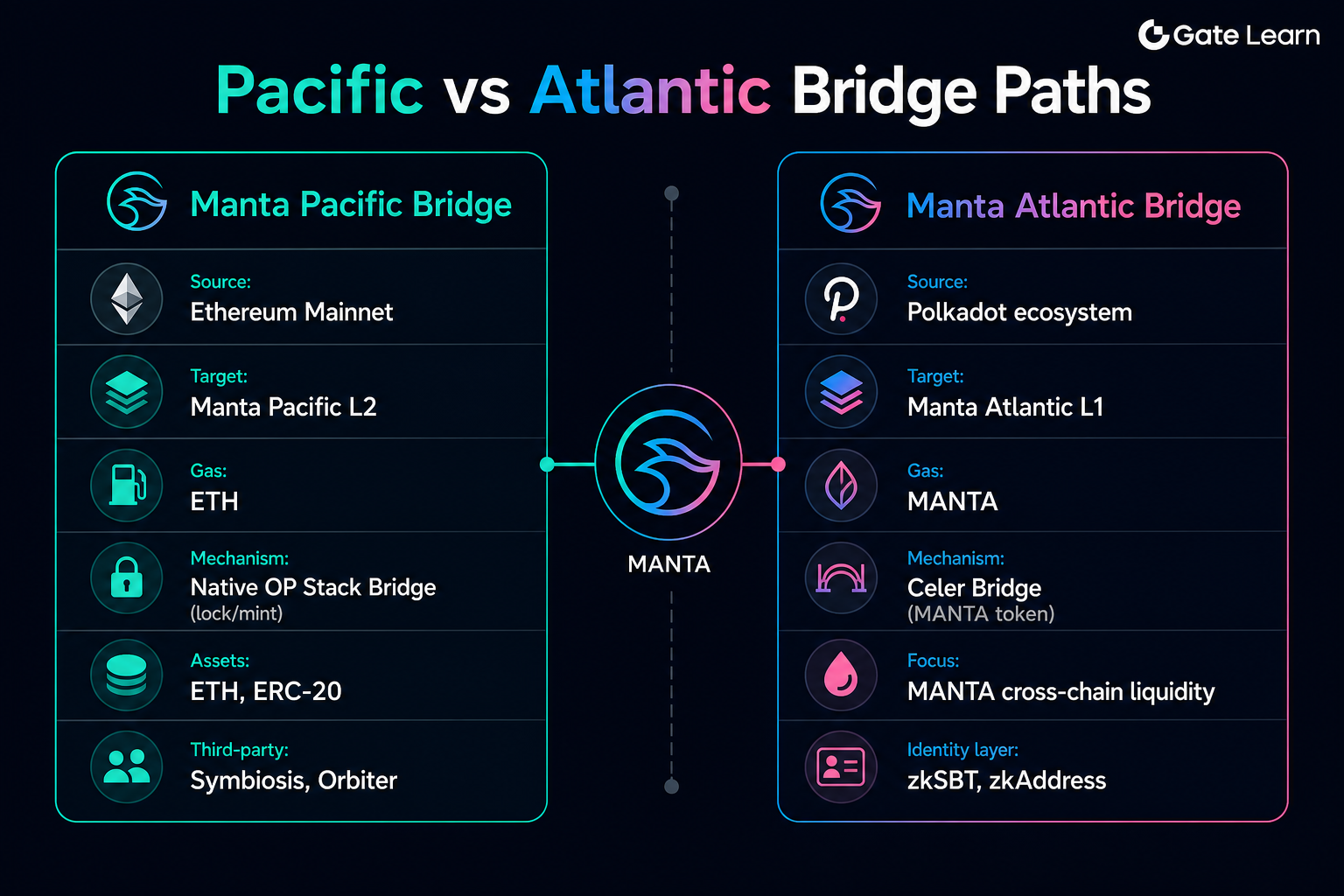 Figure 2. Side-by-side comparison of Manta Pacific and Manta Atlantic across ecosystem, layer type, gas token, and core focus.
The table comparison shows that Pacific and Atlantic are not two modes of the same network, but two independent chains addressing different problem domains. Choosing Pacific or Atlantic depends on the participation goal: application deployment and ZK functionality integration point to Pacific; compliant identity and credential construction point to Atlantic. The two chains achieve ecosystem coordination through the MANTA cross-chain bridge and shared token economics, but their tech stacks, gas mechanisms, and user paths must be understood separately.
Summary
Manta Pacific and Manta Atlantic form the complementary structure of the Manta Network dual-chain ecosystem: Pacific, as an Ethereum modular L2, uses Celestia DA, zkEVM, and Universal Circuits to host ZK application deployment; Atlantic, as a Polkadot ZK L1, uses zkAddress and zkSBT to host on-chain compliant identities. Gas denomination (ETH vs. MANTA), technical focus (application execution vs. identity credentials), and target users (developers/dApp users vs. identity/KYC users) constitute the three most significant differences between the two chains. Understanding this division helps in selecting the correct participation path and tech stack within the Manta Network ecosystem.
FAQ
What is the core difference between Manta Pacific and Manta Atlantic?
Manta Pacific is an Ethereum ecosystem modular L2 focused on ZK decentralized application deployment, with gas paid in ETH and core technologies including Celestia DA, zkEVM, and Universal Circuits. Manta Atlantic is a Polkadot ecosystem ZK L1 focused on on-chain compliant identities, with network fees paid in MANTA and core technologies including zkAddress and zkSBT.
Why are the gas tokens different between the two chains?
Manta Pacific is deployed on the Ethereum ecosystem, where network gas is denominated in ETH, consistent with Ethereum L2 conventions. Manta Atlantic, as an independent L1, denominates network fees in MANTA, its native functional token, which also serves functions such as governance, collator staking, and zkSBT purchases.
Which chain does Universal Circuits belong to?
Universal Circuits is the ZK-as-a-Service development library of Manta Pacific, enabling Solidity developers to call pre-built ZK circuits in Pacific contracts. Atlantic does not provide Universal Circuits; Atlantic's ZK capabilities are concentrated in the zkAddress and zkSBT identity credential layer.
Which chain do zkAddress and zkSBT belong to?
The core implementation and credential standards of zkAddress and zkSBT are anchored on Manta Atlantic. Atlantic provides UTXO-style private addresses and non-transferable on-chain credentials, supporting selective disclosure and decentralized KYC verification. The Pacific application layer can integrate zkSBT compliance verification, coordinating with the Atlantic identity layer on credential standards.
How do the two chains connect via MANTA?
Manta Pacific and Manta Atlantic connect via the Celer bridge for cross-chain locking and unlocking of MANTA, sharing a genesis total of 1 billion tokens. Cross-chain movement affects the total MANTA circulating supply, but each chain independently maintains its own block production, consensus, and security model.
How should developers choose between Pacific or Atlantic?
When deploying ZK decentralized applications on the Ethereum ecosystem, calling Universal Circuits, or participating in DeFi/gaming scenarios, target Manta Pacific. When building on-chain compliant identities, issuing zkSBT credentials, or managing zkAddress privacy identities, target Manta Atlantic. The two chains have complementary functions and can be used separately or in combination based on project needs.







