Over the past few decades, the global hotel industry has gradually shifted toward an asset-light model. Hotel groups are responsible for brands, operating standards, and customer resources, while real estate investors and hotel owners handle property development and asset ownership. This division of roles allows Marriott to keep expanding its global business scale with relatively low capital investment, making it one of the most representative companies in the global hotel industry.
Marriott International is headquartered in Maryland, United States, and is one of the world’s largest hotel groups. The company owns a wide range of brands covering luxury hotels, premium hotels, select-service hotels, extended-stay hotels, and more. Through its global operating network, it serves both business travel and leisure travel markets.
Unlike traditional real estate companies, Marriott (MAR) does not focus on holding a large portfolio of properties. Instead, it operates a hotel ecosystem through management and licensing models. As a result, MAR’s business performance is usually closely tied to global travel activity, business travel demand, and broader trends in the hotel industry.
What Are Marriott International’s Revenue Sources?
Marriott International has relatively diverse revenue sources, but its core business still revolves around the hotel operating ecosystem.
The company does not depend on sales from individual hotel rooms alone. Instead, it earns revenue through management fees, franchise fees, brand licensing income, and membership ecosystem related businesses. As its global hotel network continues to expand, Marriott’s revenue sources have gradually developed economies of scale.
Overall, Marriott’s revenue structure mainly includes the following areas:
| Revenue Source |
Main Content |
| Hotel management fees |
Providing operating and management services to hotel owners |
| Franchise and brand licensing fees |
Granting brand usage rights and collecting fees |
| Incentive management fees |
Linked to hotel operating performance |
| Membership ecosystem and partnership revenue |
Loyalty program and partner businesses |
| Owned and leased hotel revenue |
A small amount of directly operated hotel business |
This revenue structure allows Marriott to benefit from both the growth in hotel count and the expansion of the overall travel market.
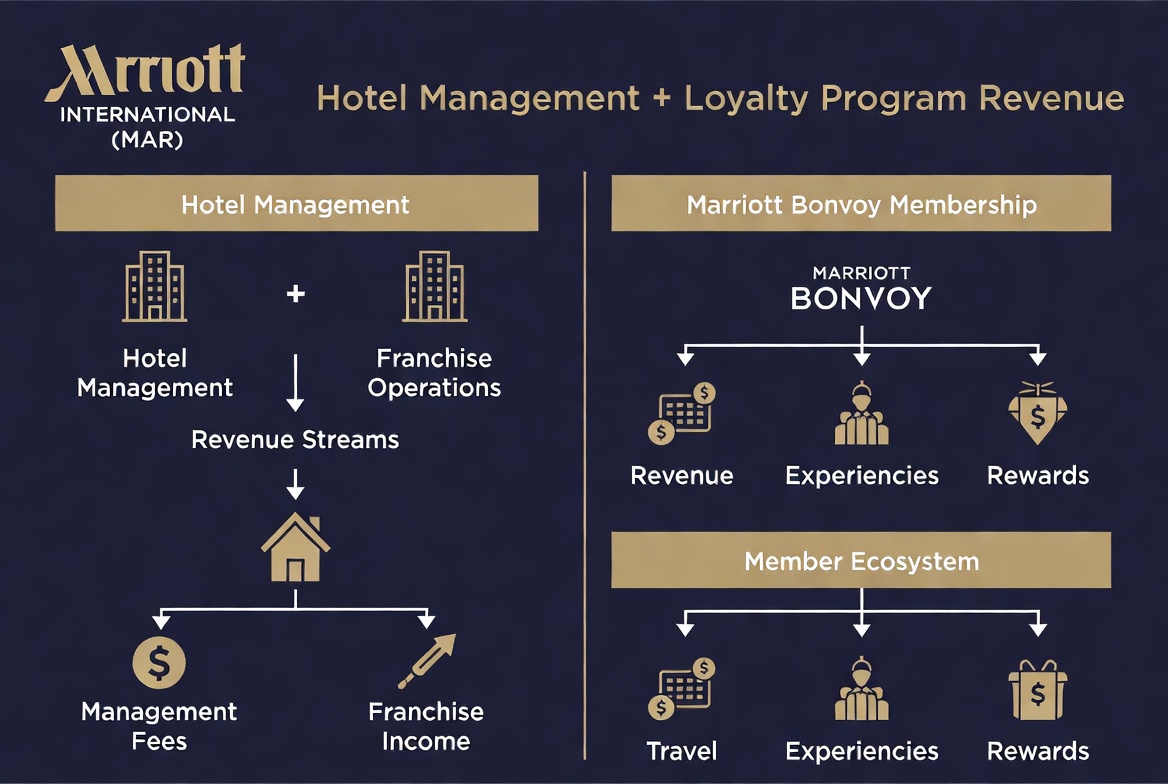
How the Hotel Management Business Generates Revenue
Hotel management is one of Marriott’s most important revenue sources.
Under the management contract model, hotel owners are responsible for investing in and developing hotel properties, while also bearing real estate related costs. Marriott provides hotels with brand standards, operating systems, staff training, marketing support, and access to its global reservation platform.
Once a hotel officially begins operations, Marriott usually collects management fees based on a certain percentage of the hotel’s revenue or operating profit. Some contracts also include an incentive management fee mechanism, allowing Marriott to earn additional income when a hotel meets preset operating targets.
The advantage of this model is that Marriott can earn recurring income through its management expertise and brand influence without taking on large real estate development and ownership costs. As a result, even when global economic conditions change, management fee revenue is usually relatively stable.
How Brand Licensing and Franchising Contribute to Growth
In addition to management contracts, franchising is also an important way for Marriott to expand.
Under the franchise model, hotel owners receive authorization to use Marriott brands and operate hotels according to the service standards set by the group. Marriott provides brand support, reservation systems, marketing, and quality management services, while day-to-day operations are handled by the owners.
For hotel owners, joining an international brand can improve market recognition and occupancy rates. For Marriott, it allows the company to rapidly expand its global network at lower cost.
As the number of hotels continues to grow, brand licensing revenue also becomes a source of sustained growth. Because the franchise model requires relatively low capital investment, it usually has higher profit margins and has become a development strategy widely used by large global hotel groups.
How Marriott Bonvoy Increases User Value
Marriott Bonvoy is not only a loyalty program, but also an important part of Marriott’s ecosystem.
Through points rewards, membership tiers, and cross-brand benefits, Marriott can connect hotels across different countries and regions into a unified user network. Members earn points when they stay at hotels and can redeem them for stays, room upgrades, and other partner services.
For consumers, the membership system increases long-term usage value. For Marriott, it helps improve customer retention and repeat purchase rates.
In addition, Marriott Bonvoy has built broad partnerships with airlines, credit card institutions, travel service platforms, and other partners. These partnerships not only expand the scope of member benefits, but also further strengthen the commercial value of the entire ecosystem.
As the membership base continues to grow, the membership ecosystem has become one of Marriott’s most important long-term competitive advantages.
Why the Asset-Light Model Strengthens Profitability
The asset-light model is one of the most important business innovations in the modern hotel industry.
Traditional hotel companies often need large amounts of capital to purchase land, build properties, and maintain assets, which limits the pace of expansion. The asset-light model separates property investment from hotel operations, allowing hotel groups to focus on building brand and management capabilities.
For Marriott, the asset-light model brings several advantages.
First, capital expenditure is significantly reduced, allowing the company to invest more resources in digital platforms, brand building, and membership ecosystem development. Second, expansion is faster because new hotels mainly rely on owner investment rather than the group’s own capital. Finally, management fee and franchise fee income usually has relatively high profit margins, helping improve overall profitability.
For these reasons, the asset-light model has become a common development direction for large global hotel groups, and Marriott is one of the most successful practitioners of this model.
How to Buy MAR (Marriott International) Stock
MAR is the ticker symbol under which Marriott International trades on the Nasdaq Stock Market in the United States.
Traditionally, investors can buy MAR stock through brokerage accounts that support U.S. stock trading, thereby participating in the development of the global hotel and travel industry. Because Marriott International’s business is closely related to business travel, international tourism, and consumer activity, MAR is also regarded as one of the key companies for observing the global travel industry.
As the digital asset market and traditional financial markets gradually become more integrated, more trading tools linked to stock price movements have also appeared in the market. For example, some platforms offer CFD products tied to stock prices, allowing users to participate in price movements without directly holding the underlying shares.
Taking Gate TradFi as an example, users can follow different markets within the same ecosystem, including digital assets, stocks, ETFs, indices, and commodities. Some markets also offer Gate CFD products, providing more options for cross-market asset allocation and price observation.
Regardless of how investors choose to participate in the market, they should fully understand the product structure, trading rules, and regulatory requirements in their region.
Conclusion
Marriott International’s business model is built on hotel management, brand licensing, and its membership ecosystem. Through an asset-light operating model, Marriott can expand its global hotel network without holding a large number of properties, while continuing to earn management fee and franchise fee income. At the same time, the Marriott Bonvoy membership system further strengthens customer loyalty and helps the company build a long-term competitive advantage across the global lodging market.
FAQs
How does Marriott International mainly make money?
Marriott International mainly earns revenue through hotel management fees, brand licensing fees, franchise fees, and membership ecosystem related businesses.
Does Marriott own all of its hotels?
No. Most Marriott-branded hotels are owned by independent owners, while Marriott is mainly responsible for brand and operational management.
What is an asset-light hotel model?
An asset-light model means that a hotel group does not hold a large number of properties, but instead operates a hotel network through management and licensing.
How does Marriott Bonvoy help the company create value?
Marriott Bonvoy can improve customer retention, increase repeat purchase rates, and expand commercial value through its partner ecosystem.
Why is the franchise model beneficial to Marriott’s expansion?
The franchise model reduces capital investment requirements, allowing Marriott to quickly expand its hotel network through brand licensing.
How is Marriott International different from a real estate company?
Real estate companies mainly rely on property investment and rental income, while Marriott mainly relies on hotel management and brand operation revenue.