For developers, both options can be used to build AI applications, but there are clear differences in data control, inference workflows, trustworthiness, and suitable use cases. Understanding these differences helps in selecting the most appropriate AI infrastructure for specific business needs.
What Is Nesa?
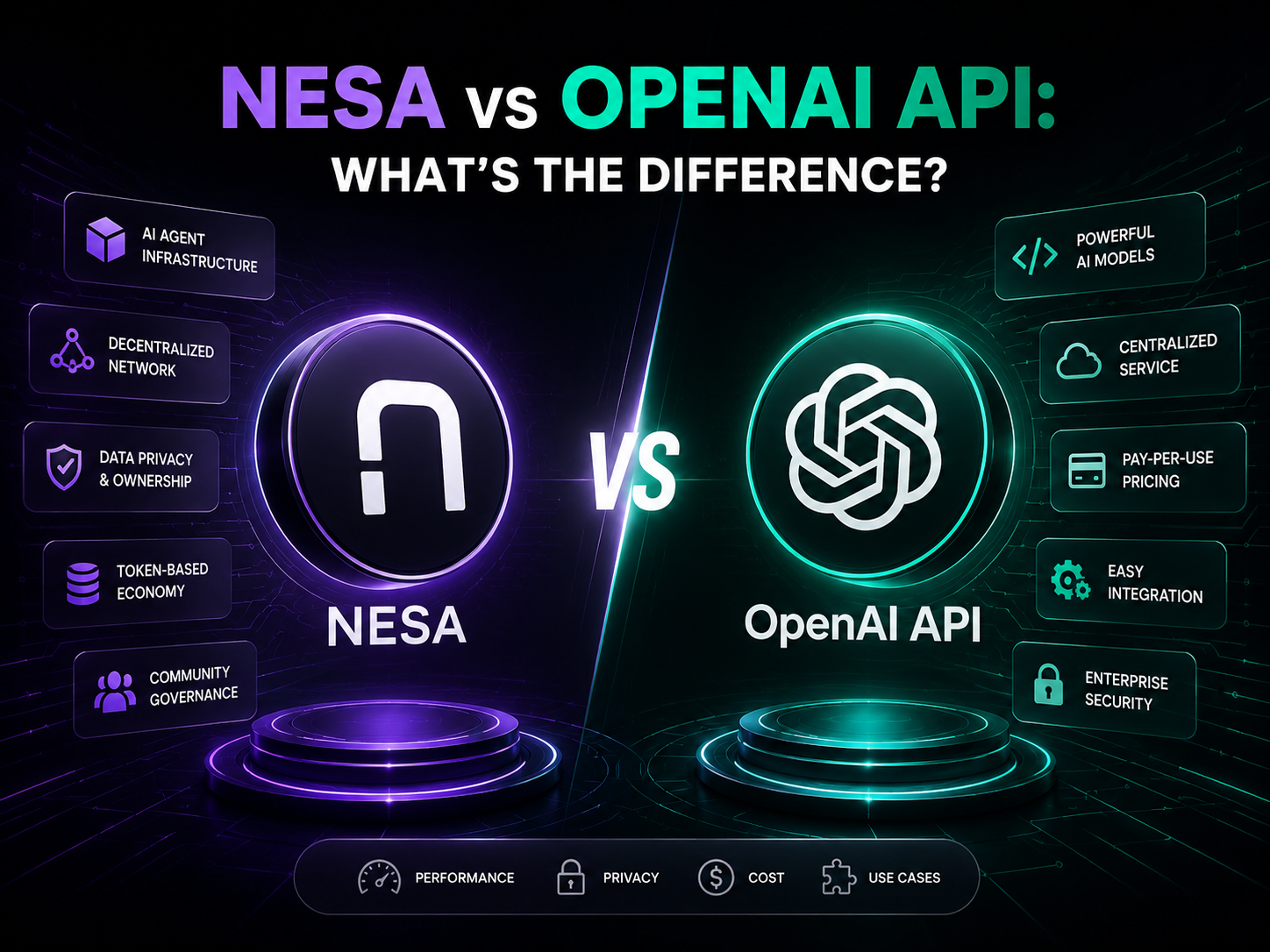
Nesa is a decentralized execution network designed for privacy-preserving and verifiable AI. Its core objective is to perform AI inference within an open network and enhance data security and result trustworthiness using cryptographic mechanisms.
Unlike platforms that primarily offer AI model capabilities, Nesa focuses more on how AI is executed. According to official sources, Nesa leverages technologies such as Equivariant Encryption (EE), HSS-EE, and the MetaInf scheduling system to enable distributed AI inference and result verification.
Within the Nesa network, developers can deploy models or access AI services, while the network handles task scheduling, node execution, and result verification, thereby minimizing reliance on any single service provider.
What Is the OpenAI API?
The OpenAI API is a centralized AI service interface provided by OpenAI. Developers can call on models like GPT, Embeddings, and image generation via the API without needing to deploy models or manage the underlying infrastructure themselves.
OpenAI handles everything from model training and inference services to resource scheduling and platform operations. Developers simply send requests and receive results, allowing them to quickly integrate AI capabilities.
This model offers the advantages of easy integration, mature models, and a robust ecosystem, making it widely used in chatbots, content generation, code assistants, and enterprise AI products.
How Do the Two Architectures Differ?
The core difference between Nesa and the OpenAI API lies in how AI inference tasks are executed and how the underlying infrastructure is designed.
The OpenAI API uses a centralized cloud architecture where OpenAI controls model deployment, inference execution, and resource management. Developers access models through a unified interface without having to manage any underlying computing resources.
Nesa, on the other hand, employs a decentralized network architecture. AI inference tasks are executed collaboratively by multiple nodes, with the MetaInf scheduling system allocating tasks and a verification layer confirming the results, creating a more open AI execution environment.
| Comparison Dimension |
Nesa |
OpenAI API |
| Architecture Model |
Decentralized Execution Network |
Centralized Cloud Service |
| Inference Method |
Distributed Node Execution |
OpenAI Data Center Execution |
| Scheduling Method |
MetaInf Network Scheduling |
Unified by OpenAI Platform |
| Execution Verification |
Supports Result Verification |
Platform Handles Result Delivery |
The two architectures are designed for different needs. Neither is inherently superior; rather, each emphasizes different aspects in terms of data security, deployment methods, and operational models.
Who Controls the Data?
Nesa places greater emphasis on developers' and users' control over data.
In the Nesa network, the official introduction of private inference and encrypted computing mechanisms aims to reduce the risk of exposing input data and model parameters to any single node. For sensitive scenarios such as healthcare, finance, or enterprise knowledge bases, this design provides stronger data protection.
The OpenAI API offers a unified model service managed by OpenAI. Developers submit requests following platform specifications and receive inference results through the official interface, with the data processing workflow managed primarily by the platform.
Therefore, in business scenarios requiring greater data autonomy, Nesa is the more distinctive option. For applications that prioritize rapid development and a mature model ecosystem, the OpenAI API is generally the better fit.
How Is Result Trustworthiness Ensured?
Nesa makes result trustworthiness a fundamental part of its network design.
After inference is complete, Nesa not only returns the inference results but also uses verification mechanisms to confirm that the entire execution process complies with network rules. This design reduces the impact of erroneous computations or malicious nodes on inference results, improving the transparency of AI services.
The trustworthiness of the OpenAI API comes primarily from OpenAI's platform capabilities and infrastructure management. Developers typically trust the results returned directly by the platform without needing to verify the inference process.
Thus, for applications requiring auditable AI or trusted computing, Nesa offers stronger verification capabilities. For most general AI applications, the centralized service model of the OpenAI API is sufficient.
Which Applications Are Best Suited to Each?
Nesa is better suited for AI applications requiring privacy protection, trusted execution, and open networks.
Examples include enterprise knowledge bases, financial risk control, medical data analysis, on-chain AI applications, and AI agents—all of which can benefit from private inference and result verification.
The OpenAI API is more appropriate for applications that need to quickly integrate mature AI models, such as intelligent customer service, content generation, office assistants, code development, search enhancement, and enterprise automation.
| Scenario |
Better for Nesa |
Better for OpenAI API |
| Enterprise Sensitive Data Processing |
✓ |
|
| AI Agent Execution Environment |
✓ |
✓ |
| On-Chain AI Applications |
✓ |
|
| Content Generation |
|
✓ |
| Intelligent Customer Service |
|
✓ |
| Rapid Product Development |
|
✓ |
Developers can choose between the two based on data security requirements, deployment models, and business goals, or combine both services to build a hybrid AI architecture.
Summary
Nesa and the OpenAI API represent two distinct approaches: a decentralized AI execution network and a centralized AI service platform, respectively. The former focuses on private inference, result verification, and open networks, while the latter relies on mature cloud infrastructure to deliver stable, high-performance AI model services.
As AI applications continue to evolve, different businesses have varying needs for data control, trusted computing, and development efficiency. Understanding the differences between these two service models helps developers select the most suitable AI infrastructure for their specific use cases.
FAQ
What Is the Main Difference Between Nesa and the OpenAI API?
The primary difference lies in their service architecture. Nesa uses a decentralized execution network with result verification, while the OpenAI API uses a centralized cloud service model where OpenAI manages model operation and resources.
Can Nesa Replace the OpenAI API?
Nesa may not serve as a direct replacement for the OpenAI API. Nesa is better suited for scenarios requiring privacy protection and trusted execution, whereas the OpenAI API excels when you need to quickly call mature AI models. The two can be used separately or together depending on business requirements.
Why Does Nesa Emphasize Private Inference?
Nesa emphasizes private inference to reduce the exposure of sensitive data during AI inference and to give enterprises and developers greater control over their data.
Does the OpenAI API Support Decentralized Inference?
No, the OpenAI API does not support decentralized inference architecture. Model inference is performed by OpenAI's centralized infrastructure, with developers accessing capabilities through the official API.
Which Applications Are Best for Nesa?
Enterprise knowledge bases, financial risk control, medical data processing, on-chain AI applications, and any business requiring verifiable AI are well-suited for development using Nesa's decentralized execution capabilities.







