As the television industry shifts toward digital platforms, the subscription economy has become a pivotal business model for streaming services. Netflix connects directly with consumers, leveraging stable membership income to fund content production while enhancing user value through personalized recommendations, data analytics, and global distribution. Unlike the traditional film and television sector—which relies on box office revenue, TV licensing, and advertising—Netflix’s approach is rooted in long-term user relationships and sophisticated digital operations.
From an industry perspective, Netflix’s business model is in constant evolution. The introduction of ad-supported plans, AI-driven applications, localized content production, and new ventures such as gaming are transforming Netflix from a single-streaming platform into a comprehensive entertainment ecosystem. Going forward, competition in the streaming industry will shift from user acquisition to content efficiency, commercialization, and technological innovation.
How Netflix’s Subscription Model Works
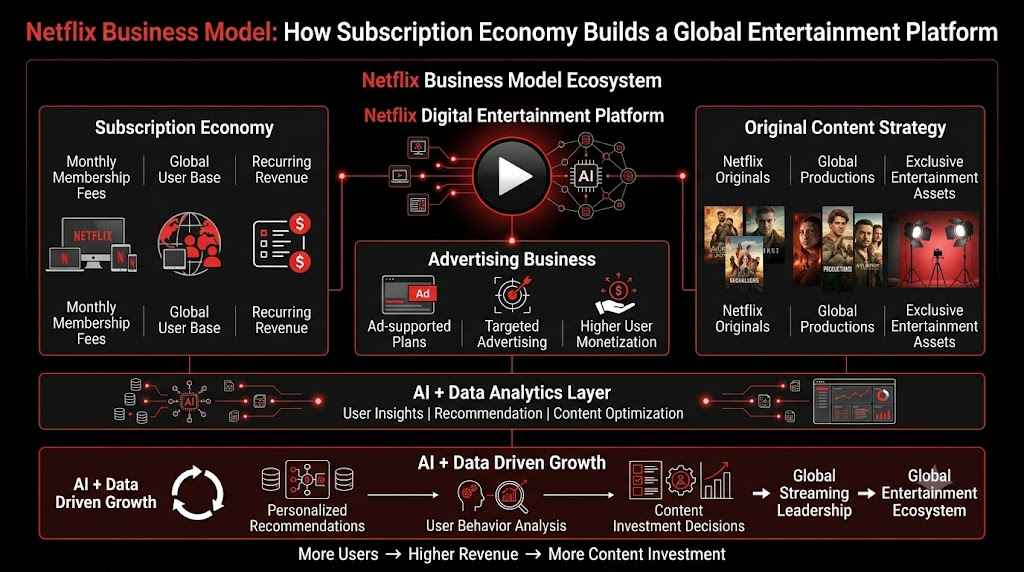
Netflix’s core business model is a membership-based streaming service. Users pay a fixed fee to access a wide range of digital content—including movies, TV series, documentaries, and reality shows—while Netflix secures steady revenue by consistently delivering content value.
Unlike traditional film and television, Netflix doesn’t depend on the box office performance of individual titles. Instead, revenue accumulates through ongoing membership relationships. Users pay monthly subscription fees, which the platform reinvests in content creation, technology R&D, and global expansion.
Netflix typically offers multiple subscription plans tailored to different markets, varying in price, video quality, and device access. This tiered approach allows Netflix to reach users with diverse spending power and boosts market penetration.
For price-sensitive users, lower-cost plans reduce entry barriers; for heavy media consumers, premium plans provide an enhanced viewing experience. This pricing strategy drives user growth across regions with different economic profiles.
The greatest advantage of the subscription model lies in revenue stability. Compared to ad-supported models, which can be impacted by economic cycles, membership subscriptions deliver predictable cash flow, enabling Netflix to invest in content for the long term.
At the same time, the subscription economy elevates the importance of user experience. Because users can cancel at any time, Netflix must continually provide high-quality content, increase platform engagement, and minimize churn.
Netflix’s business model isn’t simply about selling content; it’s about building enduring digital entertainment relationships through continuous content updates, optimized viewing experiences, and enhanced user loyalty.
Why Ad-Supported Plans Are Driving New Growth
As the global streaming market matures, growth driven solely by new subscribers is increasingly challenging. To expand its revenue streams, Netflix has introduced ad-supported plans.
Historically, Netflix maintained an ad-free model to distinguish itself from traditional television. However, as competition intensified and subscriber growth slowed, advertising emerged as a key strategic pivot.
Ad-supported plans are designed for users seeking lower subscription costs. By offering budget-friendly options, Netflix can attract previously untapped consumers and scale its user base.
For Netflix, the ad model delivers not only additional revenue, but also broader user reach. Some users may start with ad-supported plans and upgrade to premium memberships as their habits evolve.
Advertising is reshaping Netflix’s commercial logic. Where the platform once focused solely on subscription revenue per user, it now aims to maximize user value through both subscription and advertising income.
AI and data analytics are integral to the advertising business. By analyzing user interests and viewing patterns, Netflix enables advertisers to target audiences more precisely and improve ad effectiveness.
However, the ad-supported model introduces new challenges. Netflix must balance commercialization with user experience, ensuring ads don’t disrupt viewing.
How Netflix Boosts User Retention
User retention is the foundation of long-term value in the subscription economy. For Netflix, keeping users subscribed is critical to business success.
Netflix’s retention strategy centers on three pillars: content refresh, personalized recommendations, and user experience optimization.
Content is the primary driver of retention. The competitive edge for streaming platforms isn’t the sheer volume of titles, but the ability to consistently deliver compelling new content.
Netflix invests heavily in original series, films, and documentaries each year, aiming to make exclusive content indispensable to users.
Personalized recommendation algorithms are another key tool. By analyzing viewing history, Netflix surfaces tailored content for each user.
When users easily find content they enjoy, they’re more likely to develop lasting viewing habits. Compared to traditional TV’s fixed schedules, Netflix’s recommendation engine aligns with digital-era consumption.
Netflix continuously enhances the product experience, offering cross-device synchronization, offline downloads, multilingual subtitles, and intelligent search.
These features lower the barrier to entry, positioning Netflix as a daily entertainment gateway rather than just a viewing tool.
Advancing Netflix’s Global Content Localization Strategy
Netflix’s global growth is anchored in its localized content strategy.
While the early streaming market focused on North America, Netflix quickly realized that global expansion required locally produced content tailored to regional cultures.
In recent years, Netflix has increased investment in markets such as Korea, Japan, Europe, and Latin America. Korean productions, for instance, have gained worldwide exposure through Netflix, proving that local content can transcend language barriers and become international hits.
This approach differs from traditional Hollywood distribution, which typically produces English-language content for overseas release. Netflix develops content simultaneously in multiple regions and leverages its global platform for distribution.
Localization not only attracts new users, but also enhances the value of content assets. Successful regional productions can generate greater commercial returns through global distribution.
Netflix uses data analytics to assess content preferences in each market and optimize investment decisions.
Going forward, global local content production will remain a key competitive advantage for Netflix and other streaming platforms.
Why Original Content Is Netflix’s Core Competitive Strength
Original content is essential to Netflix’s long-term competitive moat. Initially, Netflix relied on licensed content to attract users, but as competitors proliferated and licensing costs soared, the company ramped up investment in original productions.
Original content offers several key benefits:
-
Netflix retains long-term control over its content, reducing reliance on third-party licenses.
-
Hit originals build brand equity. Globally popular series drive short-term viewership and strengthen brand recognition.
-
Original content enables Netflix to differentiate itself in diverse markets.
However, investing in original content carries cost pressures. Film and TV production is inherently uncertain, and large-scale investment doesn’t guarantee success. Netflix leverages data analytics and market feedback to optimize investment efficiency, balancing scale with profitability.
How Netflix Balances Content Investment and Profitability
Content investment is central to Netflix’s competitive strategy, but controlling costs and maximizing returns are critical for sustained growth.
Streaming is an asset-heavy industry. Platforms must invest in content acquisition, original production, technology infrastructure, marketing, and global operations.
Netflix has increased content investment in recent years, driving user growth with original productions. As the industry matures, focus is shifting from scale to quality of earnings.
To improve efficiency, Netflix prioritizes project ROE over sheer content volume, evaluating content value based on viewership, user growth, and retention metrics.
For example, a hit series delivers value not just through viewership, but by attracting new users, reducing churn, and fostering long-term retention.
Netflix is refining its production strategy, emphasizing high-quality content and projects with global appeal.
AI and data analytics play an expanding role. By analyzing user interests, market trends, and content performance, Netflix can target investments more accurately and reduce risk.
Advertising also opens new profit avenues. Combining subscription and ad revenue may boost per-user income and reduce reliance on a single business model.
Long term, Netflix must balance content investment and profit growth dynamically. Under-investment can harm user experience, while over-investment can erode profitability. Cost efficiency will be a future focal point for competition.
How Netflix’s Business Model Differs from Disney and Amazon Prime Video
Netflix, Disney+, and Amazon Prime Video represent three distinct approaches in the global streaming landscape.
Netflix’s core strengths are digital operations and a global content ecosystem. The company connects directly with consumers via subscriptions and uses user data to optimize recommendations, content investment, and market expansion.
The Walt Disney Company’s business model is built on decades of entertainment asset accumulation.
Disney+ leverages powerful IP—including Marvel, Star Wars, Pixar, and classic animation—to quickly attract families and fan communities.
Disney+ emphasizes content asset value, forming an entertainment ecosystem through film, theme parks, and merchandise.
Amazon Prime Video benefits from Amazon’s broader ecosystem.
Amazon doesn’t rely solely on video profitability, but uses Prime membership to enhance overall user value. Prime Video integrates with e-commerce, cloud computing, and logistics, making video part of the membership package.
Netflix, by contrast, is focused on entertainment content itself.
In summary:
- Netflix: subscription revenue + original content + data-driven recommendations
- Disney+: IP assets + entertainment ecosystem + brand influence
- Amazon Prime Video: membership ecosystem + multi-business synergy
Future competition will be less about content volume and more about efficiently connecting users, content, and commercial value.
Streaming Industry Trends
The streaming industry is entering a new phase, with competition centered on business model innovation, AI applications, and content efficiency.
-
Ad-supported models are poised to become a major trend.
As subscriber growth slows, platforms are exploring ad plans to diversify revenue. Ads help platforms reach more consumers and increase per-user value.
-
AI will further transform streaming operations.
AI optimizes recommendations and supports content analysis, subtitle translation, market forecasting, and ad targeting. Future user interactions may be more intelligent, with users describing needs in natural language and AI curating personalized content.
-
Localized content competition will intensify.
Global audiences increasingly embrace non-English content. Markets like Korea, Japan, and Spain have shown that outstanding local productions can become worldwide hits. Platforms will need global production capabilities, not just distribution.
-
Streaming platforms may evolve into comprehensive entertainment hubs.
Beyond film and TV, gaming, interactive entertainment, sports streaming, and virtual experiences are emerging growth areas. Netflix is already exploring gaming and sports, aiming to boost engagement and platform value.
Profitability will become a greater focus. Where streaming companies once traded high investment for user growth, markets will increasingly emphasize cash flow, margins, and content ROI.
Summary
Netflix’s business model centers on connecting global users through the subscription economy and building a long-term entertainment ecosystem powered by content, technology, and data.
From membership subscriptions to ad-supported plans, from original content investment to global localization, Netflix continually adapts its business model to meet industry changes.
Netflix’s greatest advantage is its digital operational capability. The platform leverages user data to understand consumer needs and amplifies content value through a global distribution network.
At the same time, Netflix faces challenges in content costs, market competition, and profitability. The company must find new balance among content quality, technological innovation, and commercialization efficiency.
With ongoing advances in AI, advertising technology, and global digital entertainment demand, Netflix remains positioned as a leader in streaming. Future competition will be defined not by content volume, but by the ability to intelligently and efficiently create and distribute entertainment value.
For investors and industry observers, Netflix’s evolution reflects the broader transformation of business models in the digital economy.