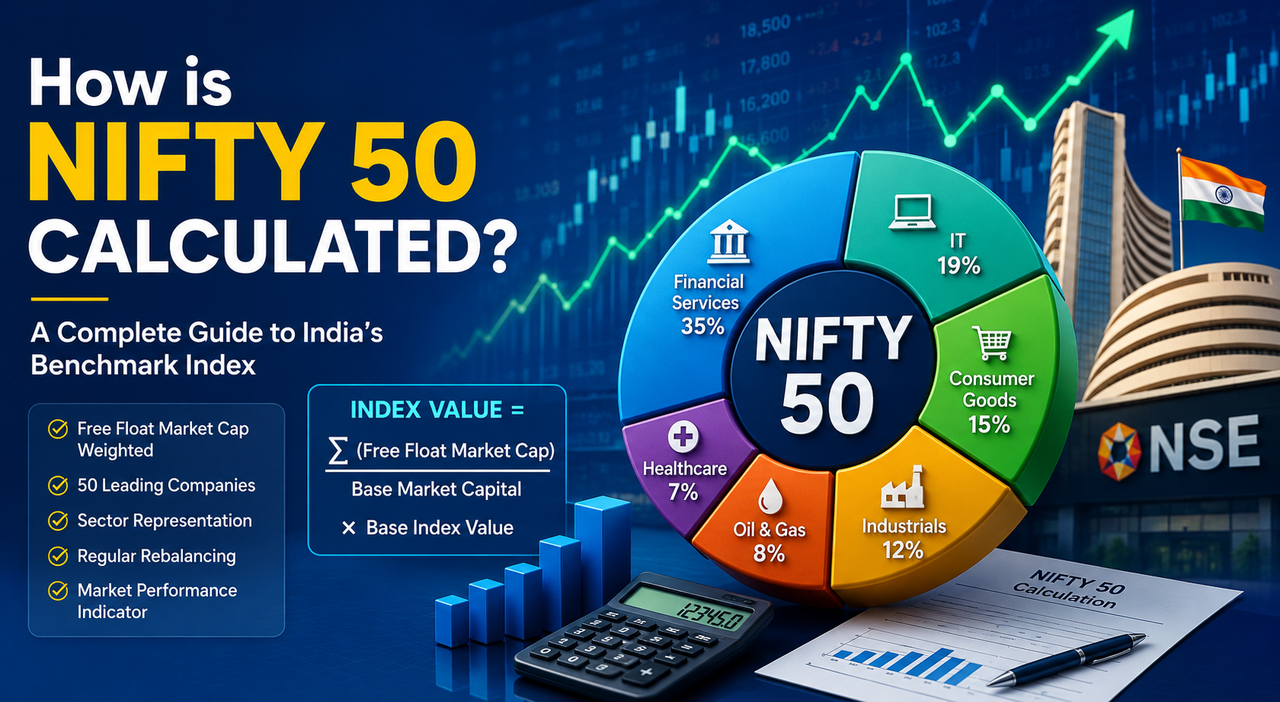
Because it uses a free float market capitalization weighted methodology, the financial and technology sectors have long held relatively high weights in the Nifty 50. Large companies such as HDFC Bank, Reliance Industries, Infosys, and TCS have a significant influence on the index’s movements.
In global financial markets, the Nifty 50 is regarded as one of India’s most representative blue chip stock indices. The ETF, index fund, and derivatives markets built around the index have also made it an important benchmark for international investment institutions allocating capital to Indian assets.
How Are Nifty 50 Constituents Selected?
The constituents of the Nifty 50 are regularly screened and adjusted by the index committee under the National Stock Exchange of India. Companies included in the index usually need to meet several core requirements:
Because the index uses a free float market capitalization weighted methodology, larger companies usually have higher weights in the index. Compared with selection based purely on stock price or total market capitalization, the free float mechanism more accurately reflects the actual scale of market trading.
In addition, the index committee reviews the constituents regularly. If some companies experience a decline in market capitalization or weakening trading activity, they may be removed from the index, while new large companies may be added.
Which Sectors Does the Nifty 50 Mainly Cover?
The sector structure of the Nifty 50 provides a fairly direct view of the core components of India’s economy. Financial services, information technology, and energy have long been the dominant sectors.
The financial sector carries a high weight mainly because India’s economy has long relied on banks and the broader financial system to support corporate financing and consumer growth. The information technology sector, meanwhile, reflects India’s important position in global software services and the digital economy.
At present, the Nifty 50 mainly covers the following sectors:
| Sector |
Representative companies |
Sector characteristics |
| Financial services |
HDFC Bank, ICICI Bank |
Highest weight, large capital scale |
| Information technology |
Infosys, TCS, Wipro |
Global software and outsourcing services |
| Energy |
Reliance Industries, ONGC |
Energy and industrial infrastructure |
| Consumer goods |
ITC, Hindustan Unilever |
Consumption upgrading and demographic dividend |
| Healthcare |
Sun Pharma, Dr. Reddy’s |
Global generics and healthcare industry |
| Industrial manufacturing |
Larsen & Toubro |
Infrastructure and engineering construction |
This multi sector structure allows the Nifty 50 to reduce single sector risk to some extent while maintaining representation of India’s core economic industries.
Why Does the Financial Sector Have the Highest Weight in the Nifty 50?
The financial sector has long been the most important component of the Nifty 50. During India’s economic growth, the banking system has taken on a major role in corporate financing, consumer lending, and infrastructure investment, which has helped large financial institutions continue to expand in market size.
Banks such as HDFC Bank, ICICI Bank, and State Bank of India have long ranked among the largest weights in the index, and their stock price movements often have a direct impact on the overall direction of the Nifty 50.
In addition, India’s rapidly developing digital payments and fintech industries in recent years have further increased the importance of the financial sector. As mobile payments, online lending, and digital banking become more widely adopted, the influence of financial services in India’s capital market continues to grow.
However, this high weighting also means that when the financial sector faces policy adjustments or an economic slowdown, the overall performance of the Nifty 50 may be noticeably affected.
Why Are Indian IT Companies Important to the Nifty 50?
Information technology is one of the most internationally oriented sectors in the Nifty 50. Companies such as Infosys, Tata Consultancy Services (TCS), and Wipro have long provided software development, digital transformation, and outsourcing services to global clients.
Because a large share of their revenue comes from overseas markets, Indian IT companies are strongly linked to global technology cycles. When companies in the United States and Europe increase digitalization spending, India’s IT industry usually benefits.
At the same time, the importance of IT companies in the Nifty 50 also reflects India’s economic shift from traditional manufacturing toward the digital economy.
In recent years, growing demand for artificial intelligence, cloud computing, and enterprise software has further increased global capital market attention on India’s technology sector.
Why Does Reliance Industries Have Such a Large Influence on the Index?
Reliance Industries is one of India’s largest companies by market capitalization and one of the most influential constituents in the Nifty 50.
Unlike traditional energy companies, Reliance operates across petrochemicals, energy, telecommunications, digital platforms, and consumer retail. Its business structure spans several core areas of the Indian economy.
After expanding its digital businesses in particular, Reliance is no longer viewed only as an energy company. It has gradually become an important representative of India’s digital economy. As a result, changes in its share price often have a significant impact on the overall performance of the Nifty 50.
Because of its high weighting, international investment institutions also tend to closely monitor Reliance’s earnings reports, capital expenditure, and business expansion.
Will the Sector Structure of the Nifty 50 Change?
The Nifty 50 is not a fixed index. As India’s economic structure changes, its sector distribution also gradually adjusts.
For example, over the past few decades, the weights of financials and information technology have continued to rise, while the influence of some traditional industrial and utility companies has declined.
In the future, sectors such as new energy, digital platforms, e commerce, and semiconductors may take on more important positions in India’s capital market. If related companies continue to grow in market capitalization, they may gradually enter the Nifty 50.
This dynamic adjustment mechanism allows the Nifty 50 to continue reflecting the latest trends in India’s economic development, rather than remaining tied to a traditional industrial structure.
What Risks Can Sector Concentration Bring to the Nifty 50?
Although the Nifty 50 covers multiple sectors, financials and technology still account for a relatively high share. This means the index carries a certain degree of sector concentration risk.
For example, if global technology growth slows or India’s financial system faces liquidity pressure, the overall performance of the index may be significantly affected.
In addition, large weight stocks have a clear impact on index volatility. If companies such as Reliance, HDFC Bank, or Infosys experience sharp price swings, the entire index may be dragged down as well.
From a long term perspective, however, sector concentration also reflects the industries where India’s economy is currently most competitive. It is therefore both a source of risk and a signal of the market’s growth direction.
Conclusion
The Nifty 50 is mainly composed of the most representative blue chip listed companies in the Indian market. Its sector structure covers several core areas, including finance, technology, energy, consumer goods, and healthcare.
Financial services and information technology have long held relatively high weights, allowing the Nifty 50 to offer a fairly direct view of India’s economic growth, digital transformation, and consumption upgrading. Large companies such as Reliance Industries, Infosys, and HDFC Bank have also become key forces shaping the index’s direction.
FAQs
How Many Companies Are Included in the Nifty 50?
The Nifty 50 includes 50 large blue chip listed companies on the National Stock Exchange of India.
Which Sector Has the Highest Weight in the Nifty 50?
Financial services are usually the highest weighted sector in the Nifty 50.
Why Are Indian IT Companies Important in the Nifty 50?
Because companies such as Infosys and TCS play an important role in the global software and digital services market and generate substantial overseas revenue.
Why Does Reliance Industries Have a Major Impact on the Index?
Reliance is one of India’s largest companies by market capitalization. Its businesses cover energy, retail, telecommunications, and digital platforms, giving it a high index weight.
Do Nifty 50 Constituents Change?
Yes. The index committee regularly adjusts constituents based on market capitalization, liquidity, and sector representation.
Can the Nifty 50 Reflect India’s Economy?
To some extent, yes. Its sector structure reflects the core trends in India’s financial, technology, consumer, and industrial development.