Buying NVIDIA stock on Gate gives eligible users USDT-settled access to NVIDIA stock exposure, but it also requires careful checks on rights, execution, liquidity, fees, and platform rules. NVIDIA trades under the ticker NVDA and is widely followed because of its role in GPUs, AI computing, data centers, and software ecosystems such as CUDA.
This topic matters because buying a stock through a crypto platform is not always the same experience as using a traditional securities broker. Users may be able to trade supported stock products with USDT inside Gate, but they still need to understand what rights are included, what actions are limited, and which details must be checked on the live order page.
NVIDIA stock on Gate refers to supported access to NVIDIA stock trading through Gate’s stock service, with USDT used as the settlement asset and product rights handled according to Gate’s current stock trading rules.
How Does NVIDIA Stock on Gate Work?
NVIDIA stock on Gate works through a stock trading service that allows eligible users to use USDT as the funding and settlement asset for supported U.S. stock products. Instead of funding a separate brokerage account with fiat currency, users manage the process from within the Gate account system.
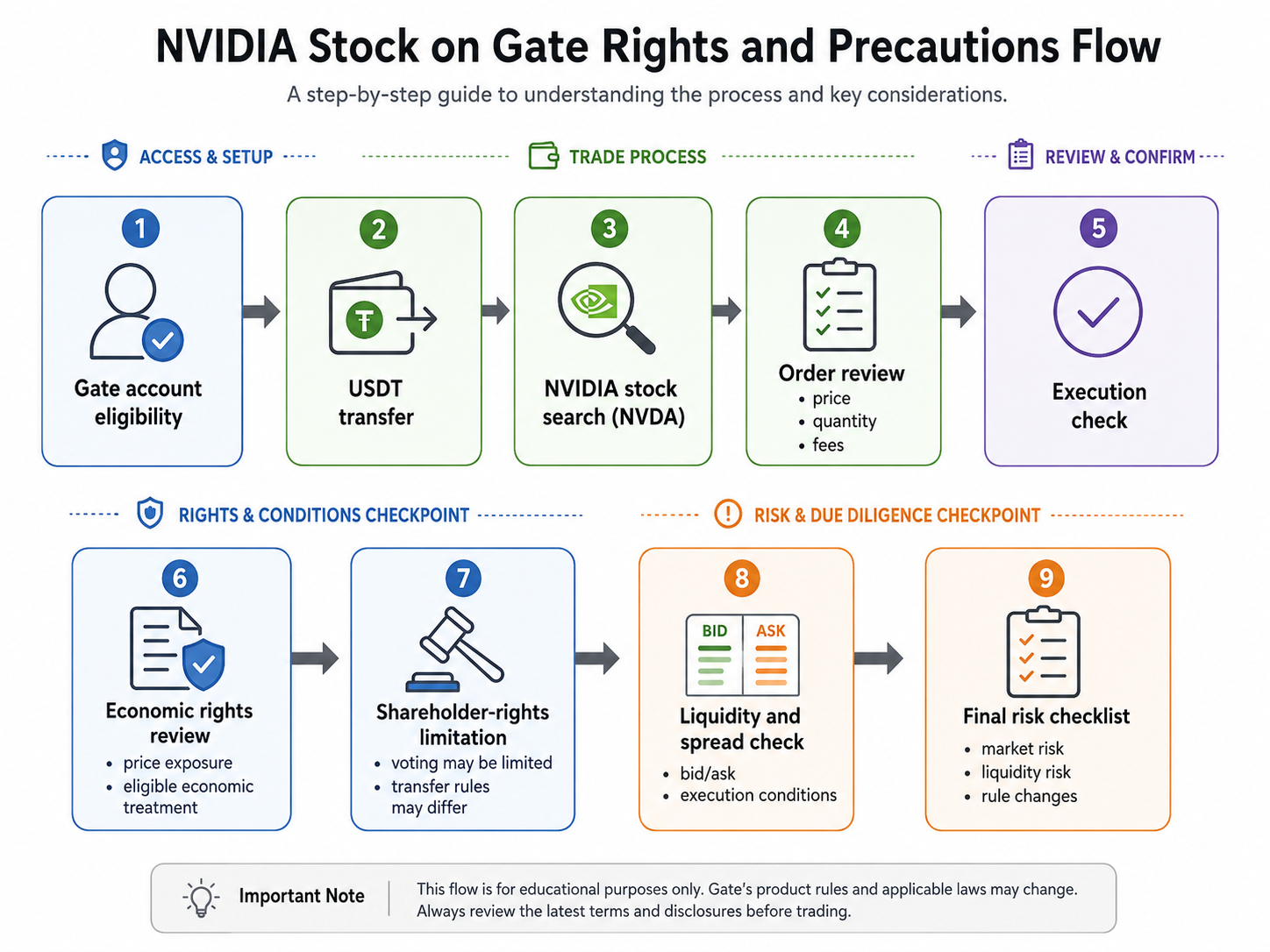
A typical flow is simple: prepare a Gate account, complete required verification, hold or transfer USDT, enter the stock trading area, search for NVIDIA or NVDA, review the order page, and place an order only when the product is available under current rules. Users who need the basic operating steps can review NVIDIA stock with USDT before focusing on rights and precautions.
NVIDIA itself is not a crypto asset. It is a publicly traded company associated with AI chips, GPUs, data centers, software tools, and enterprise computing demand. A separate background on NVIDIA’s AI GPUs and business ecosystem can help users understand the company behind the ticker without turning that background into a trading decision.
A simple analogy may help. Gate stock access is like using a platform window into the stock market. The window may let users view and trade supported assets, but it does not automatically include every shareholder process that a traditional brokerage account may offer.
What Rights Should Users Understand When Buying NVIDIA Stock on Gate?
Users should separate economic exposure from shareholder services when reviewing NVIDIA stock on Gate. Economic exposure means the account may reflect price movement and eligible economic benefits according to product rules. Shareholder services may involve voting, meeting participation, direct registration, transfer-out functions, or other actions normally associated with holding shares through a traditional brokerage infrastructure.
The key point is not whether NVIDIA is an important company. The key point is what the Gate stock product actually provides. Before placing an order, users should read the live product page, order confirmation, corporate action rules, and any rights statement shown in the interface.
Dividend handling is one example. If a supported stock has dividend-related arrangements, the actual treatment depends on the platform’s product rules, eligibility conditions, record-date logic, applicable fees, tax treatment, and corporate action procedures. Users should not assume that every economic benefit works exactly like a traditional broker account.
Voting rights require even more caution. Stock products on a crypto platform may not provide direct voting, shareholder meeting participation, or direct company registry access. Users who require full shareholder services should compare the product rules carefully before choosing an access method.
What Can Users Do and Not Do With NVIDIA Stock on Gate?
NVIDIA stock on Gate may support common trading and account-management actions, but users should not assume that every brokerage-style function is available. The table below shows the practical difference.
| Area |
What Users May Be Able to Do |
What Users Should Not Assume |
| Funding |
Use USDT as the settlement asset where the product is supported |
Direct fiat settlement or bank-broker workflows |
| Trading |
Buy or sell supported NVIDIA stock products during available sessions |
24/7 execution regardless of market status |
| Position view |
Review holdings, market value, and order records in the Gate account |
Direct company share registry access |
| Economic rights |
Receive eligible economic treatment according to product rules |
Automatic identical treatment to every traditional broker |
| Shareholder rights |
Check whether voting or corporate action participation is supported |
Full voting rights or meeting access by default |
| Transfer |
Manage the position inside Gate according to rules |
Transfer NVIDIA shares freely to any outside broker |
This table matters because the user experience is built around the product interface and current rules. A stock product can provide market access while still having limits around custody structure, transferability, corporate actions, and shareholder services.
What Should Users Check Before Placing an NVIDIA Stock Order?
Users should check eligibility, ticker accuracy, USDT balance, order type, estimated cost, fee display, spread, liquidity, trading session, and rights information before placing an NVIDIA stock order on Gate. These checks reduce operational mistakes and make the product structure easier to understand.
| Checkpoint |
Why It Matters |
Practical User Action |
| Account eligibility |
Stock services may depend on region, verification, and account status |
Confirm access before preparing funds |
| Ticker and product name |
Similar names or products may confuse users |
Search NVDA and verify the trading page |
| USDT balance |
USDT is used for settlement where supported |
Confirm the balance is in the correct account |
| Order type |
Market and limit orders behave differently |
Review how execution may occur |
| Spread and liquidity |
Thin liquidity can affect fill prices |
Compare bid, ask, size, and session conditions |
| Fees and costs |
Trading costs may change the final amount |
Check the order confirmation page |
| Rights statement |
Economic and shareholder rights may differ |
Review dividend, voting, and transfer rules |
| Risk tolerance |
NVIDIA can be volatile like other equity assets |
Decide position size independently |
Spreads and liquidity deserve special attention. A displayed quote is not always the same as a final filled price, especially during fast-moving periods or sessions with lower activity. The Gate US stock liquidity and spread gives more context on why bid-ask spreads, slippage, and order size can change the execution experience.
Users should also understand why USDT settlement changes the funding workflow. The broader USDT buying U.S. stocks explains how crypto balances can connect with supported stock products inside the platform.
What Is an Example of Reviewing an NVIDIA Stock Order on Gate?
A user holds USDT in a Gate account and wants to buy NVIDIA stock on Gate. Before placing the order, the user opens the stock trading area, searches for NVDA, confirms that the page shows NVIDIA, checks whether the current session supports trading, and reviews the order type available on the interface.
The user then compares the displayed price with the bid and ask, checks the estimated USDT cost, reviews any visible fee information, and reads the rights or product rule notes. If the order is placed, the user later checks the filled quantity, average execution price, stock account record, and whether the final USDT deduction matches expectations.
This example shows that the buying decision is not only about selecting NVIDIA. It also involves confirming the exact product, session status, execution conditions, rights limitations, and post-trade record. For users who want to understand NVIDIA’s ecosystem more deeply, CUDA is often part of the company’s competitive discussion because it connects hardware, software, and developer workflows.
What Risks and Precautions Matter Most for NVIDIA Stock on Gate?
NVIDIA stock on Gate carries both normal stock-market risk and platform-specific product considerations. NVIDIA’s market price may move because of earnings, AI infrastructure demand, semiconductor cycles, data-center spending, competition, supply-chain factors, interest rates, and broad market sentiment.
Execution risk also matters. A market order may fill quickly, but the final price can differ from the last displayed price. A limit order gives more price control, but it may not fill if the market does not reach the chosen level. Wider spreads, lower liquidity, and extended-session conditions can make execution less predictable.
Rights and transfer limitations are also important. Users should verify whether dividend treatment, voting rights, corporate action handling, tax-related treatment, and transfer-out functions are supported. If a user needs traditional broker features, that requirement should be checked before using a USDT-settled stock product.
Regional availability can also change the experience. Stock services may not be available in every location or under every account status. Product rules, supported assets, trading sessions, fees, and corporate action procedures can change, so the live Gate interface should be treated as the final operating reference.
Summary
NVIDIA stock on Gate gives eligible users a USDT-settled way to access supported NVIDIA stock trading, but the product should be reviewed carefully before use. The most important checks are account eligibility, NVDA ticker confirmation, USDT account balance, order type, spread, fees, liquidity, trading session, rights treatment, and transfer rules.
The main rights question is whether the product provides only economic exposure and eligible economic benefits, or whether it also supports broader shareholder services. Users should not assume that voting, direct registration, transfer-out, or every corporate action process works like a traditional brokerage account.
Stock investing involves market risk, and prices may fluctuate significantly. Please make decisions carefully based on your own risk tolerance.
FAQs
What is NVIDIA stock on Gate?
NVIDIA stock on Gate refers to supported access to NVIDIA stock trading through Gate’s stock service, with USDT used as the settlement asset where available. Users should check the live product page for eligibility, order rules, fees, and supported functions before placing an order.
Does NVIDIA stock on Gate give voting rights?
NVIDIA stock on Gate may not automatically provide voting rights or direct shareholder meeting participation. Users should review the current rights statement and corporate action rules in Gate before assuming any shareholder-service function.
Can NVIDIA stock on Gate be transferred to a traditional broker?
NVIDIA stock on Gate should not be assumed to support free transfer to an outside traditional broker. Transfer rules depend on the product structure and current platform rules, so users should verify transfer availability before trading.
How does NVIDIA stock on Gate settle in USDT?
NVIDIA stock on Gate uses USDT as the settlement asset where the product is supported. That means users should review their USDT balance, internal transfer requirements, estimated order value, fees, and final filled order record.
What should users check before trading NVIDIA stock on Gate?
Users should check account eligibility, ticker accuracy, order type, market status, liquidity, spread, fees, rights rules, and risk tolerance before trading NVIDIA stock on Gate. These checks help reduce operational mistakes and clarify the difference between market exposure and shareholder services.







