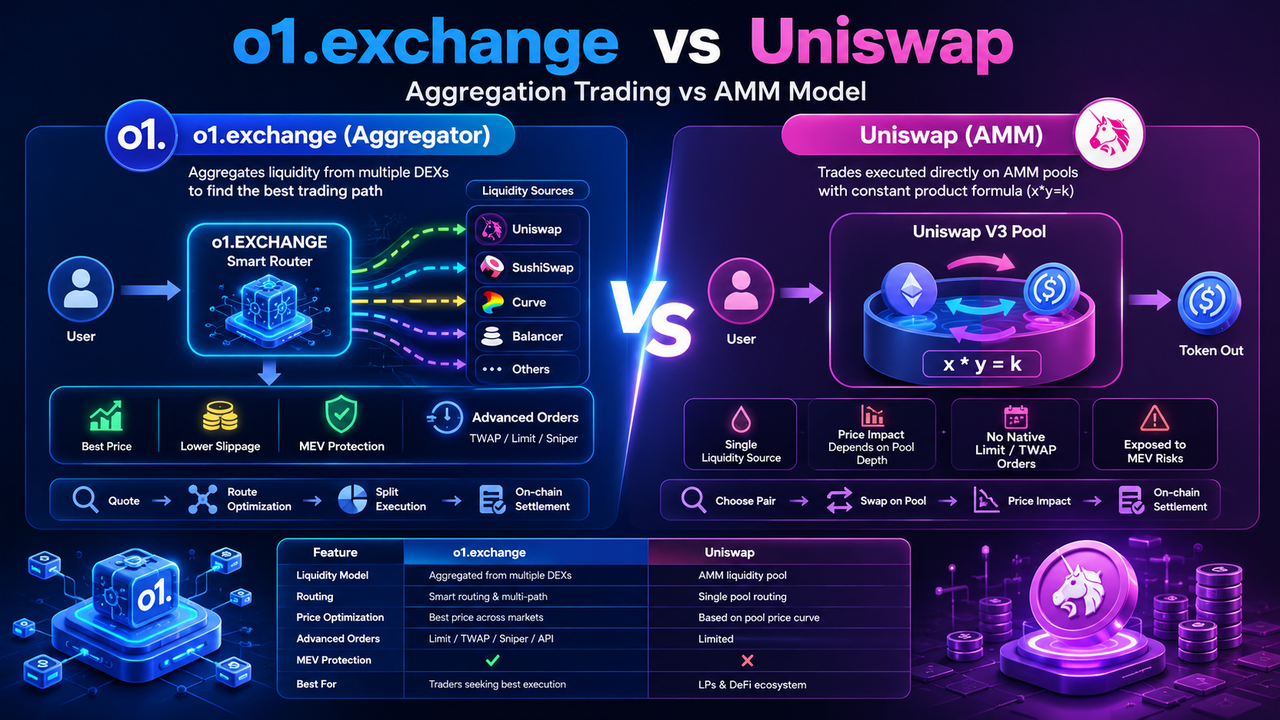
Uniswap is one of the most iconic AMM protocols in DeFi, enabling asset swaps through liquidity pools without relying on an order book. o1.exchange, by contrast, functions more as a trade execution infrastructure, leveraging smart routing, order splitting, and liquidity aggregation to improve execution quality.
As on-chain liquidity becomes increasingly fragmented, aggregators and AMMs are forming a complementary relationship. Uniswap provides the raw liquidity, while aggregation platforms like o1.exchange tap into these sources to build more efficient execution networks.
What Is o1.exchange?
As an aggregated on-chain trading platform, o1.exchange’s core strength lies in smart routing and liquidity aggregation.
When a user initiates a trade, the system simultaneously analyzes multiple DEXs, liquidity pools, and trading venues to automatically identify the optimal execution path.
Beyond basic swaps, o1.exchange supports advanced features such as limit orders, TWAP orders, Sniper orders, MEV protection, and programmable trading interfaces.
This design positions o1.exchange as a trade execution infrastructure rather than a single trading venue.
What Is Uniswap?
Uniswap is a decentralized exchange protocol built on the automated market maker (AMM) model. Unlike traditional order book markets, Uniswap uses liquidity pools to store assets and automatically handles price calculation and trade matching through mathematical formulas.
Any user can supply assets to a liquidity pool and become a liquidity provider (LP).
This model lowers the barrier to market entry and has fueled the growth of the DeFi liquidity ecosystem.
How Do the Liquidity Sources of o1.exchange and Uniswap Differ?
Liquidity sourcing is one of the most fundamental differences between the two.
Uniswap’s Liquidity Source
Uniswap trades rely primarily on its own liquidity pools.
When a user swaps assets, the trade is executed directly within the corresponding pool, with the execution price determined by the pool’s asset ratio and liquidity depth.
o1.exchange’s Liquidity Source
o1.exchange does not depend on a single liquidity pool.
The system scans multiple DEXs and liquidity sources—including Uniswap and other protocols—simultaneously to automatically find the best quote.
As a result, o1.exchange can harness the entire market’s liquidity to execute trades.
How Do the Trade Execution Mechanisms of o1.exchange and Uniswap Differ?
Trade execution logic directly determines the final outcome a user receives.
Uniswap’s Execution Method
Uniswap directly calls the corresponding liquidity pool for the selected trading pair to complete the swap.
The process is straightforward, and the execution path is generally fixed.
o1.exchange’s Execution Method
o1.exchange first evaluates multiple candidate paths, then generates the optimal solution based on price, liquidity, and slippage.
For large orders, the system may split the trade across multiple protocols for simultaneous execution.
This approach improves execution quality and reduces price impact.
How Do the Price Discovery Mechanisms of o1.exchange and Uniswap Differ?
Price discovery is a key process by which the market forms quotes.
Uniswap’s Price Formation
Uniswap’s price is primarily determined by the asset ratio within its liquidity pool.
When buying or selling changes the pool’s asset composition, the price adjusts accordingly.
o1.exchange’s Price Formation
o1.exchange does not set the price directly.
The system collects real-time quotes from multiple protocols and uses aggregation algorithms to find the best available price across the entire market.
Thus, o1.exchange functions more like a price search engine and trade optimizer.
How Do the Advanced Order Features of o1.exchange and Uniswap Differ?
As on-chain trading demand grows, advanced order tools become increasingly important.
Uniswap focuses primarily on asset swaps and liquidity provision.
o1.exchange, on the other hand, offers a broader suite of professional trading tools, including limit orders, TWAP orders, Sniper orders, multi-wallet management, and API trading interfaces.
For high-frequency traders and quantitative strategy participants, these features significantly enhance flexibility and automation.
How Do the MEV Risk Control Capabilities of o1.exchange and Uniswap Differ?
MEV is a major challenge in on-chain trading.
Uniswap trades are typically broadcast through public mempools, making them vulnerable to front-running and sandwich attacks.
o1.exchange introduces aggregated routing, order splitting, and trade protection mechanisms at the execution layer to reduce trade exposure.
While no on-chain platform can completely eliminate MEV, different execution strategies affect both the likelihood and severity of attacks on trades.
o1.exchange vs Uniswap: Which Model Suits Different Users?
Different trading needs call for different models.
For users who want to directly participate in liquidity provision and the mechanics of AMM markets, Uniswap is the more representative choice.
For those focused on price optimization, slippage control, and advanced order management, aggregated platforms typically offer a broader range of tools.
As the DeFi ecosystem continues to expand, these two models are forming a synergistic relationship rather than a purely competitive one.
o1.exchange vs Uniswap Comparison Table
| Comparison Dimension |
o1.exchange |
Uniswap |
| Core Positioning |
Aggregated trading platform |
AMM protocol |
| Liquidity Source |
Multi-protocol aggregation |
Own liquidity pools |
| Price Discovery |
Aggregated quotes |
Pool-based pricing |
| Trading Path |
Dynamic routing |
Fixed pool routing |
| Multi-Path Execution |
Supported |
Not supported |
| Limit Orders |
Supported |
Limited support |
| TWAP Orders |
Supported |
Typically not available |
| API Trading |
Supported |
Limited support |
| Liquidity Provision |
Not a core function |
Core function |
| MEV Optimization |
Provides trade protection mechanisms |
Relies on network environment |
Summary
o1.exchange and Uniswap represent two distinct types of infrastructure within the DeFi trading ecosystem. Uniswap provides an open liquidity market through its AMM model, while o1.exchange optimizes trade execution by aggregating multiple liquidity sources.
The most significant differences lie in how liquidity is organized and how trades are executed. Uniswap creates and manages liquidity; o1.exchange finds and utilizes it. As the on-chain market continues to evolve, these two models are jointly building a more complete DeFi trading ecosystem.
FAQs
What is the biggest difference between o1.exchange and Uniswap?
o1.exchange aggregates multiple DEXs to find the best trading path, whereas Uniswap relies primarily on its own AMM liquidity pools to execute trades.
Does o1.exchange use Uniswap’s liquidity?
Yes. As an aggregation platform, o1.exchange can include protocols like Uniswap as liquidity sources to find better quotes.
Why can aggregators usually offer better prices?
Aggregators simultaneously compare quotes and liquidity depth across multiple protocols and select the trading path that offers the best overall execution.
Does o1.exchange support liquidity provision?
o1.exchange’s core focus is trade execution and liquidity aggregation, not operating its own AMM liquidity pools. Therefore, its model differs significantly from Uniswap’s liquidity provision framework.







