The derivatives market is an important part of the modern financial system. Its core functions include price discovery, risk hedging, and leveraged trading. Futures contracts in traditional financial markets have existed for decades and are widely used across commodities, stock indices, interest rates, and foreign exchange markets.
As the crypto asset market has expanded, digital asset trading platforms have also introduced similar derivatives structures. However, because crypto markets trade around the clock, experience high volatility, and operate globally, traditional futures mechanisms have certain limitations in practice. As a result, perpetual contracts have gradually become one of the most mainstream forms of derivatives in the crypto market.
Why Are Perpetual Contracts and Traditional Futures Important?
Perpetual contracts and traditional futures both help traders use leverage and manage risk, giving them an important role in the market. For institutions and professional traders, derivatives are not only used for speculation, but also for managing the risk of asset price fluctuations.
In the crypto market, perpetual contract trading volume has long exceeded spot market volume, making it an important source of liquidity for both on-chain and centralized trading platforms. Meanwhile, traditional futures remain one of the most mature derivatives structures in global financial markets.
What Are Traditional Futures?
Traditional futures are standardized contracts that agree to buy or sell an asset at a predetermined price at a specific time in the future. Futures contracts usually have a clearly defined expiration date, after which they are settled in cash or through physical delivery.
Traditional futures were first widely used in commodity markets, including crude oil, gold, and agricultural products. As financial markets developed, stock index futures, interest rate futures, and foreign exchange futures also became important financial instruments.
In traditional futures markets, contract prices are affected by market supply and demand, time value, and future expectations. As a result, futures prices may trade at a premium or discount to spot prices.
What Are Perpetual Contracts?
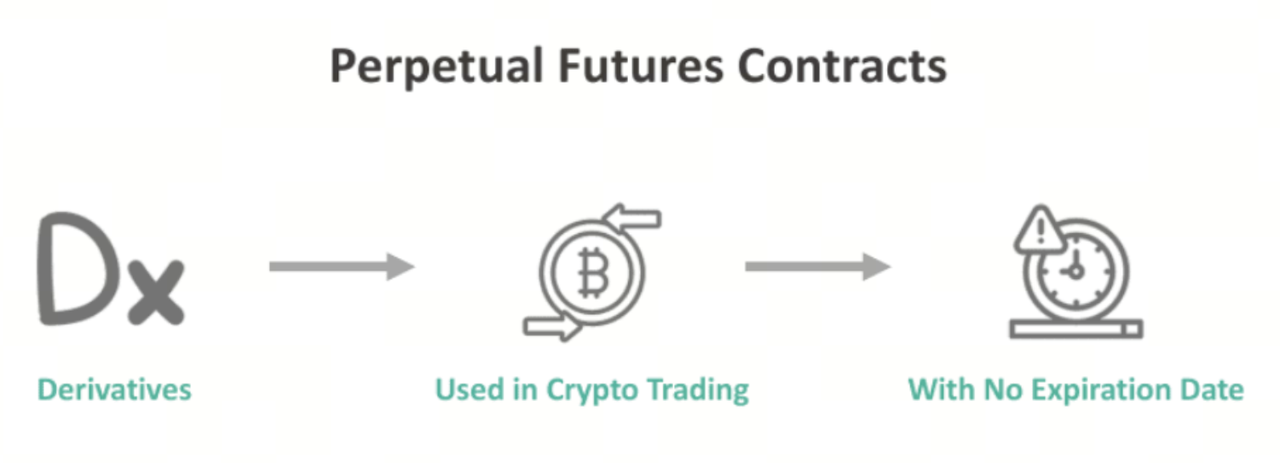
Perpetual contracts are derivatives contracts with no expiration date. They trade in a way that is similar to traditional futures, but they do not require regular delivery. Users can hold positions for an extended period without having to settle on a fixed date, as they would with traditional futures.
To keep the contract price close to the spot price, perpetual contracts usually use a funding rate mechanism. When long demand is high, long positions generally pay funding fees to short positions. When short demand is higher, shorts pay funding fees to longs.
Perpetual contracts were initially widely promoted by crypto trading platforms and have now become one of the dominant trading structures in the digital asset derivatives market.
What Is the Biggest Difference Between Perpetual Contracts and Traditional Futures?
The biggest difference between perpetual contracts and traditional futures is whether they have an expiration date.
Traditional futures have a fixed delivery time, so traders need to close positions, roll them over, or complete settlement before expiration. Perpetual contracts have no expiration limit, allowing users to keep holding positions continuously.
In addition, the two use different methods to keep prices anchored. Traditional futures prices gradually converge toward spot prices as the expiration date approaches, while perpetual contracts rely on the funding rate mechanism to dynamically maintain price stability.
Therefore, although both are derivatives instruments, their underlying operating logic is clearly different.
How Do Funding Rates and Futures Delivery Mechanisms Differ?
The funding rate is one of the core mechanisms of perpetual contracts. Its role is to balance long and short market demand and keep the contract price close to the spot price.
For example, when the perpetual contract price is higher than the spot market price, long positions usually need to pay funding fees to short positions. This helps reduce excessive deviation from the spot price.
By contrast, traditional futures do not rely on a funding rate mechanism. Instead, they achieve price convergence through delivery at expiration. As the contract approaches its expiration date, the futures price usually moves gradually toward the spot price.
For this reason, the funding rate mechanism can be viewed as a way for perpetual contracts to replace the traditional delivery mechanism.
How Do the Two Contract Types Differ in Trading Experience?
Perpetual contracts are usually better suited to high-frequency trading and long-term position holding because users do not need to roll over positions frequently or monitor expiration dates. This structure also fits the around-the-clock nature of the crypto market more naturally.
Traditional futures place more emphasis on standardized delivery and term structure management, so they are more widely used in institutional markets and traditional finance. Some professional traders also use futures contracts with different expiration dates for arbitrage and calendar spread trading.
From a user experience perspective, perpetual contracts are relatively simple to operate, while traditional futures involve more management around delivery dates and rollover strategies.
Why Does the Crypto Market Prefer Perpetual Contracts?
Crypto markets are highly volatile, trade around the clock, and have global liquidity, so perpetual contracts are better suited to the needs of digital asset markets.
Compared with traditional futures, perpetual contracts do not require regular position rollovers and avoid the complexity caused by frequent delivery. For high-frequency traders, this structure can provide more continuous market liquidity.
In addition, many trading platforms in the crypto market place greater emphasis on real-time leveraged trading and short-term trading experiences. This has helped perpetual contracts gradually become the mainstream derivatives structure.
However, high leverage in perpetual contracts can also amplify market risk, making risk management essential.
Perpetual Contracts vs Traditional Futures Comparison Table
| Comparison Dimension |
Perpetual Contracts |
Traditional Futures |
| Expiration Date |
No expiration date |
Fixed expiration date |
| Price Anchoring |
Funding rate mechanism |
Expiration delivery mechanism |
| Rollover Required |
Usually no |
Usually yes |
| Trading Hours |
Mostly 24/7 |
Limited by exchange hours |
| Common Markets |
Cryptocurrencies |
Commodities, equities, forex |
| Position Holding |
Can be held long term |
Must be settled at expiration |
| Leverage Trading |
Common |
Common |
| Risk Profile |
High volatility, high leverage |
Affected by term structure |
Conclusion
Although perpetual contracts and traditional futures are both derivatives trading instruments, they differ significantly in expiration mechanisms, price maintenance logic, and market structure.
Traditional futures rely on fixed delivery dates to complete price convergence, making them better suited to standardized financial markets. Perpetual contracts use the funding rate mechanism to maintain price stability, which makes them better suited to around-the-clock, highly liquid crypto market environments.
As the digital asset market continues to develop, perpetual contracts have become important infrastructure for the crypto derivatives market. However, whether using perpetual contracts or traditional futures, leveraged trading itself carries considerable risk. Users participating in these markets should still pay close attention to capital management and risk control.
FAQs
Why Do Perpetual Contracts Have No Expiration Date?
Because perpetual contracts use the funding rate mechanism to replace the traditional delivery mechanism, helping maintain price stability.
Why Are Perpetual Contracts More Popular in the Crypto Market?
Because crypto markets trade around the clock, are highly volatile, and emphasize high-frequency liquidity, perpetual contracts are better suited to digital asset trading needs.
Are Perpetual Contracts Risky?
Perpetual contracts usually involve leveraged trading, so they can amplify market volatility and capital risk.
What Is a Funding Rate?
A funding rate is a balancing mechanism used in perpetual contracts to keep the contract price close to the spot price.







