As the Solana DeFi ecosystem develops rapidly, on-chain derivatives protocols are gradually becoming important infrastructure. Compared with the simple AMM trading models used in earlier stages, a new generation of protocols is paying closer attention to high frequency trading, low slippage, risk control, and professional market making capabilities.
Against this backdrop, Phoenix and Drift represent two different directions: the on-chain order book model and the hybrid liquidity model.
Brief Overview of Phoenix and Drift and Their Core Differences
As an on-chain perpetual futures trading protocol running on Solana, Phoenix uses a Fully On-Chain Order Book architecture. Buy and sell orders submitted by users enter an on-chain central limit order book, or CLOB, and are matched according to price priority and time priority.
Phoenix is designed to deliver a trading experience on-chain that feels closer to a traditional centralized exchange. Compared with the AMM model, Phoenix places more emphasis on:
Drift is also a perpetual futures protocol in the Solana ecosystem, but its market structure differs clearly from Phoenix. Drift initially used a vAMM, or Virtual Automated Market Maker, mechanism to support perpetual futures trading through a virtual liquidity model.
As the protocol evolved, Drift gradually introduced order book and external liquidity support, forming a hybrid liquidity structure.
Compared with Phoenix’s order book model, Drift places more emphasis on capital efficiency, open liquidity, flexible market structure, and hybrid matching. This design allows Drift to keep markets functioning even when liquidity is limited, but it also means its price formation logic differs from Phoenix.
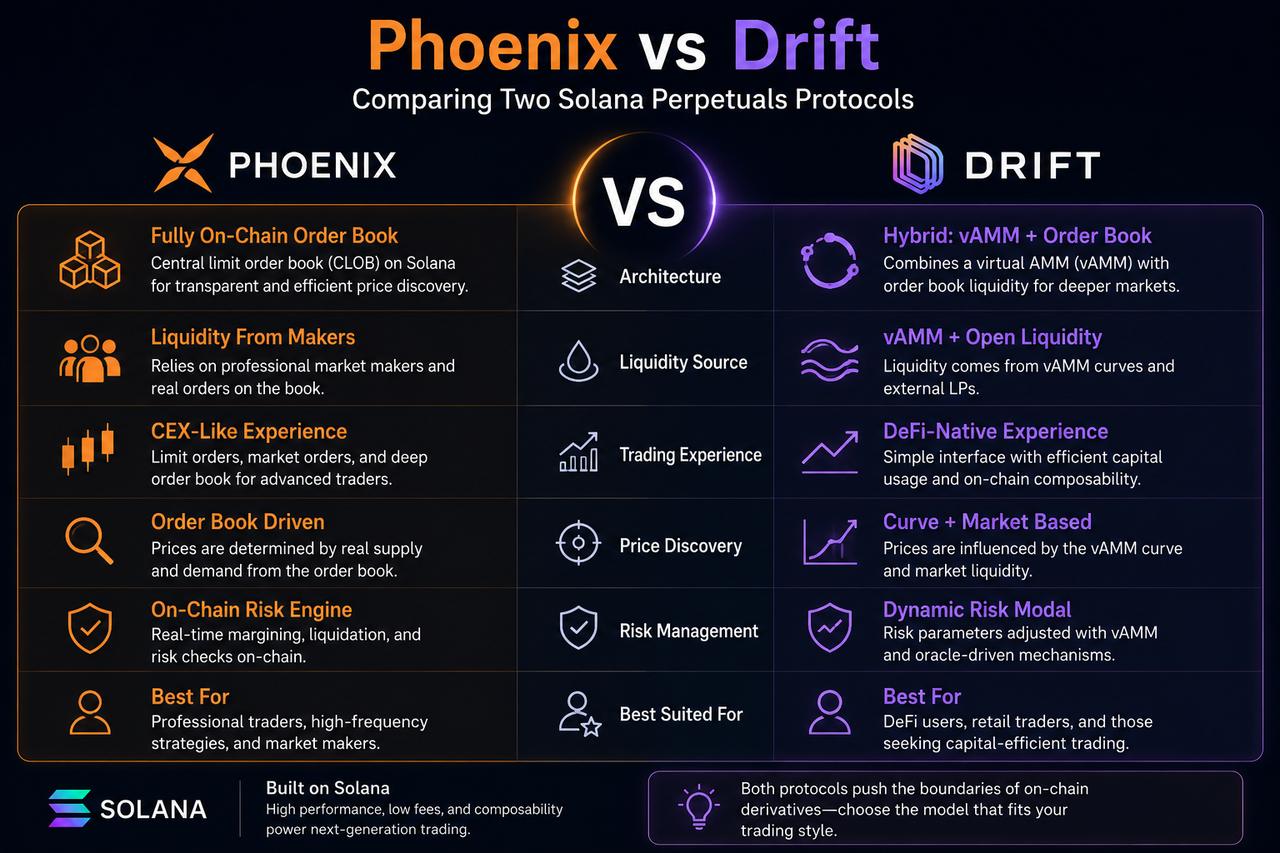
How Do the Core Architectures of Phoenix and Drift Differ?
The biggest difference between Phoenix and Drift lies in their underlying market structure.
Phoenix uses a pure on-chain order book architecture, where all prices are formed by real limit orders. Users trade directly through limit orders and market orders, while market prices come from the supply and demand between buyers and sellers.
Drift leans more toward a hybrid model. In its early stage, it mainly relied on a vAMM to provide liquidity, and later gradually introduced order book and external market maker support. As a result, Drift’s market prices come partly from an algorithmic model and partly from external liquidity.
From a structural perspective:
| Comparison Dimension |
Phoenix |
Drift |
| Core structure |
On-chain order book |
vAMM + hybrid liquidity |
| Price formation |
Buy and sell limit orders |
Algorithm + market liquidity |
| Liquidity source |
Market maker limit orders |
Virtual liquidity + market making |
| Market experience |
Closer to traditional exchanges |
More DeFi oriented |
| High frequency trading support |
Stronger |
Moderate |
Phoenix is closer to the order book structure used in traditional financial markets, while Drift places greater emphasis on on-chain liquidity flexibility.
How Do the Liquidity Mechanisms of Phoenix and Drift Differ?
Phoenix’s liquidity mainly comes from professional market makers and limit orders placed in the market.
Under the order book model, market depth depends on the number of real orders, so Phoenix relies more heavily on high quality market making and continuous order flow. Its advantage is more efficient price discovery and, in many cases, better slippage control.
Drift uses a vAMM and hybrid liquidity mechanism to keep markets tradable even when liquidity is relatively low. This structure reduces reliance on professional market makers, but in highly volatile markets it may face the risk of price deviation.
Simply put:
This is also an important reason their trading experiences differ.
How Do the Trading Experiences of Phoenix and Drift Differ?
Phoenix’s trading logic is closer to that of a traditional centralized exchange.
Users can place more professional order types, such as limit orders and market orders, and view real time order book depth. This model is generally better suited for high frequency trading, quantitative strategies, professional market making, and large trades.
Drift’s trading experience is closer to what traditional DeFi users are used to. Because its liquidity model is more flexible, ordinary users can participate in trading more easily.
That said, for large trades and complex strategies, Phoenix’s order book structure can often provide higher order precision and lower slippage.
How Do the Risk Management Mechanisms of Phoenix and Drift Differ?
Phoenix and Drift both use margin, funding rates, and liquidation mechanisms to manage risk, but they implement them differently.
Phoenix’s risk system is mainly built around the order book and real time market prices. Because market prices come from real limit orders, its risk control depends more on order depth and market liquidity.
Drift, on the other hand, needs to manage both vAMM parameters and market risk. Since part of its pricing comes from an algorithmic model, the protocol needs to adjust liquidity parameters dynamically to maintain market stability.
The two models each have their own characteristics:
During extreme market conditions, the order book model usually provides more direct price discovery, while a vAMM may face the risk of price deviation.
Which Users Are Phoenix and Drift Best Suited For?
Phoenix is better suited for professional traders and users running high frequency strategies.
Because its order book structure is closer to traditional trading markets, Phoenix’s operating logic is more intuitive for users familiar with centralized exchanges.
Drift is better suited for traditional DeFi users and small to mid sized trading scenarios. Its hybrid liquidity model lowers the barrier to launching markets and also makes it easier for the protocol to maintain trading activity in low liquidity environments.
From a user perspective:
Why Is Solana Suitable for On-Chain Perpetual Futures Protocols?
Both Phoenix and Drift are built on Solana’s high performance network.
Perpetual futures markets require:
Solana’s high throughput and low fee structure allow it to support complex on-chain trading systems.
Compared with earlier blockchain networks, Solana is better suited to running order books, high frequency matching, and complex financial logic. As a result, more on-chain derivatives protocols are choosing Solana as their core infrastructure.
Conclusion
Phoenix and Drift are both important perpetual futures protocols in the Solana ecosystem, but they follow different market design approaches.
Phoenix places greater emphasis on a Fully On-Chain Order Book architecture, using an order book to support low slippage, high frequency trading, and a professional market experience. Drift uses a vAMM and hybrid liquidity model, placing greater emphasis on open liquidity and capital efficiency.
Neither model is absolutely better than the other. Instead, each is suited to different market needs and user groups.
FAQs
What is the biggest difference between Phoenix and Drift?
Phoenix mainly uses an on-chain order book model, while Drift leans more toward a vAMM and hybrid liquidity structure.
Does Phoenix use an AMM?
Phoenix mainly uses a central limit order book, or CLOB, rather than a traditional AMM.
Why does Drift use a vAMM?
A vAMM can keep markets tradable when liquidity is limited and improve capital efficiency.
Which protocol is better suited for high frequency trading?
Phoenix’s order book structure is generally better suited for high frequency trading and quantitative strategies.







