Samsung Electronics does not directly offer general-purpose large model capabilities. Instead, it participates in AI deployment through semiconductors, memory, displays, and smart devices, positioning itself as a critical component of next-generation computing systems. AI’s rapid growth is reshaping the hardware industry’s operating model. For decades, computing power expansion relied on mobile internet and endpoint upgrades, but the generative AI era now demands higher coordination among chips, memory, and devices for training, inference, and real-time computing. This means AI competition extends beyond the model layer into hardware infrastructure.
From an industry standpoint, Samsung Electronics holds multiple strategic nodes: it contributes to foundational semiconductor and memory development as well as end-user devices and the consumer ecosystem. This cross-layer architecture allows Samsung to bridge data processing, model execution, and user experience, making it a key lens for tracking the AI hardware cycle.
Why AI Is Driving a Hardware Industry Overhaul
For over a decade, the global tech industry’s growth logic was anchored in mobile internet expansion. Computing tasks flowed between cloud services and mobile devices, with hardware upgrades centered on performance, energy efficiency, and user experience.
Generative AI disrupted this paradigm.
Training models demand massive hashrate clusters. Inference requires higher bandwidth and faster data access. Real-time AI applications are migrating to edge devices. Consequently, computing systems now prioritize holistic architecture over raw processor performance.
At an industry level, AI is steering computing logic from “single-chip competition” toward “system-level synergy.” Chips, memory, interconnects, displays, and endpoint experiences collectively determine overall efficiency. This is why hardware companies are re-entering the spotlight. Future hardware value may hinge not on manufacturing alone, but on the ability to sustain growing computational demands.
Samsung Electronics’ Role in AI Infrastructure
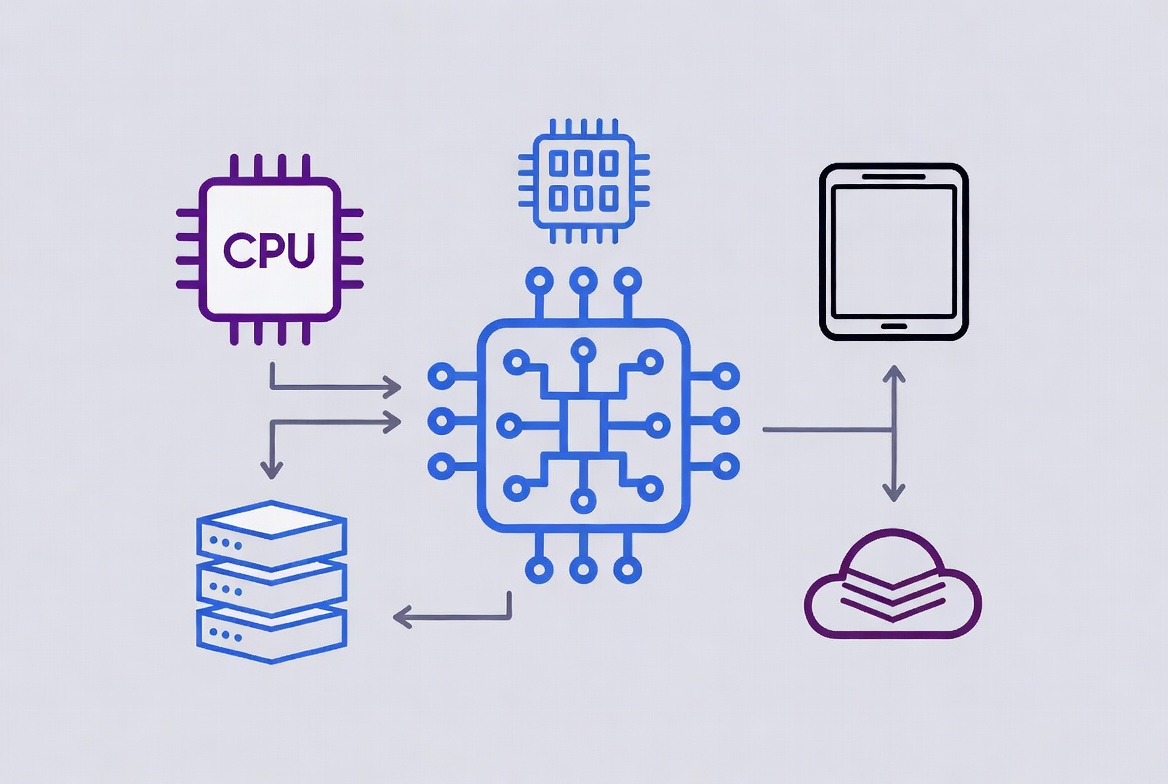
Samsung Electronics’ approach to AI does not follow the typical large-model development path; instead, it functions more as an underlying computing infrastructure provider. Unlike companies that train models, operate AI platforms, or deliver general-purpose model services, Samsung has long invested in semiconductors, memory, display technology, and devices. Its value lies in supporting AI system operation rather than directly outputting model capabilities.
As generative AI scales, the industry is recognizing the complexity of computing systems. Modern AI relies not on a single chip but on an integrated chain of computing, memory, data transfer, system integration, and endpoint interaction. Underlying hardware capabilities grow increasingly critical. Larger models and more frequent training cycles place greater demands on infrastructure, shifting focus from raw hashrate to system-wide efficiency.
From Samsung’s vantage point, its AI value emerges in two ways. First, its long-standing memory expertise directly impacts data read speeds and system throughput. Second, its positions in semiconductor fabrication, display technology, and devices allow it to connect underlying computing with real-world applications. As AI capabilities shift from cloud to device, endpoints take on more real-time inference tasks, further solidifying Samsung’s role in AI infrastructure.
Therefore, understanding Samsung’s relationship with AI should not hinge on whether it owns a model. Instead, we should view it from a computing infrastructure perspective: it links data processing, system operation, and user experience, positioning Samsung as a foundational capability player in the AI ecosystem.
When people think of AI hardware, GPUs often come to mind first. However, high-performance computing is never solely about a single processor’s power. As model parameters explode, bottlenecks increasingly appear in data exchange, memory bandwidth, and system coordination—not just in the compute core.
AI model operation requires continuous parameter retrieval, data caching, and cross-node communication. If data cannot reach the computing system in time, even the most powerful processors can’t unleash full efficiency. That is why modern AI infrastructure emphasizes high-bandwidth memory, low-latency access, and system-level optimization. Computing speed defines theoretical performance; data flow determines actual efficiency.
This shift has elevated the memory industry’s standing. Previously, memory chips were seen as standard components focused on capacity, cost, and stability. Now, in the AI cycle, memory becomes computing infrastructure—a factor directly influencing training and inference performance.
For Samsung, this gives its traditional strengths new significance. As high-performance computing expands, memory is no longer just supporting hardware but actively shaping the efficiency of the entire AI computing system. Long term, AI hardware may evolve not merely toward stronger processors, but toward the co-evolution of computing and memory.
AI’s impact on Samsung extends beyond data centers and infrastructure; endpoint devices are becoming critical computing gateways. For decades, smartphones, TVs, and home appliances focused on information display and function execution. Now, as AI matures, devices are evolving from tools into intelligent interactive systems.
This shift means consumer electronics are no longer just about hardware upgrades—it’s a change in device capability logic. Future devices will emphasize understanding user needs, automating tasks, and learning from the environment. For instance, terminals may handle real-time content generation, speech recognition, image analysis, cross-device collaboration, and decision-making, turning user experience from operating a device to collaborating with it.
Samsung has a natural advantage here. With both endpoint products and underlying technology, it can translate foundational computing power directly into user experience without relying entirely on external ecosystems. Hardware capability, display technology, and device coordination now determine whether AI functions truly land.
From an industry perspective, the battleground may shift from who owns more devices to who can turn underlying model capabilities into a seamless, stable, and natural user experience. This explains why more tech companies are reinvesting in endpoint intelligence.
Samsung and the GPU Ecosystem
AI computing is often linked to GPUs, but a GPU alone does not make a complete system. As generative AI develops, many see GPUs as the core AI resource—yet modern AI infrastructure is a collaborative system of computing, memory, interconnects, manufacturing, and endpoints. Boosting computing power alone does not guarantee system-wide efficiency.
Technically, GPUs handle parallel computation for training and inference. The memory system supplies data, determining how consistently computing power is delivered. Packaging, network interconnects, and system integration dictate efficient collaboration among components. Finally, endpoint devices convert computing power into user experience.
This means Samsung and GPU companies are not in simple competition; they occupy different layers in a collaborative structure. As AI models expand, demand for computing resources drives upgrades in memory, manufacturing, and terminals—and those improvements, in turn, enable further model evolution.
| AI Ecosystem Layer |
Core Responsibility |
Role in AI |
Samsung’s Participation |
| Model Layer |
Training & algorithms |
Provides intelligence |
Indirect support |
| Computing Layer (GPU/AI Chips) |
Training & inference execution |
Core hashrate |
Partial involvement |
| Memory Layer |
Data reading & high-speed exchange |
Boosts system throughput |
Core involvement |
| Manufacturing & Integration Layer |
Chip fabrication & system assembly |
Provides operational base |
Core involvement |
| Terminal Device Layer |
User interaction & application runtime |
Delivers end-user experience |
Core involvement |
Going forward, the AI ecosystem may form a clear division of labor: models deliver intelligence, computing executes tasks, infrastructure ensures efficiency, and terminals enable deployment. Samsung is not trying to conquer any single layer—it connects multiple technology levels, turning computing power into running products and services.
Thus, the question of Samsung’s relationship with GPUs should not be reduced to “does it make GPUs?” but viewed through the lens of complete AI infrastructure. Its value comes from bridging computing, memory, manufacturing, and endpoint ecosystems, not from competing in model development.
Global AI Hardware Competition
As AI becomes the primary driver of the technology cycle, the global hardware industry is restructuring.
Past competition focused on device sales or chip fabrication. The future centers on complete computing systems.
More companies are simultaneously investing in chips, cloud capabilities, endpoints, and system coordination.
This means single-point advantages are no longer sustainable.
The industry is shifting from a linear supply chain to an ecosystem of collaboration.
Samsung’s strength lies in its ability to both build infrastructure and reach the terminal market.
Thus, its competition is not against any single company but across combined capabilities at different layers.
Samsung’s Future Technology Direction
In the coming years, AI’s impact on hardware will likely intensify.
Growing computing demands will raise expectations for efficiency, bandwidth, system coordination, and endpoint intelligence.
Samsung’s direction may revolve around three pillars.
First, strengthening its foundational computing capabilities.
Second, upgrading on-device intelligence.
Third, bridging infrastructure and terminal ecosystems to deliver complete experiences.
This evolution shows that the hardware industry is regaining strategic importance.
For Samsung, long-term value may come not from a single product but from its ability to connect multiple technology nodes.
Summary
Samsung Electronics’ relationship with AI is not about model competition like traditional software companies. It is a foundational capability system built on semiconductors, memory, terminals, and the consumer ecosystem.
As generative AI reshapes computing, hardware rises in importance. Industry value expands from single-chip performance to full-system capability. Because Samsung connects both underlying technology and end-user applications, it serves as a key window into next-generation computing. Understanding Samsung’s role in AI is essentially understanding how hardware and intelligent systems will co-evolve.
FAQ
Is Samsung Electronics an AI company?
Strictly, no. Samsung is more of an AI infrastructure and endpoint capability participant rather than a model developer.
Why does AI drive semiconductor demand?
Because model training and inference require sustained computing power, relying on chips, memory, and system coordination.
Is there competition between Samsung and NVIDIA?
They operate at different layers. GPUs handle compute, while Samsung focuses on foundational capabilities and terminal ecosystems.
Will AI change consumer electronics?
Yes. Devices will evolve from functional tools into continuously active intelligent interaction hubs.