Within South Korea's chaebol system, SK Group has long stood alongside Samsung Group, Hyundai Group, and LG Group as one of the most influential business conglomerates. As artificial intelligence and the digital economy continue to expand, SK's affiliates have grown increasingly vital in areas like AI servers, high-bandwidth memory (HBM), the battery supply chain, and data center construction, solidifying SK's role as a key player in the global tech supply chain.
SK Overview
SK Holdings serves as the top holding company of SK Group, listed on the Korea Exchange under ticker 034730. Unlike traditional operating companies, SK does not directly handle large-scale manufacturing. Instead, it governs the group and allocates resources by holding equity in its core subsidiaries.
SK Group traces its roots to 1953, when it began as Sunkyong Textiles. Over decades, the group expanded into petrochemicals, telecommunications, semiconductors, and digital technology, building a comprehensive business ecosystem across multiple industries.
SK Holdings' primary responsibilities include capital allocation, investment management, strategic planning, and group governance. Its revenue streams come mainly from dividend income, investment returns, and brand licensing fees.
What Are the Components of SK Group's Business Landscape?
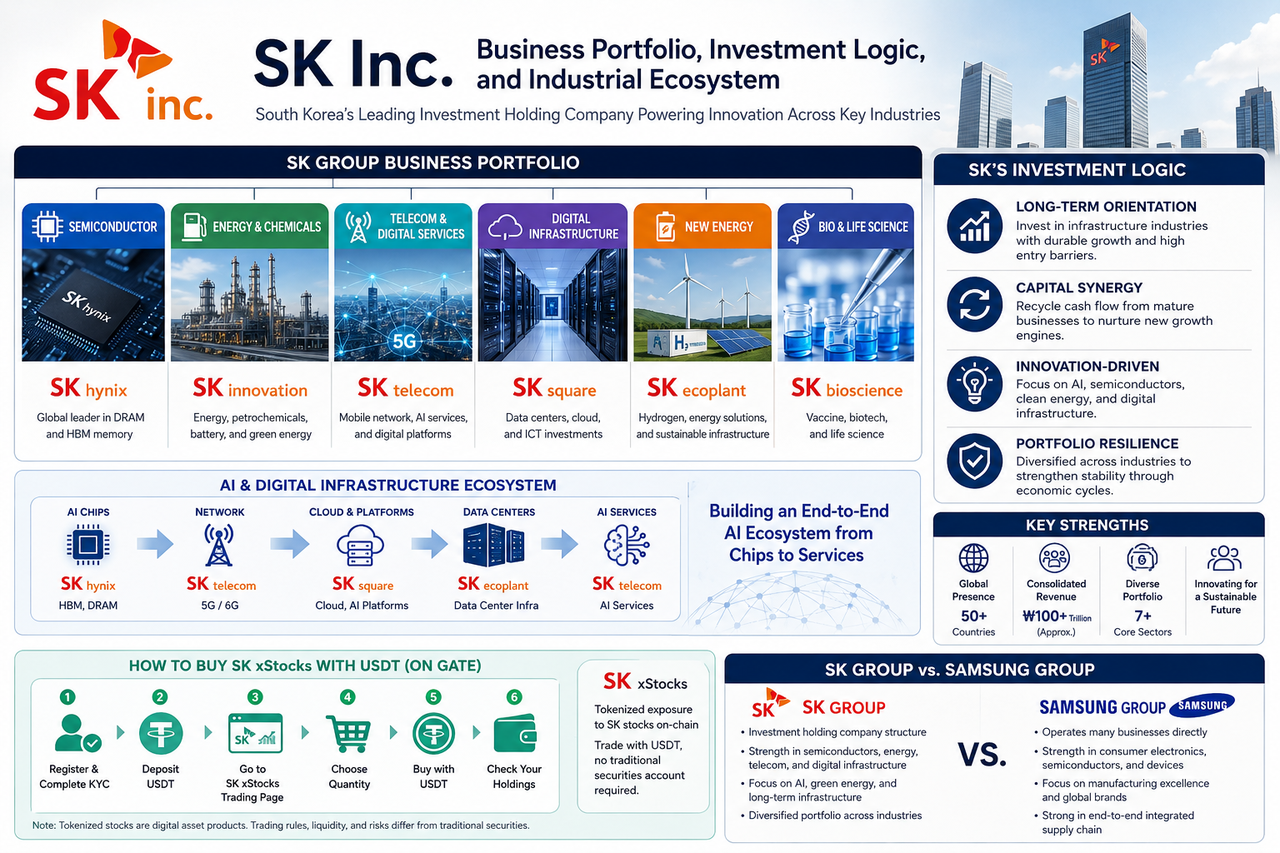
SK Group operates a vast industrial network, with its most critical segments spanning semiconductors, energy, telecommunications, digital services, and new energy.
| Business Segment |
Core Company |
Main Business |
| Semiconductors |
SK hynix |
DRAM, NAND Flash, HBM |
| Energy |
SK Innovation |
Petrochemicals, Batteries, Energy Solutions |
| Telecommunications |
SK Telecom |
Communication Services, AI Platform |
| Technology Investment |
SK Square |
Digital Technology Investment |
| IT Services |
SK C&C |
Enterprise Digital Services |
| New Energy |
Multiple Affiliates |
Batteries, Hydrogen, Green Energy |
This diversified structure allows SK to maintain strong industrial resilience across different economic cycles while generating cross-industry synergies.
What Is SK Group's Investment Logic?
SK Group's investment approach rests on long-term industrial upgrades and capital synergy.
The group typically prioritizes infrastructure industries with strong long-term growth potential: semiconductors, energy networks, telecommunications, and digital infrastructure. Although these sectors involve longer investment cycles, they come with high entry barriers and durable competitive advantages.
Through its holding company model, SK dynamically allocates capital across industries, channeling cash flow from mature businesses into emerging sectors to fuel overall group growth.
| Investment Direction |
Strategic Goal |
| Semiconductors |
Build core computing infrastructure for the AI era |
| Telecommunications Networks |
Support the digital economy |
| Data Centers |
Meet cloud computing and AI demands |
| Battery Industry |
Establish a new energy transportation ecosystem |
| Hydrogen Industry |
Explore long-term green energy transition |
| Biotechnology |
Expand into future growth areas |
This model enables SK to stay engaged with new technology cycles while reducing dependence on any single industry.
How Is SK Group Positioning Itself in AI and Digital Infrastructure?
Artificial intelligence has become one of SK Group's most important strategic focuses in recent years.
SK hynix provides critical hardware like HBM, SK Telecom drives AI service platform development, SK Square invests in digital technology, and the group as a whole continues to ramp up spending on data centers and cloud infrastructure.
From an industry chain perspective, SK is building a complete AI ecosystem that spans chips, networks, and data centers.
This positions SK not only as a semiconductor supplier but also as a major contributor to digital infrastructure.
What Are SK Group's Plans in the New Energy Sector?
New energy is a key strategic pillar for SK Group.
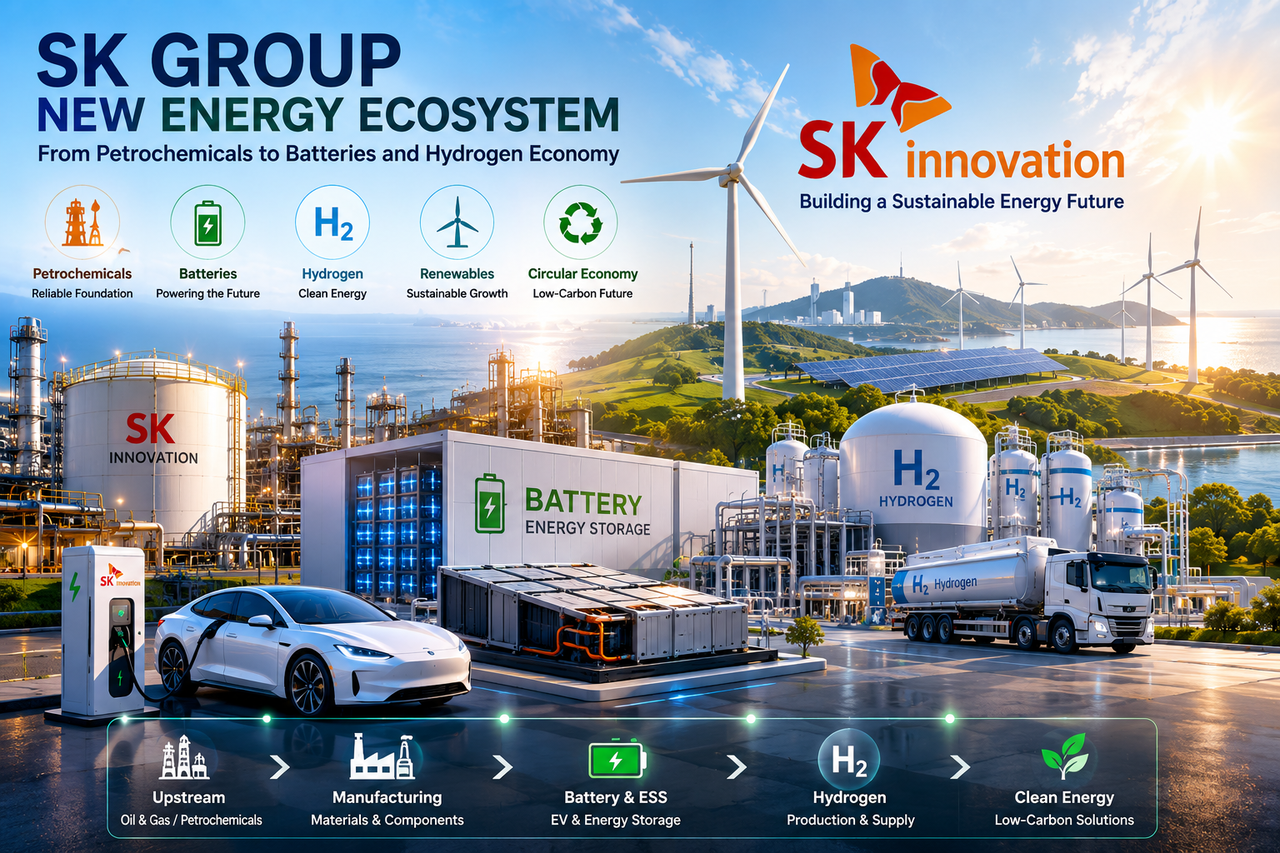
SK Innovation has long operated in energy and chemicals and is now pivoting toward power batteries and green energy. The group is also investing in hydrogen, energy storage systems, and low-carbon energy projects to adapt to the shifting global energy landscape.
This new energy push not only diversifies SK's business but also creates new long-term growth opportunities.
How to Buy SK xStocks Using USDT
SK xStocks are tokenized stock products linked to South Korea's SK stock. Gate Stocks lets users gain market exposure through a digital asset account without needing a traditional securities account. The general process for buying SK xStocks on Gate is as follows:
-
Register and complete identity verification
-
Deposit USDT into your account
-
Navigate to the SK xStocks trading page
-
Select the quantity to trade
-
Complete the purchase with USDT
-
View your holdings in the assets account
Keep in mind that tokenized stocks are digital asset products. Their trading rules, liquidity, and market risks differ from those of traditional securities markets.
What Are the Differences Between SK Group and Samsung Group?
SK Group and Samsung Group are both major South Korean chaebols, but their development paths diverge.
Samsung's core strengths lie in consumer electronics, semiconductors, and end-user devices. SK, by contrast, has built a model that balances semiconductors, energy, telecommunications, and digital infrastructure.
| Comparison Dimension |
SK Group |
Samsung Group |
| Core Strengths |
Semiconductors, Energy, Telecommunications |
Consumer Electronics, Semiconductors |
| AI Focus |
HBM and Infrastructure |
Chips and Device Ecosystem |
| Energy Business |
Strong |
Relatively Limited |
| Telecommunications Business |
SK Telecom |
No Operator Entity |
| Holding Model |
Unified Management by SK Inc. |
Multi-Entity Structure |
These differences give each company a distinct role in South Korea's economy.
Summary
SK Holdings (034730) is the strategic core of South Korea's SK Group, connecting semiconductors, energy, telecommunications, digital infrastructure, and new energy through its holding structure. Its investment philosophy emphasizes long-term industrial upgrades and capital synergy, enabling the group to stay at the forefront of global technology and energy transformation.
With the rise of artificial intelligence, high-performance computing, and green energy, SK Group's importance in HBM memory, data centers, battery supply chains, and digital infrastructure continues to grow.
FAQs
What is the relationship between SK Holdings (034730) and SK Group?
SK Holdings (034730) is the central holding entity of SK Group, overseeing group governance, capital allocation, and strategic investments. All companies within SK Group operate under a unified management framework through SK Holdings.
What is SK Group's largest asset?
SK hynix is widely considered SK Group's most valuable core asset. As a world-leading memory chip manufacturer, SK hynix holds a dominant position in the DRAM and HBM markets.
What industries does SK Group primarily operate in?
SK Group operates across semiconductors, energy, telecommunications, IT services, digital infrastructure, new energy, and biotechnology — making it a classic diversified industrial conglomerate.
What is the difference between SK xStocks and traditional stocks?
SK xStocks are tokenized stock products that reflect the value of underlying traditional stocks using blockchain technology. Their trading methods, settlement mechanisms, and market structure differ from those of traditional securities markets.
Do I need a securities account to buy SK xStocks with USDT?
Generally, users can trade using USDT on platforms that support these products without needing to open a local South Korean securities account. However, always refer to the platform's own disclosures for specific rules.