As the multi-chain ecosystem evolves, cross-chain protocols have become critical infrastructure for connecting disparate blockchains. Synapse and LayerZero represent two distinct technical approaches in the cross-chain arena. Understanding their differences provides clearer insight into how cross-chain communication networks support asset mobility and application interoperability.
What Is Synapse?
Synapse is a cross-chain interoperability protocol designed to facilitate asset transfers, liquidity sharing, and message passing across different blockchains.
Beyond its cross-chain bridge functionality, Synapse also features a cross-chain liquidity network and messaging system, enabling developers to build applications that operate seamlessly across multiple blockchains. Its core mission is to solve liquidity fragmentation and enhance inter-chain collaboration.
As chain abstraction and omnichain applications gain traction, Synapse has evolved from a simple bridge into a comprehensive cross-chain infrastructure spanning asset, messaging, and execution layers.
What Is LayerZero?
LayerZero is an interoperability protocol specialized in cross-chain message passing.
Its core design goal is to allow different blockchains to exchange information securely without requiring full nodes to synchronize all on-chain data. To achieve this, LayerZero introduces an Ultra Light Node architecture that uses oracles and relayers to jointly verify cross-chain messages.
Compared to traditional cross-chain bridges, LayerZero focuses on the messaging layer itself and provides an open communication framework, enabling developers to build omnichain applications and cross-chain asset protocols.
How Do Their Core Positions Differ?
The fundamental difference between Synapse and LayerZero lies in product positioning.
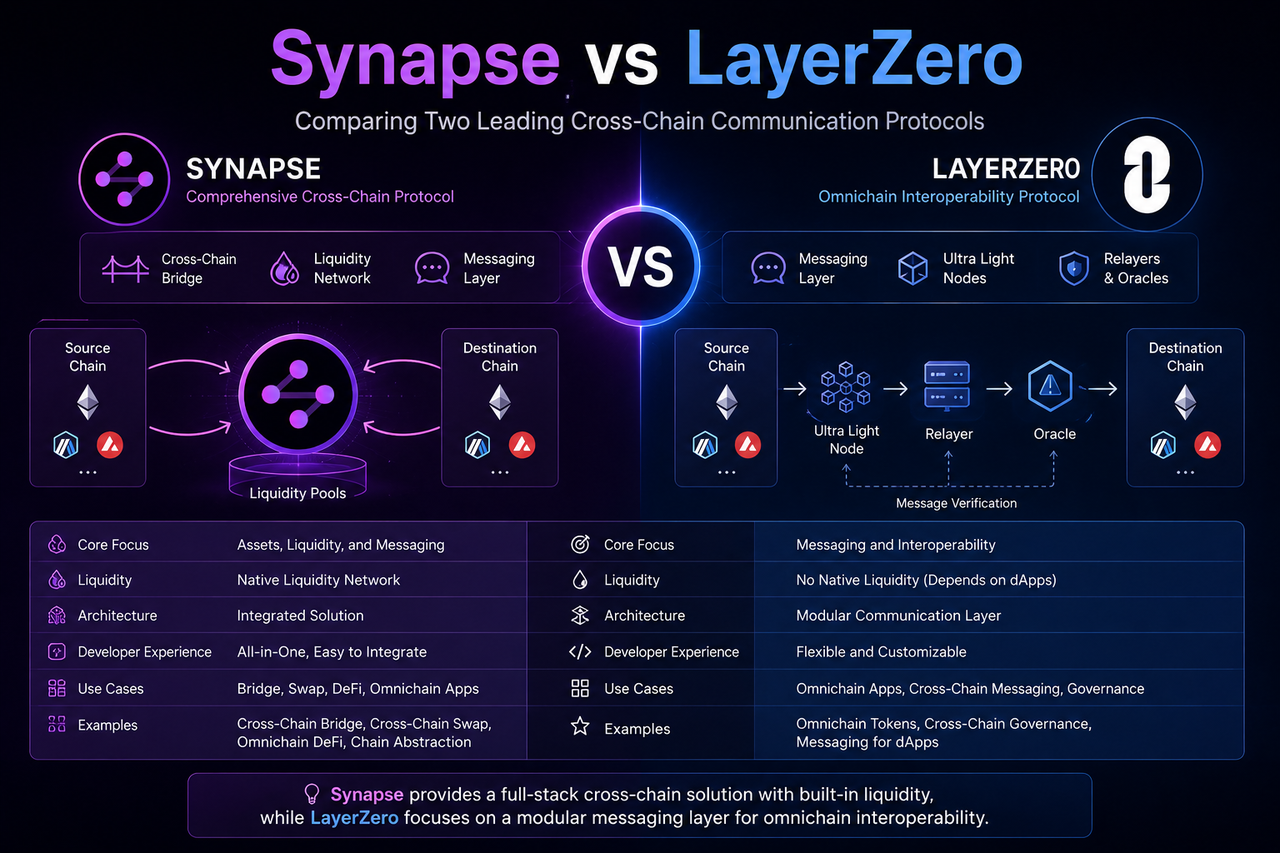
Synapse is positioned as a comprehensive cross-chain protocol that simultaneously covers liquidity networks, cross-chain bridges, and messaging. Its focus is on addressing both asset and application cross-chain needs.
LayerZero, by contrast, is positioned more as a foundational communication protocol. It does not provide liquidity directly; instead, it offers cross-chain messaging infrastructure for other protocols to build upon.
In short, Synapse is closer to a turnkey solution, while LayerZero is more akin to a foundational communication layer.
How Do Their Cross-Chain Messaging Mechanisms Differ?
Cross-chain messaging is a core capability for both, but their implementations differ.
LayerZero uses an Ultra Light Node architecture. When a message is sent from the source chain, the oracle transmits the block header while the relayer submits the transaction proof. If both verification results match, the target chain considers the message valid. Synapse's messaging system, however, is built on its own cross-chain network. The protocol verifies the message origin, completes cross-chain transmission, and triggers smart contract execution on the target chain.
From a design standpoint, LayerZero emphasizes modularity and composability, whereas Synapse prioritizes a unified cross-chain experience.
How Do Their Liquidity Models Differ?
Liquidity design is one of the most striking differences between Synapse and LayerZero.
Synapse operates its own cross-chain liquidity network. Users performing cross-chain transfers or swaps can settle directly using the protocol's internal liquidity pools.
LayerZero itself does not provide liquidity pools. Protocols built on LayerZero must source their own liquidity. For instance, Stargate is a cross-chain liquidity protocol built on LayerZero, with its liquidity network complementing LayerZero's communication layer.
Thus, Synapse integrates liquidity and communication within a single protocol, while LayerZero keeps them separate.
How Do They Support Omnichain Applications?
Omnichain applications are a key development direction for cross-chain infrastructure.
LayerZero introduced the Omnichain Application (OApp) concept, allowing apps to connect multiple blockchains through a unified messaging layer. Developers can use LayerZero's communication interfaces to let smart contracts on different networks interact.
Synapse also supports omnichain application development. Through its cross-chain messaging and liquidity network, developers can enable cross-chain lending, trading, and chain abstraction use cases.
Both support omnichain applications but with different emphases: LayerZero focuses on the communication capability itself, while Synapse focuses on the synergy between communication and execution.
How Does Developer Experience Differ?
When selecting cross-chain infrastructure, developers often consider integration complexity and flexibility.
LayerZero offers high modularity. Developers can choose different verification components based on their needs and build customized cross-chain applications. This model offers flexibility but requires more system design effort from the development team.
Synapse provides a more complete cross-chain infrastructure. Developers can directly use the protocol's existing liquidity and messaging networks, reducing additional development costs.
Therefore, LayerZero is better suited for teams needing highly customized solutions, while Synapse is ideal for developers looking to quickly build cross-chain applications.
How Do Typical Use Cases Differ?
Although both serve the cross-chain ecosystem, their common use cases vary.
LayerZero is frequently used to build omnichain tokens, cross-chain governance systems, and cross-chain communication networks. Due to its communication layer nature, many protocols adopt LayerZero as their underlying messaging infrastructure.
Synapse is more commonly used for cross-chain bridging, swapping, liquidity management, and chain abstraction applications. When a project needs both asset cross-chain and message passing, Synapse's integrated design typically offers more comprehensive support.
Synapse vs LayerZero: Core Differences Comparison
| Dimension |
Synapse |
LayerZero |
| Core Positioning |
Comprehensive cross-chain protocol |
Cross-chain communication protocol |
| Cross-chain bridge |
Supported |
Not directly provided |
| Liquidity network |
Built-in |
Relies on third-party protocols |
| Message passing |
Supported |
Core function |
| Asset cross-chain |
Supported |
Via ecosystem protocols |
| Development model |
Integrated solution |
Modular solution |
| Chain abstraction support |
Supported |
Supported |
| Typical use cases |
Bridges, swaps, omnichain dApps |
OApps, communication layer, cross-chain governance |
How Should We Understand These Two Technical Approaches?
Synapse and LayerZero are not simply competitors; they represent different technical choices in the cross-chain interoperability landscape.
LayerZero resembles the communication protocol layer of the internet, focusing on how information is securely transmitted.
Synapse is more like infrastructure that provides both a communication network and a payment network, addressing not only information transfer but also asset movement.
As chain abstraction and omnichain applications evolve, the future cross-chain ecosystem will likely adopt multiple infrastructures—communication layers, liquidity layers, execution layers—working in concert. Synapse and LayerZero each represent important components of this vision.
Summary
Both Synapse and LayerZero are important protocols in cross-chain interoperability, but they have taken different paths. LayerZero focuses on cross-chain message passing, using an Ultra Light Node architecture to connect blockchains. Synapse provides a liquidity network, cross-chain bridge, and messaging capabilities, covering asset transfers and cross-chain application execution.
Essentially, LayerZero leans toward communication layer infrastructure, while Synapse leans toward a comprehensive cross-chain protocol. Together, they drive multi-chain ecosystem development and provide foundational support for omnichain applications, chain abstraction, and cross-chain finance.
FAQs
What is the biggest difference between Synapse and LayerZero?
The key difference is in liquidity design. Synapse has a built-in cross-chain liquidity network, while LayerZero does not provide liquidity and primarily serves as a cross-chain communication layer.
Can LayerZero handle asset cross-chain transfers?
LayerZero itself handles message passing. Asset cross-chain transfers are typically executed by protocols built on LayerZero, such as Stargate.
Does Synapse support cross-chain message passing?
Yes. In addition to its cross-chain bridge, Synapse offers a Cross-Chain Messaging system for smart contract communication across chains.
Which protocol is better for building omnichain applications?
Both support omnichain applications. LayerZero is better suited as a foundational communication framework, while Synapse is ideal for applications needing both liquidity and cross-chain execution capabilities.
Are Synapse and LayerZero competitors?
They compete in some areas, but their technical approaches are not identical. LayerZero is more of a communication layer infrastructure, while Synapse offers a more complete cross-chain solution. They can also complement each other within the same ecosystem.







