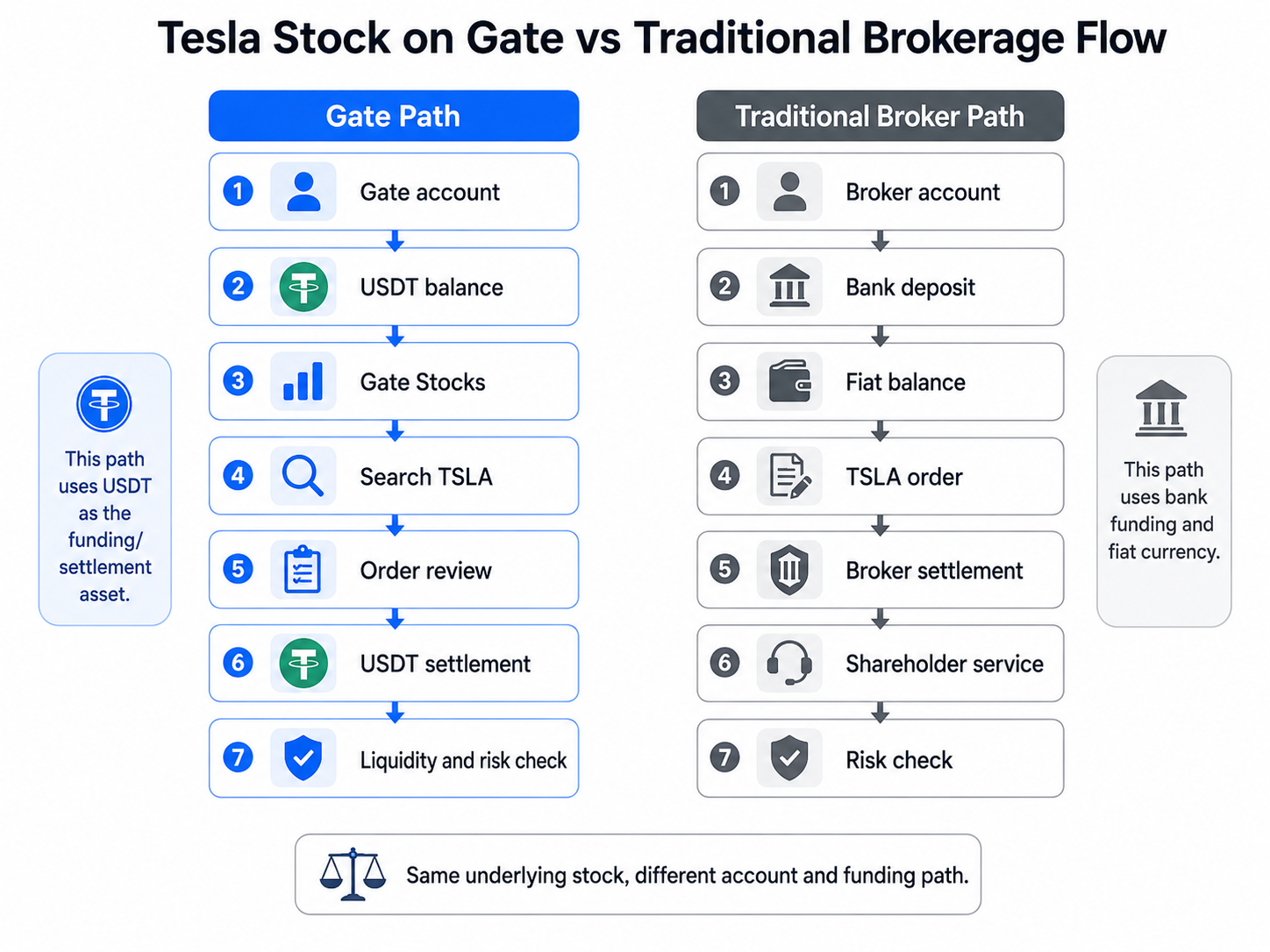
Buying Tesla stock on Gate is different from buying it through a traditional brokerage firm because Gate uses a digital-asset account and USDT settlement, while a broker usually uses bank funding, fiat currency, and a securities account.
Tesla Inc. trades on NASDAQ under the ticker TSLA. Through Gate Stocks, eligible users may access supported U.S. stock products using USDT, a U.S. dollar-pegged stablecoin commonly used in crypto markets. A traditional brokerage path is more familiar to many stock investors: open a securities account, deposit fiat currency, and trade through broker market access.
The important point is not that one route removes stock-market risk. It does not. The difference is the access path, funding asset, account structure, trading interface, and operational checks.
Buying Tesla stock on Gate refers to using an eligible Gate account and USDT balance to access supported TSLA stock trading through Gate Stocks, subject to regional availability, identity verification, trading hours, liquidity, fees, and current product rules.
What Does Buying Tesla Stock on Gate Mean?
Buying Tesla stock on Gate means using Gate Stocks to access a supported TSLA stock product through a digital-asset platform interface. Instead of first moving funds through a bank into a traditional brokerage account, an eligible user may use USDT inside Gate as the funding and settlement asset.
A typical process looks like this:
-
Prepare a Gate account and complete required identity checks.
-
Hold or obtain USDT.
-
Transfer USDT into the relevant stock account if required.
-
Search for Tesla or TSLA in Gate Stocks.
-
Review price, quantity, order type, fees, spread, and trading session.
-
Submit the order only after confirming the details.
For users already familiar with crypto balances, this can feel closer to managing multiple asset categories in one environment. For users who mainly use bank accounts and brokers, the model may feel less familiar because the funding asset is USDT rather than a direct USD cash balance.
For the operating route, buying Tesla stock with USDT on Gate gives a focused TSLA workflow.
How Is Buying Tesla Stock on Gate Different from Buying Through a Traditional Brokerage Firm?
Buying Tesla stock on Gate and buying Tesla stock through a traditional brokerage firm can both give users access to TSLA price exposure, but the path is different.
| Comparison Area |
Buying Tesla Stock on Gate |
Traditional Brokerage Firm |
| Funding entry point |
USDT inside a Gate account |
Fiat currency through bank or broker rails |
| Account structure |
Digital asset account plus stock account |
Brokerage account and securities account structure |
| Settlement asset |
USDT |
Usually USD or another fiat currency |
| Platform environment |
Crypto assets and supported stock products in one ecosystem |
Securities-focused platform |
| Trading access |
Supported stocks and ETFs through Gate Stocks |
Broker-supported U.S. market access |
| Eligibility |
Gate account status, verification, region, and product rules |
Broker onboarding, country support, tax forms, and local rules |
| User checks |
USDT balance, stock account transfer, live quote, spread, order details |
Cash balance, order type, routing, commission, settlement rules |
The table shows that the difference is mostly operational. Gate’s route may be more natural for users who already hold USDT, while a traditional broker may be more familiar for users who already manage fiat bank transfers and conventional securities accounts.
A simple analogy can help. Buying TSLA through Gate is like entering a stock market through a digital-asset doorway. Buying through a broker is like entering through a bank and securities-account doorway. The destination may be similar, but the hallway, paperwork, balance type, and checkpoints are different.
Users comparing the broader model can also review traditional brokers vs crypto platforms for U.S. stocks.
What Can Users Do on Gate That Feels Different from a Broker?
The most noticeable difference is fund management. A Gate user who already holds USDT may not need to convert crypto into fiat, withdraw to a bank, and then fund a separate brokerage account before accessing a supported stock product.
This can matter for users who already manage digital assets and want to view crypto and supported stock exposure from the same platform environment. It may also reduce the number of separate account dashboards they need to check.
Another difference is the settlement habit. In a traditional brokerage account, users usually think in cash balance, buying power, and fiat settlement. On Gate, users need to think in USDT balance, stock account transfer, displayed stock price, estimated USDT cost, and possible spread.
For a broader explanation of the USDT funding route, buying U.S. stocks with USDT covers the general stock-access flow.
Gate Stocks also offers an extended weekday trading window for supported U.S. stocks and ETFs. This does not mean every stock is available at every moment. It means eligible users should check whether TSLA is available in the active session, including regular, pre-market, or after-hours access where supported. The current Gate U.S. Stocks extended-hours rules should be checked before assuming availability.
What Are the Main Limits of Buying Tesla Stock on Gate?
The main limits of buying Tesla stock on Gate are product availability, regional eligibility, trading-hour rules, liquidity, spread, execution, and platform-specific product rules.
Users should not assume that Gate Stocks works exactly like a traditional brokerage firm. Traditional brokers may offer wider securities services, tax documents, corporate action workflows, margin products, options, funds, and other services depending on the broker and jurisdiction. Gate Stocks focuses on supported products within Gate’s product framework.
Key limitations include:
| Limit or Risk |
What It Means |
Practical Check |
| Regional availability |
Not every user or region may have access |
Confirm Gate Stocks access in the live account |
| Product support |
Not every stock or ETF may be supported |
Search TSLA and check the product page |
| Session rules |
Extended hours are not the same as 24/7 trading |
Check active trading session before ordering |
| Liquidity |
Fewer buyers or sellers may affect execution |
Review bid, ask, spread, and order size |
| Spread |
The buy and sell quote may differ |
Do not rely only on the last displayed price |
| Platform rules |
Product details may change |
Review the live order page and latest notices |
| Market risk |
TSLA price can fluctuate significantly |
Size orders based on personal risk tolerance |
This table matters because operational convenience does not remove risk. Even if the funding process feels simpler for a USDT holder, the order still depends on TSLA market price, liquidity, session status, and execution conditions.
For spread and order-quality checks, Gate U.S. Stock liquidity and spread is especially relevant.
What Is an Example of Choosing Between Gate and a Traditional Brokerage Firm?
Consider two users who both want TSLA exposure.
User A already holds USDT on Gate and has completed the required verification. This user opens Gate Stocks, searches TSLA, checks whether Tesla is available in the current session, reviews the live quote, spread, estimated USDT cost, order type, and fee, then decides whether to place an order.
User B mainly uses a bank account and already has a traditional brokerage account. This user deposits fiat currency, checks available buying power, searches TSLA on the broker platform, reviews order type and market session, then places an order through the broker.
Both users are looking at the same underlying company, Tesla. The difference is how they enter the market. User A starts from a digital-asset balance. User B starts from a banking and brokerage balance.
This example also shows why “which is better” is not the right first question. A more useful question is: which account structure, funding route, settlement asset, documentation process, and risk-control workflow does the user understand better?
Users who want to compare stock access with derivatives should distinguish this topic from U.S. stock spot vs futures on Gate, because futures can involve different mechanics such as margin, leverage, funding costs, and liquidation risk.
What Should Users Check Before Trading TSLA on Gate or Through a Broker?
Before trading TSLA on Gate or through a broker, users should check the same core market risks and the route-specific operational details.
For Gate Stocks, check:
-
Whether Gate Stocks is available for the account and region.
-
Whether identity verification and any required permissions are complete.
-
Whether the account has enough USDT.
-
Whether funds need to be transferred into a stock account.
-
Whether TSLA is supported and available in the current session.
-
The live price, bid, ask, spread, quantity, order type, estimated cost, and fee.
-
Whether the order is being placed during regular, pre-market, or after-hours access.
-
Whether product rules, fees, or access conditions have changed.
For a traditional broker, check:
-
Whether the brokerage account is active and funded.
-
Whether the broker supports U.S. stock trading for the user’s region.
-
Whether tax forms, currency conversion, and local requirements are complete.
-
Whether the user has enough buying power.
-
The order type, quote, commission, exchange fees, and settlement rules.
-
Whether extended-hours trading requires separate permission.
For both routes, the core investment risk remains. Tesla is a publicly traded company whose share price may move because of earnings, delivery data, EV competition, software and AI developments, interest rates, macroeconomic conditions, market sentiment, and company-specific news. No access route can remove that risk.
Summary
Buying Tesla stock on Gate and buying it through a traditional brokerage firm are two different access paths. Gate uses a digital-asset account structure and USDT settlement for eligible users. Traditional brokers usually use bank funding, fiat currency, and a securities-account structure.
Gate may feel more convenient for users who already hold USDT and want to manage supported stock products and crypto assets in one environment. A traditional broker may feel more familiar for users who rely on banks, fiat cash balances, and securities-focused services.
The practical takeaway is simple: compare the funding route, account setup, settlement asset, trading hours, product support, liquidity, fees, documentation, and risk checks. Do not compare only the buy button.
Stock investing involves market risk, and prices may fluctuate significantly. Please make decisions carefully based on your own risk tolerance. This article does not constitute investment advice.
FAQs
What is the difference between buying Tesla stock on Gate and buying it through a traditional brokerage firm?
Buying Tesla stock on Gate differs from buying it through a traditional brokerage firm mainly because Gate uses USDT and a digital-asset account structure, while a broker usually uses fiat funding and a securities account. The market risk of TSLA remains in both routes.
Is buying Tesla stock on Gate the same as using a traditional broker?
Buying Tesla stock on Gate is not the same as using a traditional broker. Gate provides a crypto-platform access path with USDT settlement, while a broker usually provides securities-account access through bank and fiat rails.
Does buying Tesla stock on Gate require USDT?
Buying Tesla stock on Gate generally uses USDT as the settlement asset. Users should confirm the required account balance, transfer route, and order details in the live Gate interface before placing an order.
Can users buy Tesla stock on Gate outside regular U.S. market hours?
Buying Tesla stock on Gate may be possible during supported extended-hours sessions if TSLA is available, the user is eligible, and current product rules allow it. Extended-hours access is not the same as full 24/7 stock trading.
What risks should users check before buying Tesla stock on Gate?
Buying Tesla stock on Gate involves market risk, liquidity risk, spread risk, execution risk, regional availability limits, and platform rule changes. Users should review live price, bid, ask, spread, estimated USDT cost, fee, order type, and current session before confirming.
Which is better for Tesla stock, Gate or a traditional brokerage firm?
There is no universal answer because Gate and traditional brokerage firms serve different account habits and funding routes. Users should compare account access, settlement asset, documentation needs, trading hours, product rules, and their own risk tolerance instead of treating one route as automatically better.







