Why Do Institutional Lending Markets Need a New Risk Model?
In the early DeFi lending market, the dominant model was overcollateralization: users had to deposit high-value assets before they could borrow other tokens. The entire process relied almost entirely on on-chain liquidation mechanisms. But as the market began moving toward institutionalization, the demands evolved.
Large capital isn't just interested in simple crypto lending anymore. It's now getting into:
- Real World Assets (RWA)
- Stablecoin liquidity
- Institutional-grade credit markets
- On-chain financing operations
These markets typically involve more off-chain assets and complex financial structures. That means traditional DeFi risk management may no longer cut it. For institutions, what really matters isn't just the collateral ratio—it's the ability to continuously monitor the borrower's overall asset health.
What Problems Does Traditional Institutional Lending Face?
In traditional finance or some CeFi lending platforms, risk management usually depends on manual reviews and periodic reporting. Borrowers might have to submit financial data, collateral statements, or asset proof on a regular basis, and lenders assess risk based on that information.
The problem is the built-in lag. Market conditions can change in an instant, but lenders are stuck relying on data that's days or even weeks old. If the market takes a sharp turn, risk can pile up fast.
What's more, when data comes from different sources, inconsistencies are common.
For instance:
- On-chain and off-chain assets are hard to sync
- Data formats vary from exchange to exchange
- Centralized platforms lack transparency
- It's tough to verify collateral authenticity
These are exactly the reasons many institutions remain cautious about on-chain finance.
What Are Virtual Vaults?
 (Source: spaceandtime)
Virtual Vaults is a real-time data monitoring and verification system launched by Space and Time. Its primary goal is to improve transparency in on-chain lending. Think of it as a verifiable digital vault: lenders can set the monitoring conditions they need.
For example, they can specify which assets are acceptable as collateral, which trading platforms to track, or set a minimum collateral ratio. The system then continuously monitors the borrower's on-chain and some off-chain asset positions, using cryptographic verification to confirm data authenticity. The key difference from traditional finance is that this isn't a static report—it's near-real-time risk data.
How Do Virtual Vaults Work?
 (Source: spaceandtime)
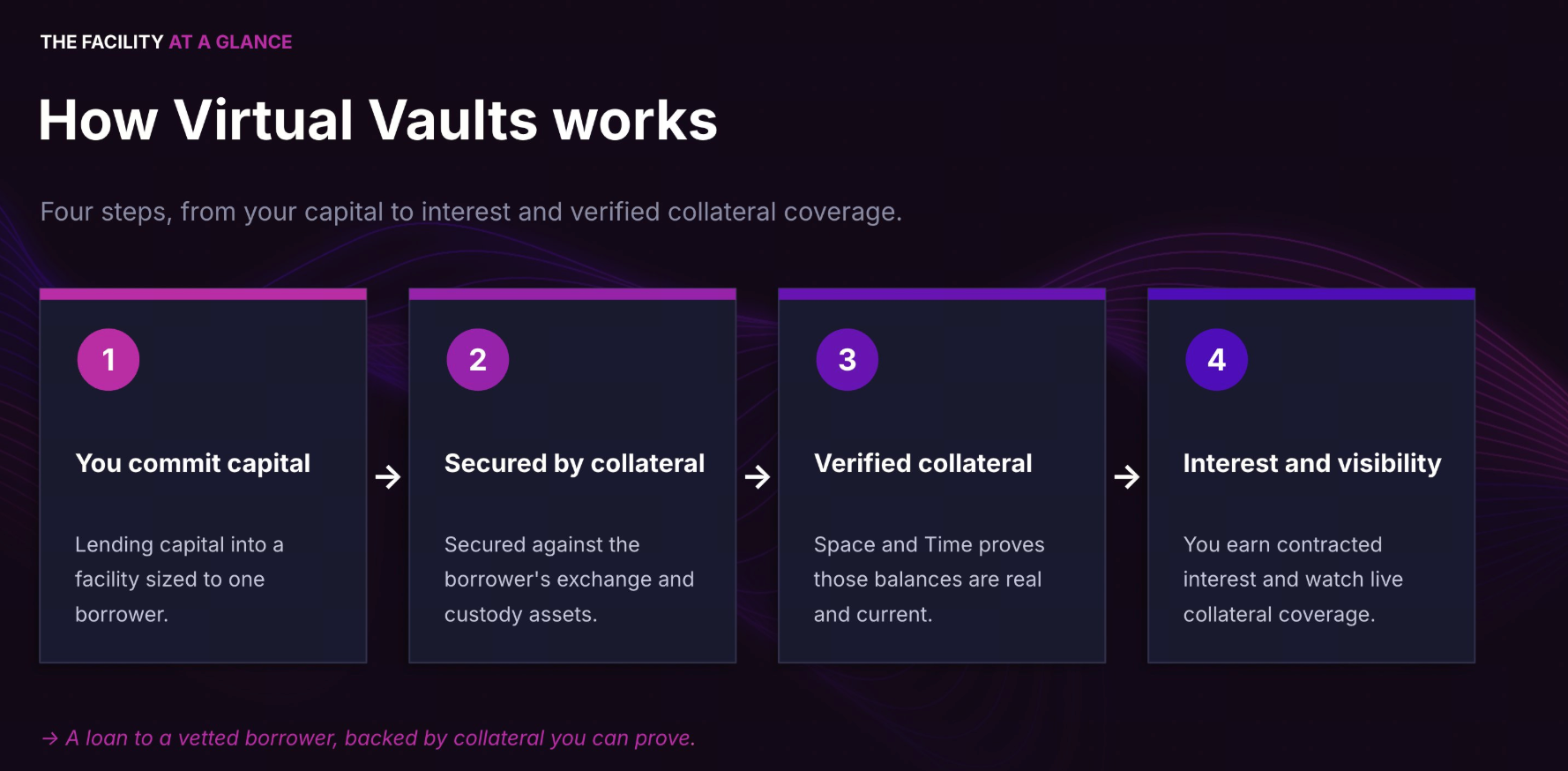
When a lending relationship is established, Virtual Vaults start continuously monitoring the borrower's asset data. The system first gathers information from various blockchains, exchanges, and data sources, then integrates it using Space and Time's data verification framework.
If specific conditions are triggered—like:
- Collateral ratio drops below a safe threshold
- Asset prices swing sharply
- Suspicious activity in designated wallets
- The system can issue risk alerts in real time.
Because the data comes with verifiable proofs, lenders don't have to blindly trust a single platform's information. Instead, they get transparency through data they can actually verify.
Why Does the RWA Market Need Verifiable Data?
RWA (Real World Assets) has become one of Web3's most important growth areas. As bonds, funds, real estate income rights, and corporate assets are tokenized on-chain, the market is no longer just about crypto trading—it's approaching the scale of traditional finance.
But the biggest challenge with RWA is data credibility. These assets involve tons of off-chain information, like:
- Asset valuations
- Legal documents
- Financial statements
- Income performance
- Collateral management
If you can't verify those data sources, it's nearly impossible to attract large institutions to on-chain finance.
Systems like Virtual Vaults are becoming essential infrastructure for the institutional market.
Space and Time's Role in the Web3 Ecosystem
 (Source: spaceandtime)
Space and Time isn't just a data platform—it's aiming to be Web3's trusted data infrastructure. Oracles used to solve the problem of getting data onto the blockchain. Space and Time goes further: how do you prove that data is trustworthy?
This role will only become more important as on-chain finance grows. As institutional capital scales up, the demand for data transparency, auditability, and robust risk standards will rise with it. A verifiable data layer is likely to become the backbone of Web3 finance.
Summary
Virtual Vaults reflects a shift: on-chain finance is moving beyond simple token trading into a more mature institutional framework. As the market scales, what matters isn't just transaction speed—it's whether data can be trusted, risk can be verified, and transparent risk controls can be built.
Space and Time aims to make DeFi suitable for institutions and large capital through real-time data verification and a monitorable on-chain risk architecture. As RWA and institutional DeFi continue to expand, verifiable data systems like Virtual Vaults are set to become a core part of the Web3 ecosystem.







