Nodes in traditional blockchain networks usually focus mainly on transaction validation and consensus maintenance. Theta, however, needs to support not only blockchain operations, but also video delivery, GPU sharing, and edge computing tasks. For that reason, Theta does not use a single-node model. Instead, it has designed a multi-layer node system, where different nodes are responsible for different functions in the network.
As Web3 and AI infrastructure increasingly converge, Theta’s node architecture is also seen as an important example of how blockchain and edge computing can be combined. The coordination between Validator, Guardian, and Edge Nodes affects not only network security and governance, but also the operating efficiency of Theta EdgeCloud and its AI GPU network.
Why Theta Uses a Layered Node Structure
Theta’s network needs to maintain blockchain consensus while also supporting complex tasks such as video streaming and AI edge computing. If every node had to handle all functions at once, the network’s operating efficiency and scalability could be affected.
For this reason, Theta uses a layered node structure, assigning different responsibilities to different types of nodes. Some nodes focus on block validation and network security, while others focus on edge computing and resource sharing.
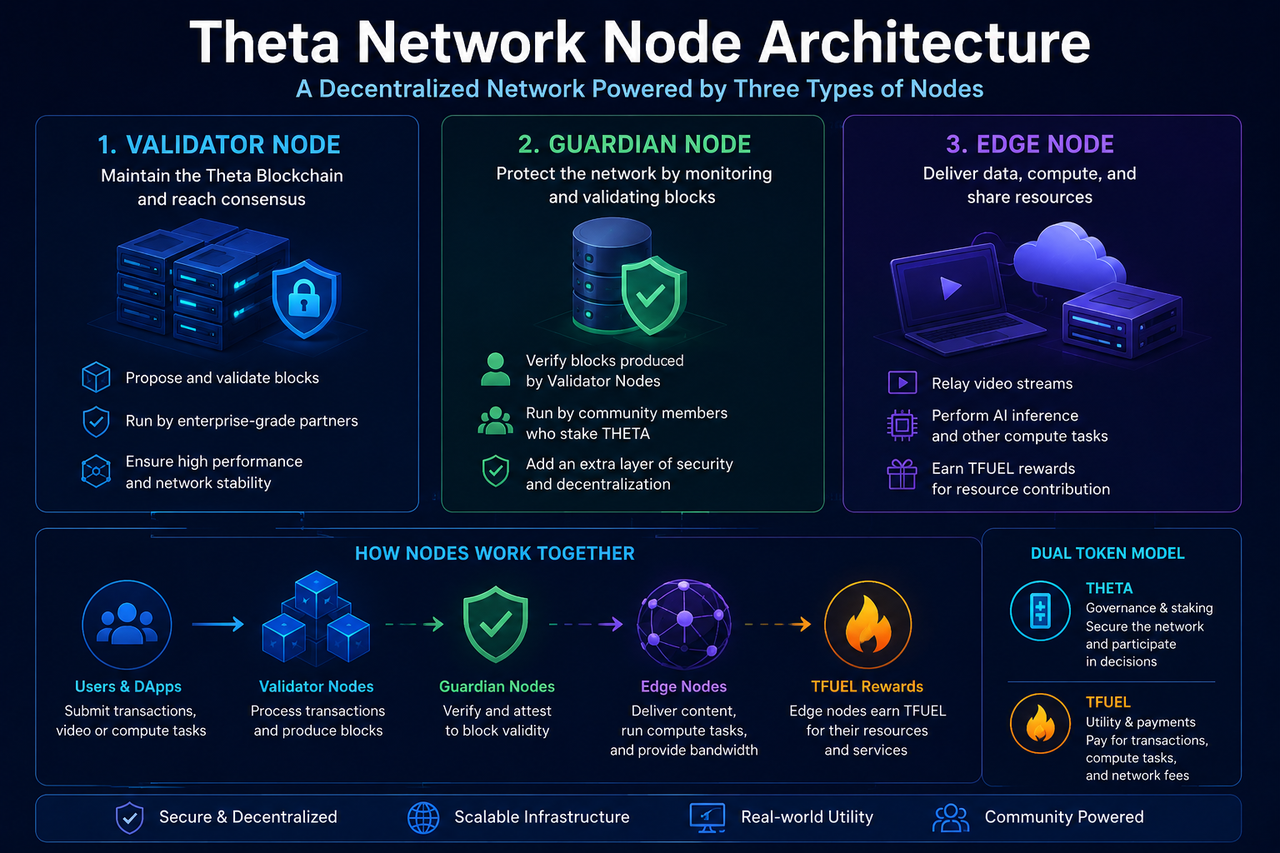
The core goal of this design is to improve network performance while also preserving decentralization and resource coordination.
Compared with traditional blockchains, Theta’s node system is closer to a hybrid architecture that combines “blockchain + edge cloud.”
What Role Does a Validator Node Play in Theta?
Validator Nodes are the core validation nodes in the Theta network. They are mainly responsible for block production and main chain validation.
When new transactions and data appear in the network, Validator Nodes participate in block packaging and the consensus process, maintaining the normal operation of the blockchain. These nodes are usually run by companies or institutions with strong infrastructure capabilities.
Some enterprise-level node operators in the Theta network include:
-
Google Cloud
-
Samsung
-
Sony
-
Binance
Validator Nodes help improve network stability and transaction processing efficiency.
Because these nodes carry significant responsibility for network security, they usually require stronger hardware and node maintenance capabilities.
How Guardian Nodes Maintain Network Security
Guardian Nodes are the second-layer validation nodes in the Theta network. Their core function is to provide secondary confirmation and oversight of block results produced by Validator Nodes.
This structure is similar to a two-layer mechanism made up of a “primary validation layer + community oversight layer.” Even if some Validator Nodes behave abnormally, Guardian Nodes can participate in validation and supervision, improving network security.
Community users can participate in Guardian Node operations by staking THETA, which also makes Guardian Nodes an important part of Theta’s decentralized governance.
Compared with Validator Nodes, Guardian Nodes generally have a lower participation threshold, allowing more community users to take part in maintaining network security.
This mechanism also helps reduce the network’s reliance on a small number of large nodes.
Why Edge Nodes Are an Important Part of the Theta Ecosystem
Edge Nodes are the core nodes in Theta’s edge computing network. They are mainly responsible for video relaying, AI inference, GPU sharing, and edge task execution.
Unlike Validator Nodes and Guardian Nodes, Edge Nodes do not primarily participate in block consensus. Instead, they focus more on resource sharing and computing task execution.
After users run an Edge Node, they can contribute:
-
GPU computing power
-
CPU resources
-
Bandwidth
-
Edge storage capacity
When there is demand for AI inference, video transcoding, or rendering in the network, some tasks are assigned to Edge Nodes for execution. After completing tasks, nodes can earn TFUEL rewards.
With the launch of Theta EdgeCloud, Edge Nodes have become even more important within the AI and GPU network.
How Theta’s Node System Supports EdgeCloud
Theta EdgeCloud depends on coordination between different parts of the node system.
Validator Nodes and Guardian Nodes maintain the blockchain and network security, while Edge Nodes handle actual GPU and edge computing tasks. After developers submit AI inference or video processing requests, the system assigns some tasks to the Edge Node network for execution.
At the same time, the blockchain layer records resource payments, task rewards, and network status, helping keep the entire system stable.
This structure allows Theta to support:
-
Blockchain governance capabilities
-
A distributed GPU network
-
AI edge computing capacity
-
Decentralized resource scheduling
Compared with traditional blockchain projects, Theta’s node system is more closely integrated with AI infrastructure.
How Theta’s Node System Differs from Traditional Blockchains
Nodes in traditional PoS blockchains usually focus mainly on:
-
Block validation
-
Transaction processing
-
Network consensus
Theta’s node system, however, must maintain the blockchain while also supporting video and AI infrastructure functions.
As a result, Theta Edge Nodes are closer to “resource nodes” than simple consensus nodes.
This model also connects Theta with concepts such as DePIN and distributed GPU networks, because nodes in the network not only validate transactions, but also provide real physical resources.
In a sense, Theta’s node structure is more like a combination of a “blockchain network + edge cloud platform.”
Advantages and Challenges of Theta’s Node System
The main advantage of Theta’s layered node structure is that it separates network security from resource computation.
Validator and Guardian Nodes focus on consensus security, while Edge Nodes focus on executing video and AI tasks. This structure helps improve overall network efficiency and supports more complex edge computing scenarios.
In addition, Edge Nodes’ open participation model can also improve the utilization of GPU and bandwidth resources.
However, this structure also comes with certain challenges.
For example, node network stability and GPU performance may vary across regions, while distributed resource scheduling itself increases system complexity. At the same time, as demand for AI computing grows, how to keep attracting Edge Nodes to contribute resources has become one of Theta’s key long-term development issues.
Summary
Theta Network uses a layered node system made up of Validator Nodes, Guardian Nodes, and Edge Nodes. Different node types are responsible for block validation, network security, and AI edge computing tasks.
This structure not only supports blockchain consensus operations, but also provides infrastructure capacity for video streaming, GPU sharing, and Theta EdgeCloud. As the AI and DePIN ecosystems continue to develop, Theta’s node architecture is gradually becoming one of the key features that sets it apart from traditional blockchain projects.
By layering governance, security, and resource computation into a collaborative structure, Theta aims to build a decentralized infrastructure network with both blockchain capabilities and edge computing capacity.
FAQs
What Types of Nodes Does Theta Network Have?
Theta Network mainly includes three types of nodes: Validator Nodes, Guardian Nodes, and Edge Nodes.
What Does a Validator Node Do?
Validator Nodes are responsible for block production, transaction validation, and main chain consensus maintenance.
Why Are Guardian Nodes Important?
Guardian Nodes supervise Validator Nodes and participate in secondary network validation, improving decentralization and network security.
What Can Edge Nodes Do?
Edge Nodes can be used for video delivery, AI inference, GPU sharing, and edge computing task execution.
How Can Users Participate in Theta’s Node Ecosystem?
Users can run an Edge Node or stake THETA to participate in the Guardian Node system.
Because Theta’s nodes not only validate blockchain transactions, but also share GPU, bandwidth, and computing resources, it is often classified as part of the DePIN infrastructure network.







