U.S. Dollar Payment Token (USDPT) – from minting to cash-out at Western Union agent locations – links four stages: issuance by Anchorage Digital Bank, transfer on the Solana blockchain, access via the Western Union Digital Asset Network, and fiat delivery at Western Union agent locations. USDPT (Western Union Stablecoin) describes the overall framework of USDPT across three dimensions: issuance division, Solana contract standards, and Digital Asset Network use cases.
In cross-border payment scenarios, users typically need to obtain on-chain dollar tokens first and then use them as local fiat at the destination. One of USDPT's core goals is to connect the 1:1 dollar-pegged token on Solana with Western Union's global agent network, giving digital assets a predictable offline cash-out path.
Below, each stage is broken down in repeatable order by trigger conditions, verification points, and risks. Actual availability depends on market-specific licensing.
Process Overview: Four-Stage Path from Minting to Cash-Out
From entering circulation to becoming local fiat currency at a Western Union agent location, USDPT follows four sequential stages. Stage 1: Anchorage Digital Bank mints USDPT on Solana after receiving dollar reserves. Anchorage Digital Bank Issues USDPT covers the minting triggers and reserve release mechanism that form the operational basis for this stage. Stage 2: Users hold and transfer tokens through partner exchanges or wallets. Stage 3: The Digital Asset Network receives cash-out requests and handles compliance and routing. Stage 4: Western Union agent locations deliver local fiat to the user.
| Stage |
Main Participant |
Core Action |
Output |
| Minting and Circulation |
Anchorage Digital Bank |
USD into reserve → mint USDPT on Solana |
On-chain transferable USDPT |
| Acquisition and Holding |
Exchange / Wallet User |
Buy, deposit, or receive USDPT |
User-controlled on-chain balance |
| Network Access |
Digital Asset Network |
Receive cash-out instructions, compliance review, routing |
Executable cash-out authorization |
| Offline Delivery |
Western Union Agent Locations |
Verify identity and pay local fiat |
User receives fiat cash or equivalent |
The table above summarizes the division of labor: minting takes place at the issuer and public chain layer; cash-out occurs at the Western Union agent network. On the user side, the process typically starts with holding USDPT, without direct involvement in Anchorage's minting.
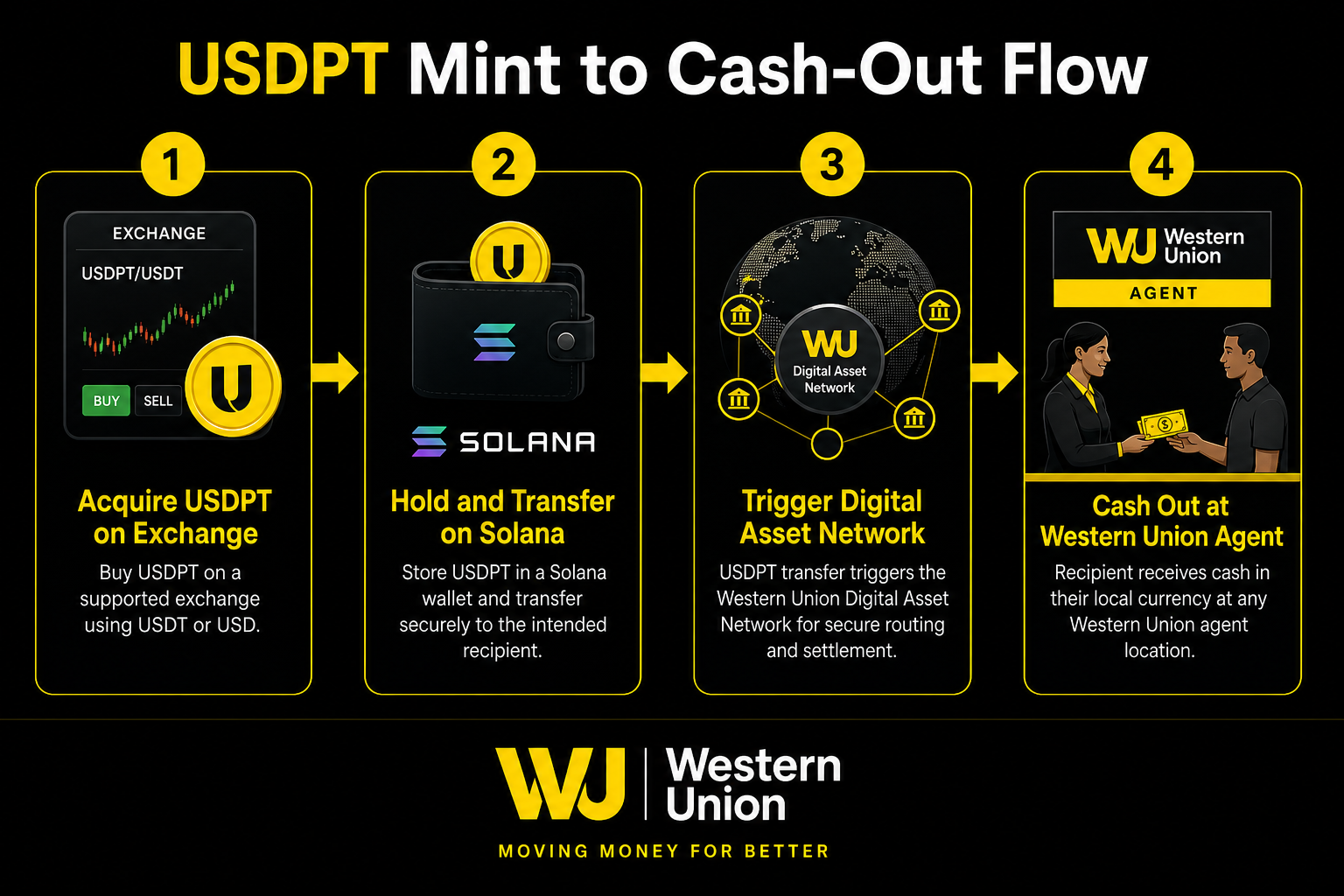 Figure 1. USDPT four-stage flow: Exchange acquisition → Holding on Solana → Digital Asset Network → Fiat cash-out at Western Union agent locations.
Step 1: How to Acquire USDPT on an Exchange?
The most common entry point for users to acquire USDPT is a global virtual asset exchange. Exchanges typically purchase USDPT from Anchorage Digital Bank or its authorized channels and then distribute tokens to user accounts. After completing identity verification and compliance checks, users can obtain USDPT balances by exchanging fiat or existing digital assets.
During acquisition, verify: the official Solana SPL USDPT, the contract address HVWf8JmLoHs99Lw8Psf3fyqAtA4crWxCPkrmSdNjhNH3, and whether the exchange supports deposits, withdrawals, and cash-out integration. USDPT vs USDC vs USDT helps differentiate the selection logic among USDPT, USDC, and USDT based on issuer and cash-out path. If you plan to cash out through the Digital Asset Network's agent locations, also confirm that the app is connected to the network and that your market is within the supported scope.
Step 2: How Do On-Chain Holding and Transfers Work?
USDPT follows the Solana SPL Token standard. It can remain on an exchange or be withdrawn to a self-custodial wallet. On-chain transfers require verification of the contract address and the Solana network. Transactions are typically irreversible after confirmation. An incorrect address or lost private key can result in permanent loss of assets.
In planned scenarios, cash-out at agent locations is typically initiated through a partner exchange app that has integrated the Digital Asset Network. The on-chain balance is linked to the platform account, rather than requiring the user to show a private key at the agent location.
Step 3: How Does the Digital Asset Network Trigger Cash-Out?
The Digital Asset Network is the middleware layer that connects virtual asset platforms with Western Union's global cash-out infrastructure. USDPT vs Western Union Traditional Remittance compares the structural differences in fund flow and intermediate steps between the two paths, helping you understand the Digital Asset Network's routing role between on-chain USDPT and offline fiat delivery.
Typical trigger conditions include: platform KYC/AML completed, market supports USDPT cash-out, sufficient balance, and the target agent location is serviceable. The network layer does not mint USDPT but maps on-chain dollar value into Western Union's compliance and settlement system. The integration of additional wallets and fintech platforms varies by market; refer to the specific app's feature documentation.
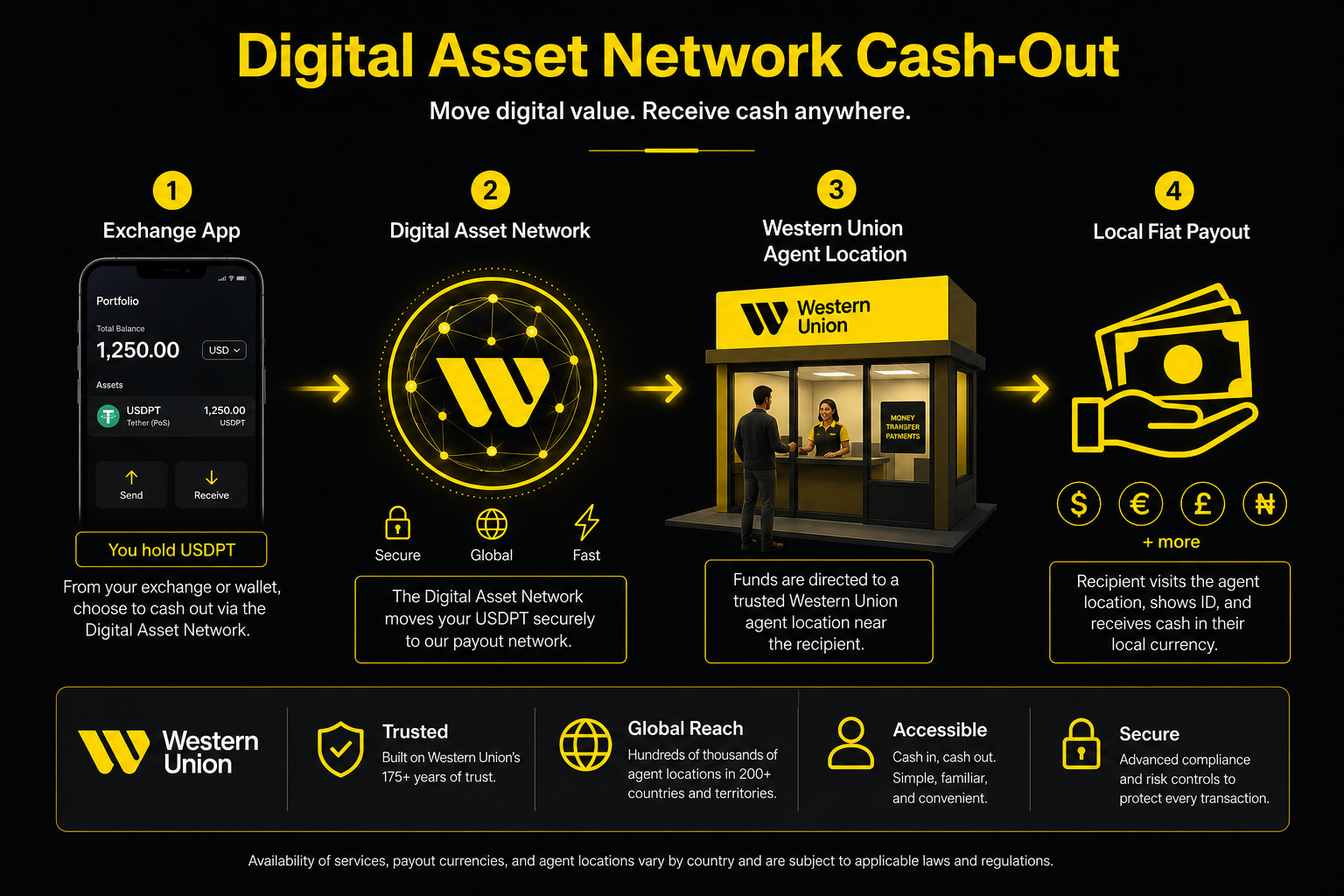 Figure 2. Digital Asset Network trigger path: User initiates cash-out on partner app → Network compliance and routing → Western Union agent locations deliver local fiat.
Step 4: How to Cash Out at Western Union Agent Locations?
After the Digital Asset Network processes the cash-out instruction, the user goes to the designated Western Union agent location to complete the offline steps. The typical process includes: generating or displaying a cash-out voucher in the app, bringing ID to the agent location, having the agent verify identity and transaction status, and the agent location paying out fiat cash or an equivalent delivery method per local regulations.
Not every Western Union agent location supports USDPT cash-out. Before initiating a request, confirm available locations, limits, fees, and documentation requirements. Regulations vary by country, so the cash-out currency and amount limits may differ. Once cash-out is complete, the USDPT balance is deducted, and the corresponding on-chain or platform ledger is updated.
Before going through the full process from minting to cash-out, check key fields at each stage to reduce the risk of wrong contracts, unsupported markets, or unavailable agent locations.
| Verification Stage |
Required Checks |
Purpose |
| Acquiring USDPT |
Contract address, Solana network, platform compliance status |
Avoid counterfeit tokens and wrong chain |
| On-Chain Operations |
Recipient address, fees, sufficient balance |
Prevent irreversible transfer errors |
| Initiating Cash-Out |
Whether app integrates with Digital Asset Network, market support |
Confirm cash-out channel availability |
| Agent Location Pickup |
Agent location list, limits, ID documents, local regulations |
Ensure offline steps can be completed |
The table above lists the core verification items for each stage. The contract address HVWf8JmLoHs99Lw8Psf3fyqAtA4crWxCPkrmSdNjhNH3 should be rechecked before every on-chain operation. The reserve and 1:1 peg relationship is on the issuer side; USDPT Reserves and 1:1 Peg provides verification from the perspective of asset types and on-chain supply. Users should also note that USDPT is not protected by FDIC insurance.
What Are the Risks in the USDPT Cash-Out Process?
| Risk Type |
Manifestation |
Association with the Process |
| Compliance and Availability |
Some markets restrict or suspend services |
Not all agent locations support USDPT |
| Liquidity and Redemption |
Large-scale redemptions may cause delays |
Separate from on-chain transfer speed and agent location fiat inventory |
| Operational and Security |
Wrong address, counterfeit tokens, platform security incidents |
Different risk profiles for self-custody vs. platform custody |
| Expectation Gap |
Scenarios like remittance pickup, Visa card vary by market |
Unavailable features should not be assumed as ready services |
The table above summarizes four risk categories. Changes in national regulatory policies may affect the scope of the Digital Asset Network and agent location cash-out. USDPT's value backing comes from Anchorage Digital Bank's reserves and is not protected by FDIC insurance.
Summary
The complete flow of USDPT from minting to cash-out at Western Union agent locations can be summarized as: Anchorage Digital Bank mints tokens on Solana → Users acquire and hold through exchanges or wallets → The Digital Asset Network receives cash-out requests and completes compliance routing → Western Union agent locations deliver local fiat currency. The four stages correspond to issuance, on-chain circulation, network access, and offline delivery. User-side operations typically start with acquiring USDPT and confirming platform integration status.
At each stage, contract address, market support, and identity compliance must be verified. USDPT is not protected by FDIC insurance or backed by the U.S. government.
FAQ
How many steps are needed from acquiring USDPT to cashing out at an agent location?
Typically four steps: acquire USDPT on a partner exchange; hold on Solana or via a platform-linked balance; initiate a cash-out request through the Digital Asset Network; collect local fiat at a Western Union agent location. The exact interface and steps vary by platform.
What does the Digital Asset Network do in the process?
The Digital Asset Network connects virtual asset platforms with Western Union's global cash-out infrastructure. After a user initiates a cash-out request on a partner app, the network performs compliance checks and routes the request to an available agent location, bridging on-chain dollar value with offline fiat delivery.
Do all Western Union agent locations support USDPT cash-out?
No. While Western Union has a large number of agent locations worldwide, USDPT cash-out at agent locations is only available in select markets and participating locations. Users should confirm available locations and limits through their platform before initiating a request.
How to confirm it is the official USDPT during on-chain transfers?
Verify the Solana network and the SPL token contract address HVWf8JmLoHs99Lw8Psf3fyqAtA4crWxCPkrmSdNjhNH3, and confirm that the token symbol and issuer information match the public details of Anchorage Digital Bank to avoid confusion with counterfeit tokens.
Is USDPT cash-out protected by FDIC deposit insurance?
No. USDPT is not a bank deposit, is not FDIC-insured, and is not guaranteed by the U.S. Treasury or the Federal Reserve. Its value is backed by U.S. dollar reserves held by Anchorage Digital Bank. Cash-out at agent locations is governed by Western Union and local regulations.
Can USDPT in a self-custodial wallet be cashed out directly at a Western Union agent location?
In planned scenarios, the Digital Asset Network primarily interfaces with partner exchanges and wallet platforms. Self-custody users typically need to first confirm whether their wallet or intermediary platform is integrated with the network. If not, they may need to use a supported platform to complete the cash-out, rather than showing their private key directly at the agent location.







