The core difference between virtual and physical U cards is not whether they are “U cards,” but which payment medium and environments they serve. Under the classification in mainstream crypto card types, virtual cards lean toward online payment tools; physical cards lean toward offline payment carriers that plug into in-person acceptance networks. Choosing based only on “can I get a card?” often misses later gaps in payment success, withdrawal, and replacement.
What Are Virtual and Physical U Cards?
A virtual U card exists as digital credentials—card number, expiry date, and security code—usually bindable to online checkout, subscriptions, or digital merchants without physical delivery. Its main advantage is speed: after account steps complete, users can often pay online immediately. That makes it attractive for users who need to test a payment path quickly or complete digital purchases without waiting for shipping.
A physical U card is a tangible card with stronger compatibility for in-person spending. Issuance typically involves card production, shipping, and activation, so the timeline is longer. It covers POS terminals, many brick-and-mortar merchants, and—where supported—ATM networks. For frequent travel, offline retail, or emergency backup payment, a physical card usually offers more practical coverage.
Both forms share the same high-level U card logic described in U card vs bank and prepaid cards: crypto or platform assets fund a spendable balance, then card-network rails reach merchants. The split between virtual and physical is therefore about delivery and acceptance environment, not about whether the product is “crypto-linked.”
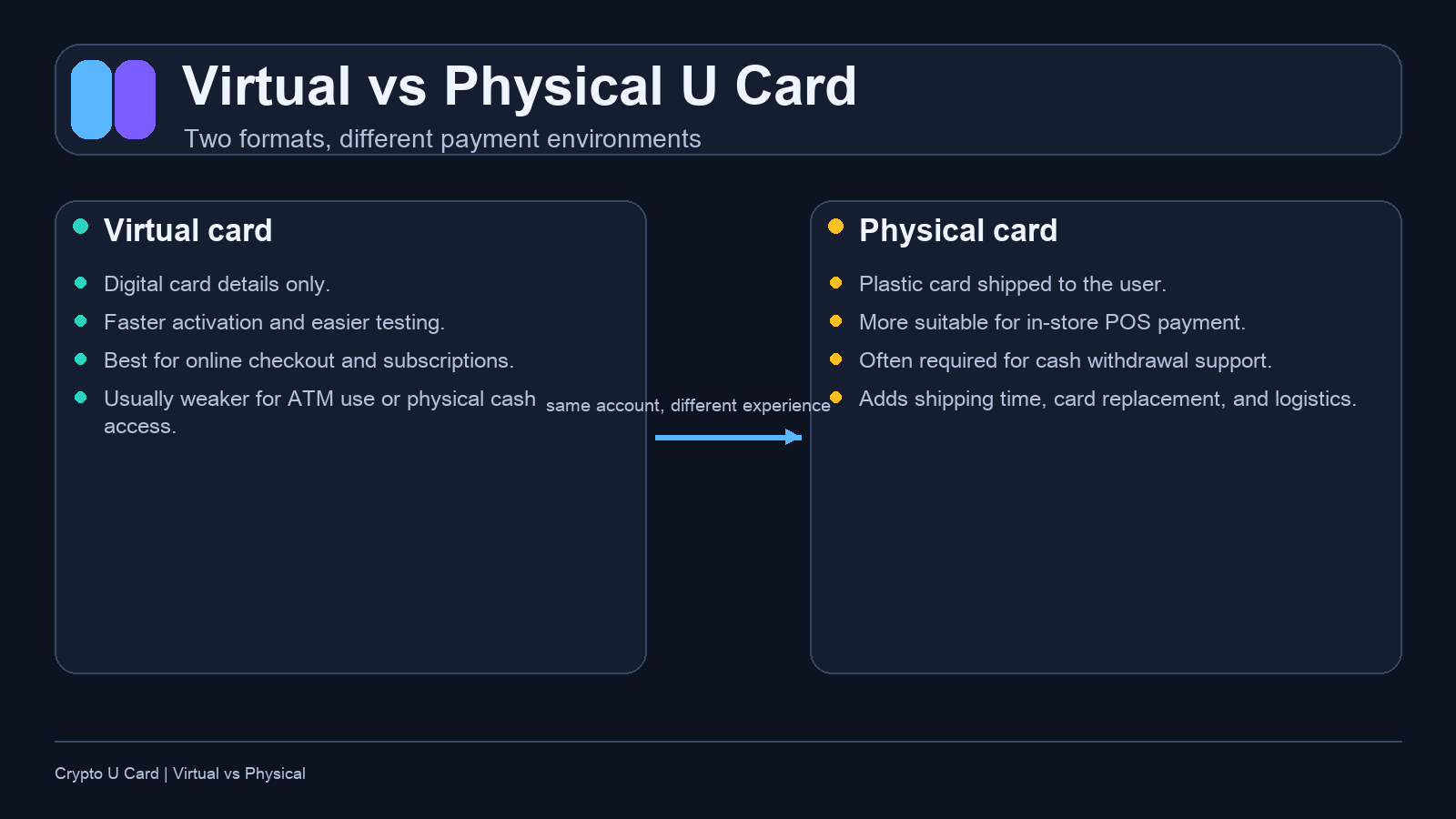
What Are the Core Differences?
| Dimension |
Virtual U card |
Physical U card |
| Issuance speed |
Fast; often usable right after onboarding |
Slower; production, logistics, activation |
| Primary use |
Online payments |
In-store POS, travel, ATM |
| Cash withdrawal |
Often limited or unsupported |
Generally stronger; network- and region-dependent |
| Delivery |
Digital card details |
Physical card shipment |
| Risk controls |
Varies by issuer; some lower entry barriers |
Often stricter identity and regional rules |
The essential distinction is that virtual cards optimize for “quick online payment capability,” while physical cards optimize for “bringing payment capability into real merchant environments.” They are complements, not strict substitutes—many users eventually hold both if their spending spans online subscriptions and offline travel.
Which Online Payment Scenarios Fit Virtual U Cards?
Virtual U cards fit subscription services, international e-commerce, advertising platforms, SaaS products, and other digital consumption. Users who mainly pay streaming services, developer tools, cloud hosting, or global online stores often do not need a plastic card. Virtual issuance is faster to obtain, faster to activate, and easier to rotate or retire when a dedicated payment line is no longer needed.
Virtual cards also suit payment isolation. Some users assign one card number to subscriptions, another to ads or software tools, keeping those flows separate from a primary account. That compartmentalization is easier when cards are issued digitally and managed in an app. Online-heavy use still requires attention to merchant risk controls, decline rates, and platform compatibility—digital checkout is not automatically friction-free.
Geography matters online as well. A virtual card may work globally for certain merchant categories yet fail on others due to issuer country lists, MCC blocks, or recurring-billing rules. Testing a small transaction before relying on a virtual U card for a critical subscription reduces surprise declines.
Which Offline and Cash-Out Scenarios Fit Physical U Cards?
Physical U cards fit hotels, restaurants, transport, offline retail, and travel. In front of a POS terminal, users need network acceptance and swipe or tap success rates that usually require a card present in the traditional offline stack. When ATM cash access or emergency backup payment abroad matters, physical cards gain further importance.
“Need withdrawal or not” is often the dividing line between virtual and physical choices. Some products manage balances similarly on both forms, but when execution moves into U card cash withdrawal flow, physical cards more often meet the conditions to access real cash networks—subject to issuer, network, and local ATM support.
Offline use also raises operational details: PIN setup, chip-and-PIN vs contactless habits, and replacement if the card is lost. Physical cards trade logistics overhead for broader in-person acceptance. Users who rarely leave digital checkout may never need that overhead; users who travel monthly often will.
How Do Fees, Risk Controls, and Onboarding Differ?
Virtual U cards usually avoid production, shipping, and physical replacement costs, which helps rapid trial and lightweight use. That does not guarantee lowest total cost. FX spreads, monthly fees, decline-related retries, or spending rules can still add expense—low headline issuance cost is not the same as low lifetime cost.
Physical U cards more often involve card production fees, shipping, replacement charges, and loss risk. They may also require fuller KYC and clearer regional eligibility. In return, they can offer stronger offline coverage and withdrawal paths. The useful comparison is total cost against primary use case, using U card fees as a structured checklist for top-up, FX, ATM, and account charges.
Risk posture differs by form and issuer, not by “virtual equals unsafe.” Virtual cards reduce physical loss but increase exposure to credential theft if card details leak. Physical cards reduce online credential reuse risks in some setups but introduce lost-card and skimming considerations. U card compliance and risk covers licensing, custody, and user-side safeguards that apply regardless of card medium.
How Should New Users Choose Between Virtual and Physical?
If the main need is online payment, subscriptions, digital tools, and fast activation, a virtual U card is often sufficient. If the main need is travel, in-store spending, and ATM withdrawal, a physical U card is usually more dependable. A common mistake is choosing based on cashback, card design, or marketing copy before confirming whether the payment environment matches actual habits.
A practical approach is to answer three questions first: Is in-store card use frequent? Is cash withdrawal required? Is waiting for shipping and completing fuller KYC acceptable? Clear answers usually resolve the virtual-vs-physical choice. Users with split needs—daily online tools plus annual travel—may prioritize the dominant spend path first, then add the other form later rather than forcing one card to cover every edge case.
Mobile-wallet binding blurs the line slightly: some virtual credentials can tap to pay in limited offline settings. Coverage remains less consistent than a dedicated physical card for POS-heavy lifestyles. When offline swipe is the primary goal, physical issuance remains the safer default.
Summary
Virtual and physical U cards differ by payment environment, not by name alone. Virtual cards favor online speed and flexible management; physical cards favor offline acceptance and cash-network access. Clarifying primary use case, withdrawal need, and KYC tolerance prevents most product mismatches.
FAQ
What is the difference between virtual and physical U cards?
The largest difference is payment medium and environment. Virtual U cards mainly serve online payments and issue quickly. Physical U cards mainly serve offline spending and ATM withdrawal with stronger real-world acceptance. Both are U cards, but they fit different contexts.
Can a virtual U card withdraw cash?
Some virtual U cards support balance management, but ATM and in-person cash paths are usually less complete than on physical cards. Withdrawal depends on issuer, card network, and region—not on the “virtual” label alone.
Is a physical U card safer?
Not automatically. Physical cards ease offline use but add lost-card, replacement, and shipping risks. Safety depends on issuer controls, account protection, and user practices—not card form alone.
Which U card type suits beginners better?
Users focused on online subscriptions and digital payments often start with a virtual U card. Users focused on travel, offline retail, and cash withdrawal usually benefit more from a physical U card. Scene-first selection beats choosing on promotional features alone.
Can a virtual U card pay offline?
Limited offline use may be possible through mobile-wallet binding in some cases, but stability generally lags a physical card. When in-store payment is the main goal, a physical U card is usually more reliable.