Vistra Corp (VST) is a U.S. electric utility stock traded on the New York Stock Exchange (NYSE). Its business model is structured around three integrated layers: power generation assets, wholesale electricity markets, and a retail customer network. To fully understand Vistra (VST), it's essential to analyze how nuclear, natural gas, energy storage, and retail brands like TXU Energy contribute to its revenue streams.
Vistra operates approximately 44,000 MW of generation capacity and a retail platform spanning 16 states plus Washington, D.C. Its revenue structure is distinct from pure nuclear companies, renewable energy platforms, and regulated utilities. From an investment perspective, VST’s income is driven by generation margins, capacity payments, retail price spreads, and long-term power purchase agreements—highly sensitive to ERCOT and PJM market rules.
What is Vistra’s generation asset layer?
Vistra’s generation assets include natural gas, nuclear, coal, solar, and battery storage, organized by geography into Texas, East, and West segments. The Texas segment aligns with ERCOT market capacity, East covers PJM, MISO, ISO-NE, and NYISO, and West operates primarily in CAISO.
Nuclear assets provide baseload, natural gas plants manage peak demand and set marginal prices when renewables fall short, solar and storage add flexibility via Vistra Zero, and coal assets are gradually retired or repurposed as solar sites.
| Power Source |
Role in Portfolio |
Primary Markets |
| Nuclear |
Baseload, zero-carbon power, anchor for long-term contracts |
PJM, ERCOT (Comanche Peak) |
| Natural Gas |
Peaking, marginal pricing, load response |
ERCOT, PJM, etc. |
| Solar |
Daytime generation, synergy with storage |
Texas, Illinois, etc. |
| Battery Storage |
Peaking arbitrage, grid ancillary services |
ERCOT, PJM, etc. |
| Coal |
Gradual retirement or site conversion |
Legacy asset locations |
This table outlines the functional roles of Vistra’s generation assets. Installed capacity and availability set the upper limit for electricity sales; fuel and O&M costs impact margins; regional market rules determine how power is routed to wholesale or retail channels. VST vs CEG vs NextEra vs Duke compares Vistra’s diversified portfolio to CEG’s nuclear focus, NextEra’s renewable platform, and Duke’s regulated utility model in terms of asset mix and regulatory exposure.
How are wholesale and capacity markets priced?
Vistra participates in wholesale trading in ERCOT, PJM, and other regional markets. Wholesale markets reflect real-time supply and demand, while capacity markets compensate generators for future reliability. Texas and East segment revenues come from actual generation, capacity auctions, ancillary services, and commodity risk management.
In ERCOT, prices are set by day-ahead bids; when renewables are abundant, marginal prices are determined by wind, solar, or low-cost thermal units. When renewable output is low, natural gas or storage becomes the marginal resource. PJM and other eastern markets feature both energy and capacity mechanisms, allowing generators to earn availability-based income.
| Market Mechanism |
Definition |
Impact on Vistra |
| Energy Market |
Settles based on actual generation or purchase |
Generation volume and price determine energy revenue |
| Capacity Market |
Pays for future available capacity |
East segment nuclear and gas assets earn capacity revenue |
| Ancillary Services |
Grid balancing services (frequency, reserve) |
Storage and flexible units can bid |
| Commodity Hedging |
Locks in fuel or power price exposure |
Smooths wholesale price swings |
This table illustrates that Vistra’s income depends on more than just generation volume. Capacity payments, ancillary service revenue, and hedging strategies all shape segment performance. Rule differences between ERCOT and PJM drive structural income distinctions between Vistra, eastern nuclear operators, and Texas independents.
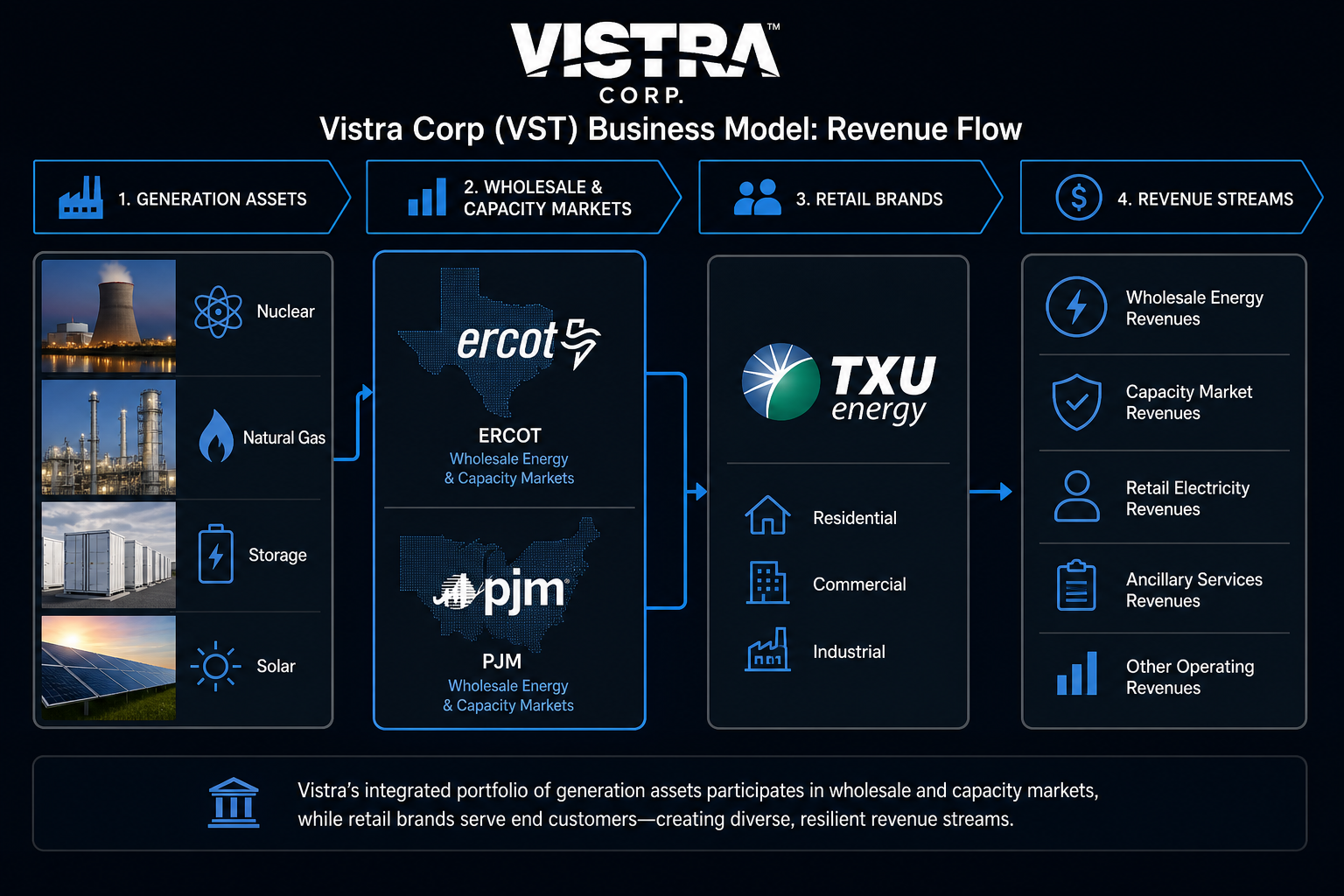
Figure 1. Vistra integrated business model: generation portfolio flows through ERCOT, PJM, and other wholesale and capacity markets, connecting retail brands like TXU Energy and long-term power purchase agreements.
What is the role of retail electricity (TXU, etc.)?
Vistra’s Retail segment, with brands such as TXU Energy, Ambit Energy, Dynegy, Homefield Energy, Energy Harbor, and U.S. Gas & Electric, supplies electricity and natural gas to residential, commercial, and industrial customers. Retail operations cover 16 states plus D.C., with TXU Energy leading in Texas’s competitive retail market.
The Retail segment fulfills three functions: (1) directly linking generation assets to end-user demand, forming an integrated “generation-to-sale” chain; (2) securing part of sales via customer contracts and rate products to reduce spot price exposure; (3) providing customer load data and demand insights for large account development and long-term contract negotiations.
Retail income is the spread between sales price and customer costs, influenced by competition, rate structure, and state regulations.
How do energy storage and transition assets affect the portfolio?
Battery storage and the Vistra Zero zero-carbon business line are reshaping Vistra’s operations. Storage units charge during price lows and discharge at peaks, participating in ERCOT and PJM energy arbitrage and ancillary services. Solar-plus-storage projects enable retired coal sites to become zero-carbon generation bases.
Storage enhances dispatch flexibility, complements natural gas and nuclear, and influences regional marginal prices. AI Data Center Power and PPA explores how nuclear assets, storage expansion, and long-term PPAs for data centers interconnect. Nuclear upgrades and gas expansions optimize the portfolio, while storage and zero-carbon assets are embedded within the three-layer structure of generation, market, and retail.
At-a-glance revenue structure
Vistra reports results by Retail, Texas, East, West, and Asset Closure segments. Retail reflects end-user electricity and gas sales; Texas, East, and West cover regional generation, wholesale trading, and commodity management; Asset Closure addresses retired asset wrap-up and compliance costs.
| Segment |
Core Activities |
Main Revenue Sources |
| Retail |
Retail electricity sales (TXU, Ambit, etc.) |
Retail price spread, customer scale |
| Texas |
ERCOT generation and wholesale trading |
Energy market revenue, ancillary services, hedging |
| East |
PJM and eastern market operations |
Energy and capacity revenue, nuclear/gas generation |
| West |
CAISO operations |
Western market energy revenue |
| Asset Closure |
Retired coal asset wrap-up |
Shutdown and compliance costs/income |
This table summarizes revenue structure by segment. Retail typically delivers the largest income, but marginal and capacity revenues from generation segments determine the market value of electricity resources. Only by combining all five segments do you see the full operating picture that underpins VST stock.
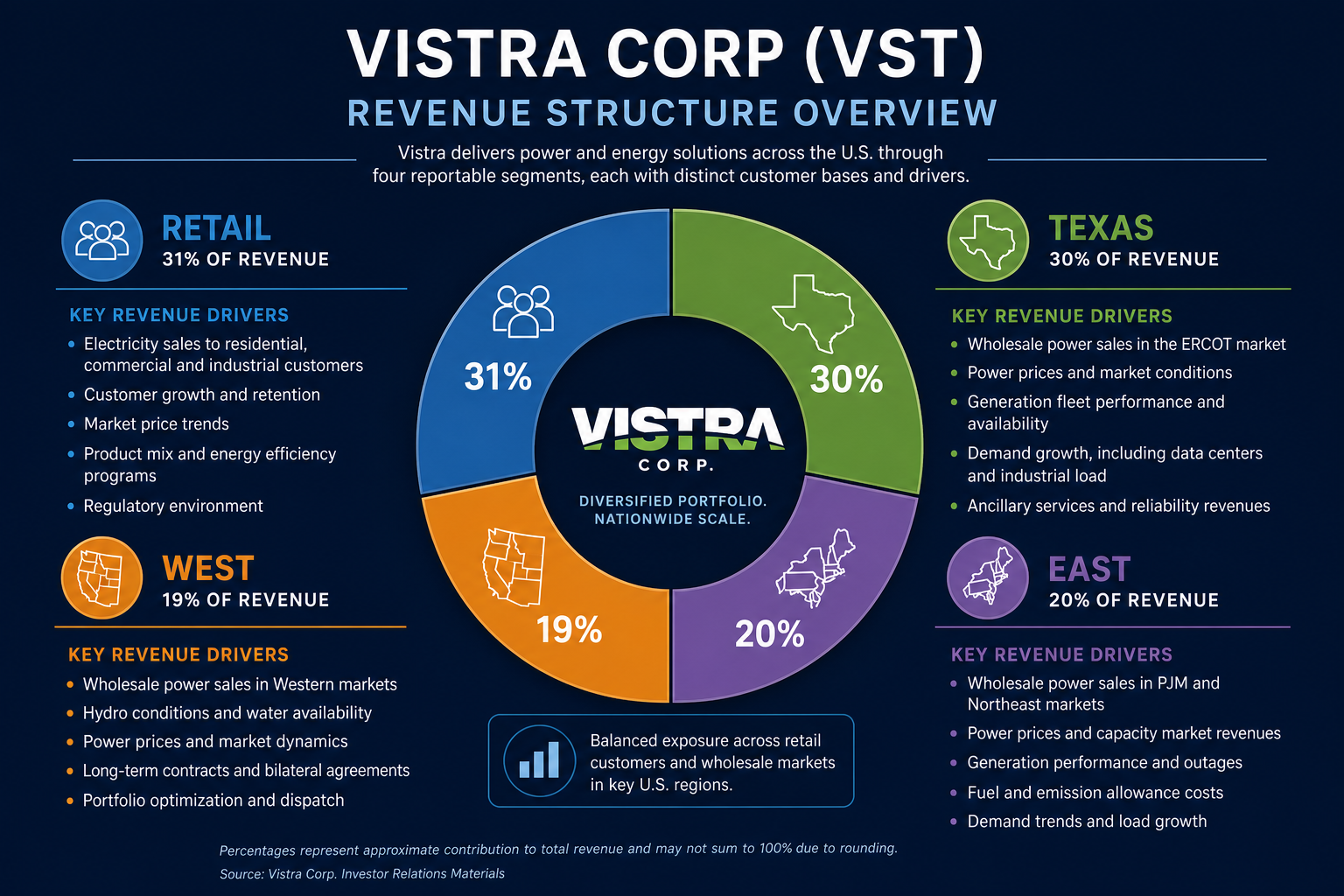
Figure 2. Vistra revenue structure overview: drivers and installed capacity distribution across Retail, Texas, East, and West segments.
When reviewing financials, distinguish between accounting and operating metrics, combine segment data and market exposure for a comprehensive view, and separate fundamental analysis from the VST risk metrics checklist. Gate Stocks buying VST covers ticker search, order placement, and position verification.
Summary
Vistra Corp (VST) operates a three-layer business model: generation assets, electricity markets, and retail customers. Natural gas, nuclear, storage, and solar form a diversified generation portfolio; ERCOT and PJM wholesale and capacity markets set power prices; retail brands like TXU Energy connect end-user demand; long-term PPAs anchor contracts for large consumers. To understand VST’s revenue, analyze all five segments, four market mechanisms, and multiple generation roles in parallel—don’t rely on a single industry label for complete structural analysis.
FAQ
What types of generation assets does Vistra have?
Vistra’s generation assets include natural gas, nuclear, coal, solar, and battery storage, distributed across Texas, East, and West segments. Nuclear provides baseload, natural gas handles peaking, solar and storage add flexibility via Vistra Zero, with about 44,000 MW of installed capacity.
How do ERCOT and PJM markets affect Vistra’s revenue?
ERCOT is driven by energy markets and day-ahead bidding, with prices sensitive to renewables and marginal gas units. PJM also has capacity markets, where nuclear and gas assets earn capacity payments. Rule differences drive distinct income profiles for Texas and East segments.
What is TXU Energy’s role in the business model?
TXU Energy is Vistra’s core retail brand in Texas, serving residential and commercial customers. The Retail segment connects generation assets directly to end-user demand, secures sales via customer contracts, and supports large commercial accounts and long-term PPAs.
How do storage and Vistra Zero change the revenue structure?
Battery storage participates in ERCOT and PJM peaking arbitrage and ancillary services. Vistra Zero integrates solar and zero-carbon resources, supporting conversion of retired coal sites. Storage and zero-carbon assets are embedded within the three-layer structure, enhancing portfolio flexibility.
How is Vistra (VST)’s revenue structure organized?
Vistra reports by Retail, Texas, East, West, and Asset Closure segments. Retail reflects end-user price spreads, Texas and East cover regional generation and wholesale revenue, West corresponds to CAISO, and Asset Closure covers asset retirement costs.