As Web3 projects evolve from single-token models to multi-layered incentive systems, more blockchain networks are separating governance from user incentives. Traditional single-token models often struggle to balance governance, payments, rewards, and growth—leading to conflicting objectives that can undermine long-term ecosystem health.
The dual-layer incentive model adopted by WeFi emerges in this context. As a Deobank infrastructure network, WeFi must not only maintain governance and value coordination but also continuously incentivize users to engage with payments, account management, and digital financial services. This is why WFI Token and Energy serve distinct roles, forming the backbone of WeFi’s incentive framework.
Core Differences Between WFI and Energy
The primary difference lies in their design purpose.
WFI is the native token of the WeFi ecosystem, responsible for governance, staking, and value coordination. Energy, on the other hand, is part of the user growth and incentive system, designed to measure ecosystem participation.
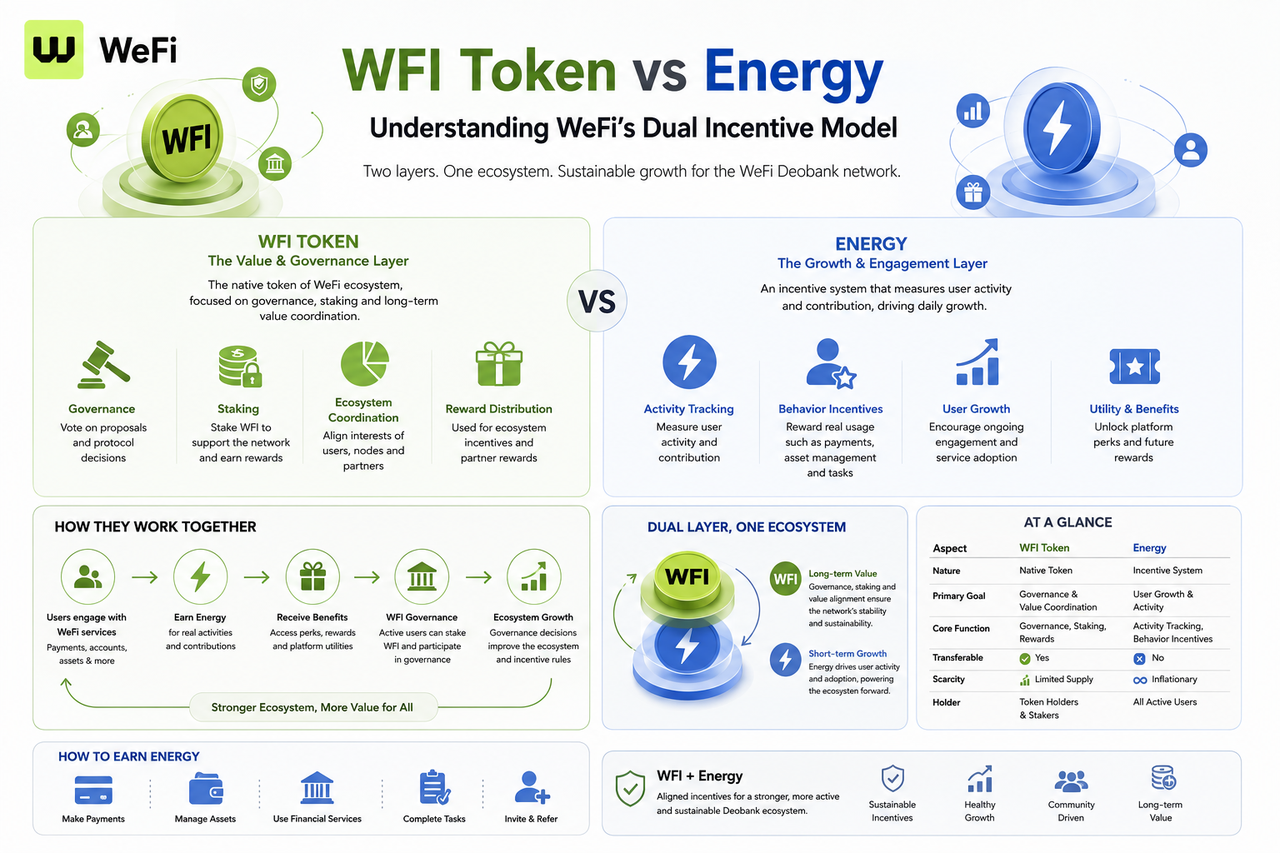
In simple terms: WFI ensures the network’s long-term operation, while Energy drives daily growth. This division allows each asset to address different ecosystem needs.
| Dimension |
WFI Token |
Energy |
| Type |
Native Token |
Incentive Points System |
| Primary Objective |
Governance & Value Coordination |
User Growth & Incentives |
| How to Obtain |
Ecosystem participation, rewards |
Network activity |
| Core Function |
Governance, staking, rewards |
Activity & contribution tracking |
| Ecosystem Role |
Long-term mechanism |
Growth mechanism |
What Is WFI Token?
WFI is the core token asset of the WeFi network.
Within the Deobank ecosystem, WFI handles governance, ecosystem coordination, and incentive distribution. Holders can participate in community governance and express opinions on the direction of protocol development. Additionally, WFI serves as a key component of ecosystem rewards, aligning the interests of users, nodes, and partners.
From an economic model perspective, WFI operates at the value layer of the ecosystem.
How Is WFI Used in the WeFi Ecosystem?
WFI’s use cases span multiple ecosystem scenarios.
First is governance: Token holders can join proposal discussions and governance votes. Second is staking: Certain ecosystem activities require staking WFI, which strengthens network stability.
WFI also functions as ecosystem rewards and partner incentives, making it a critical tool for connecting all participants.
| Function Category |
Specific Role |
| Community Governance |
Proposals & Voting |
| Ecosystem Coordination |
Incentivizing participation |
| Staking Mechanism |
Supporting network involvement |
| Reward System |
Rewarding contributors |
| Long-Term Value Capture |
Promoting ecosystem growth |
What Is Energy?
Energy is the growth and incentive system within the WeFi ecosystem.
Unlike WFI, Energy does not primarily serve a governance function. Instead, it records user activity and contribution. Users earn Energy rewards when using WeFi’s payment, account management, and digital asset services.
This mechanism resembles a loyalty points system on internet platforms but is deeply integrated with Deobank’s financial services.
Thus, Energy functions as an ecosystem participation metric.
How Do Users Earn Energy?
Energy generation is directly tied to user actions.
When users complete payments, manage assets, participate in ecosystem tasks, or use financial services, the system calculates Energy rewards based on predefined rules. The core goal is to encourage genuine usage, not just passive holding.
By linking rewards to real contributions, WeFi aims to boost ecosystem activity and user retention.
Why Does WeFi Use a Dual-Layer Incentive Model?
The dual-layer model was designed to prevent a single token from shouldering too many responsibilities.
In many blockchain projects, a governance token must handle governance, user growth, and rewards—often leading to conflicting incentives. WeFi separates the long-term value layer from the user growth layer, allowing each mechanism to function independently.
WFI focuses on long-term stability, while Energy drives user engagement and service usage. This structure improves flexibility and sustainability.
How Do WFI and Energy Create an Ecosystem Cycle?
WFI and Energy are not isolated systems. Users earn Energy through participation, and active users may become governance participants. Meanwhile, WFI-powered governance can adjust ecosystem rules, which in turn influences how Energy is earned.
This forms a continuous cycle of governance, participation, and rewards.
| Ecosystem Link |
Corresponding Mechanism |
| User Participation |
Earn Energy |
| Active Growth |
Drives ecosystem expansion |
| Governance Participation |
Use WFI |
| Rule Adjustment |
Optimize incentive mechanisms |
| Ecosystem Development |
Increases network value |
What Are the Advantages of the Dual-Layer Incentive Model?
Compared to traditional single-token structures, the dual-layer system offers clearer functional separation.
First, governance and growth mechanisms can be optimized independently without trade-offs.
Second, users don’t need to engage in complex governance to benefit from the Energy system.
Third, this model reduces the impact of speculation on user incentives, improving ecosystem efficiency.
For long-term financial infrastructure projects, separating incentive layers is becoming a standard design approach.
What Challenges Might the Dual-Layer Incentive Model Face?
Despite its advantages, the dual-layer model presents implementation challenges.
First, users must understand the distinct roles of both assets to avoid confusion. Second, a balance between the governance and incentive layers is critical. Overly strong Energy incentives may encourage short-term behavior, while weak incentives may fail to drive growth.
Dynamically adjusting this balance is a key challenge for long-term ecosystem health.
Summary
WFI Token and Energy are the two core incentive mechanisms in the WeFi Deobank ecosystem. WFI handles governance, staking, and value coordination, ensuring long-term network stability. Energy measures user activity and ecosystem contribution, driving usage of payments, account management, and digital financial services.
This dual-layer model allows WeFi to balance governance efficiency with user growth. By separating the value layer from the behavior incentive layer, WeFi aims to build a more sustainable Deobank economy and offer a novel incentive design for on-chain banking infrastructure.
FAQs
What Is the Biggest Difference Between WFI Token and Energy?
WFI is WeFi’s native token, primarily used for governance, staking, and ecosystem coordination. Energy is part of the user incentive system, mainly measuring activity and ecosystem contribution.
Can WFI Be Used for Governance?
Yes. One of WFI’s core functions is governance participation, including protocol proposals and community decision-making.
Is Energy a Cryptocurrency?
Energy is more like an ecosystem point or growth system rather than a traditional cryptocurrency. Its primary role is to track participation and incentivize network usage.
How Do Users Earn Energy?
Users earn Energy rewards by using WeFi’s payment, account management, and digital asset services, as well as by participating in ecosystem activities.
Why Doesn’t WeFi Use Just One Token?
A single token often has to juggle governance and growth tasks. By separating WFI and Energy, WeFi enables governance and user incentives to operate independently, improving overall ecosystem efficiency.







