When AI Takes Center Stage in Markets, Risk Changes Course
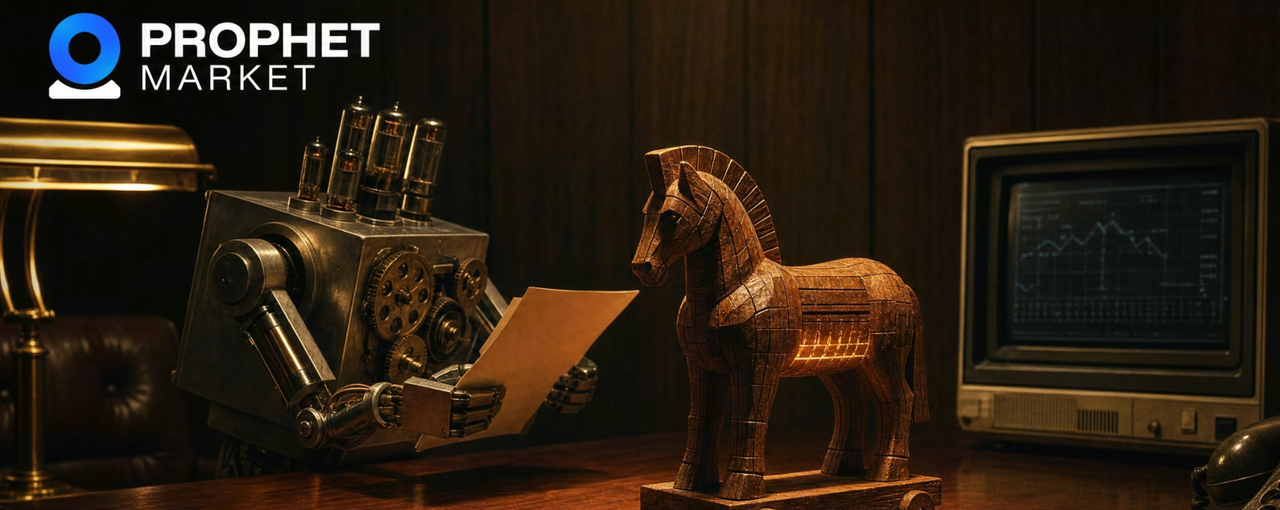 (Image Source: prophetmarketai)
Among Prophet’s most significant breakthroughs is that its AI is no longer a mere analytical or decision-support tool—it now plays an active role across the entire market lifecycle. Within this framework, AI handles event probability assessments and market price generation while also acting as a transaction counterparty. It may even take part in settlement, risk control, and overarching market management.
This approach dramatically streamlines market operations, enabling rapid market creation, on-demand liquidity, and reduced reliance on manual arbitration and traditional market makers. Yet as AI becomes the market’s central pillar, the nature of risk shifts accordingly. Traditional prediction markets faced human-centric risks like sentiment-driven volatility, manipulation, or shallow liquidity. In an AI-driven market, risk increasingly revolves around the model’s own predictive capability and stability—what is known as model risk.
AI Judgment Errors: Models Aren’t Always Right
Prophet’s entire operation rests on the assumption that AI can reliably assess event probabilities. But AI does not truly comprehend the world; it processes vast datasets, statistical patterns, and inference models to reach conclusions. No matter how sophisticated, no model is infallible.
In practice, AI can still misjudge probabilities, show overconfidence, or lose accuracy in unusual situations. This is especially true for black-swan events—sudden political shifts, wars, financial crises, or extreme market swings—where historical data is scarce and models struggle to anticipate outcomes.
When AI makes an error, the fallout goes beyond mere analytical bias—it is directly embedded in market prices. This can cause prices to diverge sharply from true event probabilities, force AI to absorb excessive risk, and lead to mispricing and market distortion. For AI-driven markets like Prophet, boosting model stability, implementing robust risk controls, and mitigating cascade effects from model inaccuracies will be critical for long-term viability.
Multiple Models Still Carry Bias
Prophet uses a multi-model ensemble to cross-validate predictions and reduce the risk of any single model’s misjudgment. But this does not eliminate bias entirely. While multiple models improve stability, if they share similar data sources and training logic, they can develop correlated blind spots.
Different AI models often train on overlapping datasets, absorb the same market signals, and employ similar inference methods. As a result, integrating multiple models does not guarantee independent perspectives. In some cases, models may even converge on the same errors, amplifying bias and creating false consensus.
This effect intensifies during extreme market sentiment—panic sell-offs or euphoric rallies—where all models are influenced by the same information and mood, producing highly uniform biases. Thus, while multi-model systems reduce certain risks, they cannot fully address structural weaknesses inherent in the AI system itself.
No Arbitration Mechanism: How Are Settlement Disputes Resolved?
Traditional prediction markets typically include arbitration mechanisms, manual reviews, or community voting to settle disputes over ambiguous events, special cases, or contested outcomes. Though slower, these processes provide a human safety net for correction.
Prophet, by contrast, favors full automation via AI for event determination and market settlement, aiming to minimize human intervention and maximize efficiency. But this approach introduces its own vulnerabilities.
For example, if an event description is vague, AI may misinterpret it. If external data sources conflict, the system may struggle to decide which is authoritative. If AI misunderstands semantic nuances, settlement results may clash with participant expectations.
Without a robust dispute resolution framework, such issues can erode user trust. For AI prediction markets like Prophet, building a transparent and reliable dispute-handling mechanism is just as important as optimizing automation.
Liquidity and Capital Constraints
Prophet is still in early testing, so overall market liquidity and capital depth remain limited. This makes the market more susceptible to single-trade impacts, amplifying price swings, reducing depth, and causing liquidity instability. When participant numbers and capital resources are immature, AI’s liquidity models also face greater uncertainty.
Compared to established financial markets, AI-driven liquidity provision lacks long-term validation. Currently, Prophet uses AI to rapidly supply prices and counterparty services, but as market scale grows, questions remain: Can AI maintain risk control, price stability, and order flow handling under larger volumes?
During high volatility or rapid capital inflows/outflows, if the AI model fails to adjust risk exposure quickly, prices may become unbalanced, exposing the system to unexpected losses. Managing liquidity and scaling capital will be key challenges for Prophet’s future.
Could the Model Be Gamed?
Another concern is whether market participants could reverse-engineer and exploit the AI model itself. Once AI is publicly involved in pricing and liquidity provision, traders will naturally study its logic, risk rules, and behavioral patterns.
If participants decipher the AI’s decision-making, they may attempt arbitrage, model attacks, price manipulation, or deliberately exploit system vulnerabilities. This mirrors traditional quant markets, where the model becomes the target of the market’s own analytical efforts.
AI prediction markets will need not only better accuracy but also stronger defenses and dynamic risk controls to prevent targeted exploitation. Otherwise, once fixed patterns are identified, the system faces heightened manipulation risk and capital pressure.
Regulatory Challenges for AI-Driven Markets
Prediction markets already navigate complex financial, gambling, and derivatives regulation. When AI directly engages in pricing, risk-taking, and market decisions, regulatory complexity deepens. Previously a mere analytical tool, AI now assumes core market functions, forcing regulators to redefine its role and accountability.
Currently, no unified global framework exists for AI financial models, automated trading responsibility, or AI market behavior. Legal definitions of AI, crypto assets, and prediction markets vary widely across jurisdictions. Future AI prediction markets will likely face compliance hurdles, regional regulatory gaps, and market entry barriers.
Especially when AI generates prices and makes market decisions, regulators will ask: Who bears responsibility for mispricing, abnormal volatility, or systemic risk? Clear answers remain elusive, meaning rapid development comes hand-in-hand with significant regulatory uncertainty.
Balancing Efficiency and Trust
Prophet’s core strength lies in using AI to deliver instant liquidity, automated market creation, and low entry barriers, enabling fast establishment of tradable markets for long-tail events that traditional systems overlook. These features boost prediction market efficiency and scalability.
But financial markets thrive on trust, not just efficiency. When participants cannot understand how AI prices, judges, or settles, transparency becomes a critical issue. If users lack insight into AI’s decision-making logic, trust in the entire mechanism declines.
Thus, the real challenge for AI prediction markets may not be improving models alone, but designing an AI financial system that is verifiable, explainable, fair, and transparent in risk. Only when participants can understand and trust AI’s operations will AI-driven markets gain broad acceptance.
Conclusion
Prophet presents a novel market model where AI functions as the core liquidity and pricing engine. This approach delivers faster market creation, better coverage of niche events, and higher automation, opening new possibilities beyond traditional frameworks.
At the same time, AI-driven markets introduce a new risk landscape: AI judgment errors, model bias, settlement disputes, liquidity limits, and regulatory uncertainty. These risks are no longer purely human—they are deeply tied to the AI model’s capabilities and architecture.
For Prophet, the real mission is not simply to integrate AI into markets, but to build an AI financial mechanism that earns lasting market trust. This deep fusion of AI and Web3 could become one of the most compelling directions in the evolution of on-chain finance.







