Zero-knowledge proofs enable on-chain verification without exposing raw data, but circuit design and cryptographic integration have historically posed significant barriers to dApp development. Universal Circuits packages common ZK circuits into reusable modules, letting EVM developers embed privacy and compliance features via contract calls without overhauling existing Solidity architectures.
In Manta Network’s dual-chain model, Pacific handles ZK application execution, and Universal Circuits is the core development tool on the Pacific side—distinct from Atlantic’s identity layer. Together with Celestia DA and the zkEVM execution environment, it creates an application stack built on "low-cost scaling + programmable ZK."
What Is Universal Circuits?
Universal Circuits is a ZK-as-a-Service development library deployed on Manta Pacific. It packages common zero-knowledge circuits into reusable modules that decentralized applications can call through standard interfaces. In the Manta Network ecosystem, Universal Circuits acts as a "ZK function middleware layer": cryptographic circuits and on-chain verification contracts form the foundation, while EVM-compatible Solidity business logic sits on top.
Unlike dedicated zero-knowledge languages such as Cairo and Noir, Universal Circuits maintains EVM equivalence. Developers can add privacy and compliance capabilities to existing contract architectures without switching programming paradigms. Universal Circuits 2.0 introduces Proof Aggregation, merging multiple proofs into a single verification unit to reduce on-chain gas and boost throughput.
| Dimension |
Universal Circuits |
Dedicated ZK Languages (Cairo / Noir) |
| Development Language |
Solidity + SDK |
Dedicated ZK DSL |
| EVM Compatibility |
Maintains EVM equivalence; contracts are portable |
Typically requires a separate execution environment |
| Circuit Source |
Pre-built general circuit library |
Developers write circuits themselves |
| Integration Barrier |
Designed for existing Solidity developers |
Requires learning ZK circuit syntax |
| Verification Cost |
2.0 supports proof aggregation for lower costs |
Varies by implementation and chain |
The table above shows that Universal Circuits is primarily positioned to "lower the barrier to ZK integration" rather than replace a full ZK virtual machine. Pre-built circuits cover high-frequency scenarios like identity verification, compliant privacy payments, and on-chain game shuffling. This allows Manta Pacific’s application layer to add zero-knowledge capabilities without restructuring contract architectures.
How Does ZK-as-a-Service Work?
ZK-as-a-Service is the service model behind Universal Circuits. Developers outsource the generation, formatting, and on-chain verification of cryptographic proofs to standardized components, while their contracts handle only business logic and interface calls. This approach splits ZK development into two layers—the "circuit layer (platform pre-built)" and the "application layer (developer-written)"—avoiding redundant reimplementation of the same cryptographic primitives across projects.
The typical ZK-as-a-Service call flow works like this: a Solidity contract sends a proof request through the Universal Circuits SDK → the SDK calls the corresponding pre-built circuit to generate a zero-knowledge proof → the proof is submitted to an on-chain verification contract → upon successful verification, the contract triggers a state change. Universal Circuits 2.0 adds an aggregation step, allowing multiple independent proofs to be merged into a single aggregated proof for one-time on-chain verification.
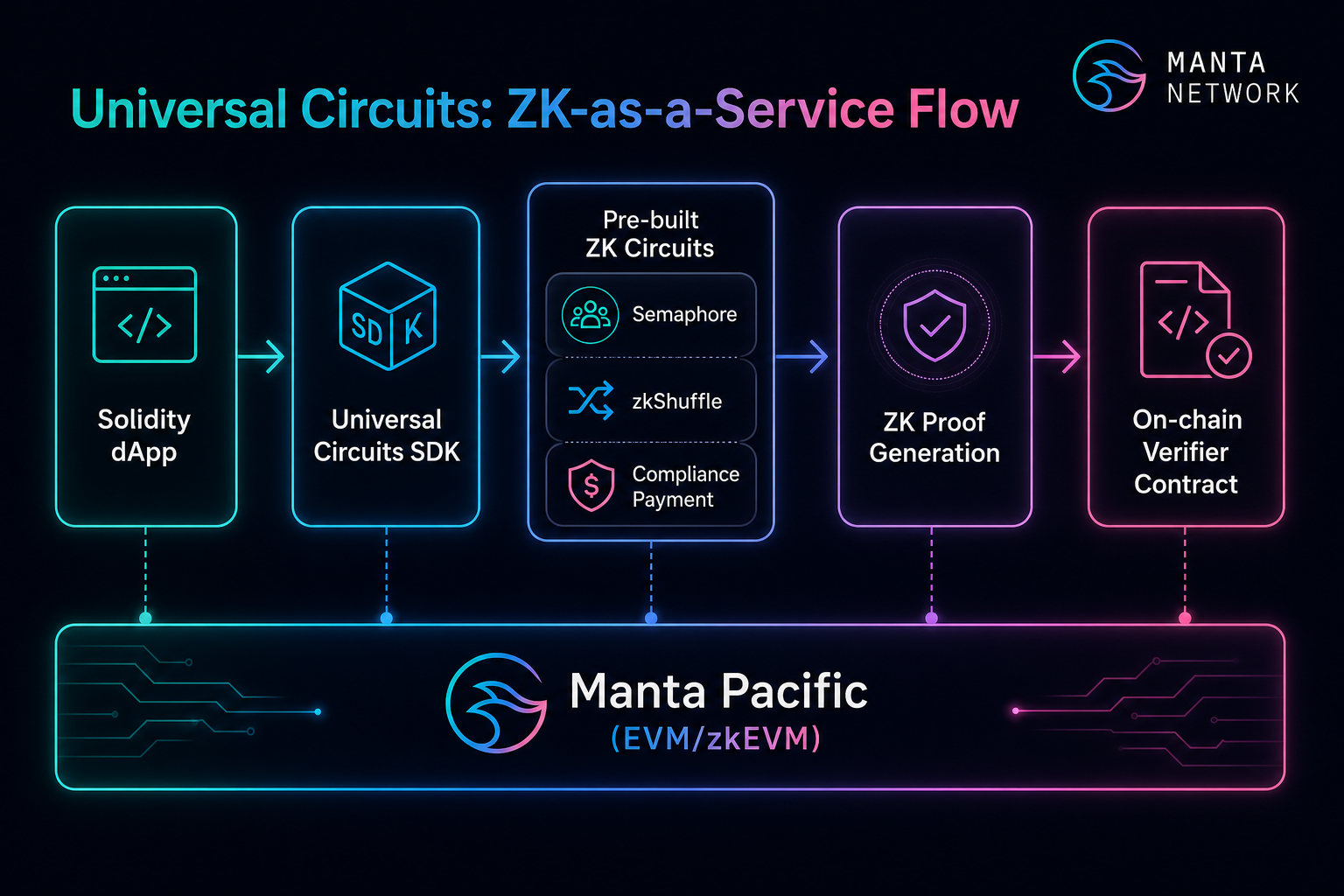 Figure 1. Universal Circuits ZK-as-a-Service flow from Solidity dApp through SDK, pre-built circuits, proof generation, to on-chain verification on Manta Pacific.
ZK-as-a-Service delivers zero-knowledge functions through standard interfaces. Circuit correctness is guaranteed by platform-wide components, reducing the scope of cryptographic auditing needed per project.
How Do Solidity Developers Integrate?
Integrating Universal Circuits with Solidity follows a four-step path: "SDK introduction → circuit selection → proof generation → on-chain verification." Developers add the Universal Circuits SDK in the Manta Pacific deployment environment, declare the required circuit type and public/private input parameters in their contracts, perform witness computation off-chain or on the client side, generate the proof, and then submit the proof along with public inputs to the verification contract.
The integration process does not require writing underlying circuits. The SDK encapsulates circuit ABIs and verification contract addresses. After migrating existing Ethereum contracts to Pacific, developers can add Universal Circuits calls at key points.
| Integration Step |
Action |
Responsible Party |
| SDK Introduction |
Add dependencies, configure network and contract addresses |
Developer |
| Circuit Selection |
Choose pre-built circuits like Semaphore, zkShuffle |
Developer |
| Witness & Proof Generation |
Compute private input witness, generate ZK proof |
Developer / Client |
| On-Chain Verification |
Submit proof to verification contract, trigger state change |
On-chain contract |
Witness computation happens off-chain; only the compact proof is submitted on-chain. This approach enables teams with EVM experience but no ZK background to deploy privacy-capable applications.
What Scenarios Can Pre-built Circuits Be Used For?
Universal Circuits pre-built circuits cover three high-frequency application scenarios: identity verification, compliant privacy payments, and on-chain game shuffling. Each scenario uses different cryptographic primitives, but all are accessed through the unified SDK interface.
The Semaphore circuit supports anonymous group membership proofs and selective disclosure, making it suitable for DAO voting and privacy KYC. The compliant privacy payment circuit conceals transaction details while preserving regulatory visibility. The zkShuffle circuit provides verifiable random shuffling for on-chain card games.
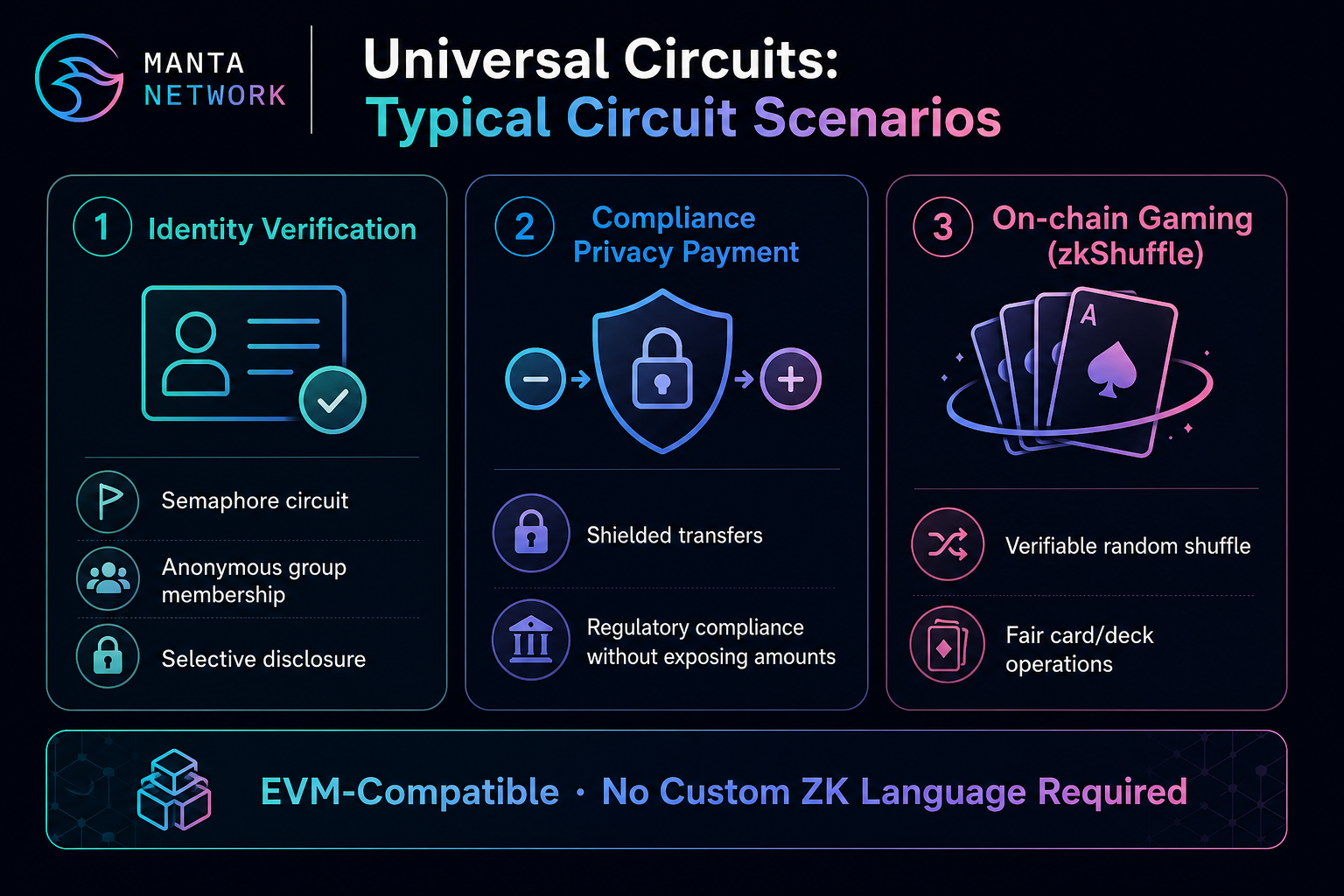 Figure 2. Universal Circuits typical scenarios: Semaphore identity verification, compliance privacy payment, and zkShuffle on-chain gaming.
| Circuit Type |
Core Function |
Typical Use Cases |
| Semaphore |
Anonymous group membership proof, selective disclosure |
DAO voting, whitelisting, privacy KYC |
| Compliant Privacy Payment |
Conceal amounts and parties, preserve compliance visibility |
Institutional payments, compliant DeFi |
| zkShuffle |
Verifiable random shuffling |
On-chain card games, fair gaming |
Developers simply select the appropriate circuit for their scenario, without building cryptographic solutions from scratch. zkSBT compliance credentials on the Pacific side also support verification, creating synergy with the Atlantic identity layer.
What Role Does Universal Circuits Play in the Pacific Ecosystem?
Universal Circuits is the application-layer ZK component of the Manta Pacific technology stack. Together with the Celestia data availability layer, the zkEVM execution environment, and the modular L2 architecture, it completes Pacific’s full capability set. Pacific provides an EVM-compatible deployment environment and cost savings via Celestia DA; Universal Circuits adds zero-knowledge capabilities on top, enabling the modular L2 to natively support privacy and compliance applications beyond general smart contracts.
The core difference between Manta Pacific and Manta Atlantic lies in their dual-chain division: Pacific focuses on ZK application execution and Universal Circuits deployment, while Atlantic focuses on zkAddress and zkSBT on-chain compliance identity. Universal Circuits lets Pacific applications directly call privacy verification logic, while Atlantic identity credentials can serve as data sources for Pacific-side zkSBT verification. The two chains complement rather than replace each other in credential standards.
The complete process for bridging to Manta Pacific covers asset cross-chain and gas preparation. After bridging, developers deploy Solidity contracts integrated with Universal Circuits in the Pacific environment. Pacific gas is denominated in ETH; the execution cost of ZK proof verification is included in the regular gas structure, and proof aggregation further reduces per-verification overhead.
What Are the Limitations and Risks of Using Universal Circuits?
As a pre-built circuit library, Universal Circuits has structural boundaries in flexibility and scenario coverage. Pre-built circuits only cover general scenarios selected by the platform; highly customized zero-knowledge logic still requires developers to write dedicated circuits or use other ZK frameworks. The circuit library update pace depends on platform maintenance, and there is a delay before new cryptographic primitives are added to the general library.
ZK-as-a-Service delegates part of the security assumptions to the platform’s verification contracts. Contract vulnerabilities, circuit defects, or aggregation layer errors all pose technical risks. Pacific’s reliance on Celestia DA and the Ethereum settlement layer also introduces external protocol risks. Requirements beyond the scope of pre-built circuits need evaluation of dedicated ZK language solutions; counterfeit SDKs must be verified against publicly disclosed information.
Summary
Universal Circuits, as Manta Pacific’s ZK-as-a-Service development library, enables Solidity developers to integrate privacy and compliance capabilities without deep zero-knowledge expertise, via pre-built circuits like Semaphore, compliant privacy payments, and zkShuffle. The ZK-as-a-Service mechanism separates circuit maintenance from application development. Solidity integration follows a standard path: SDK introduction, circuit selection, proof generation, and on-chain verification. Universal Circuits is deeply tied to the Manta Pacific modular L2 architecture—it lowers the ZK barrier while being structurally limited by pre-built circuit coverage and platform dependency.
FAQ
What is Universal Circuits?
Universal Circuits is a ZK-as-a-Service pre-built circuit library on Manta Pacific for Solidity developers. It packages zero-knowledge circuits such as Semaphore identity verification, compliant privacy payments, and zkShuffle on-chain shuffling into callable modules, allowing developers to integrate privacy and compliance functions into EVM contracts without writing underlying circuits.
How does ZK-as-a-Service work?
ZK-as-a-Service standardizes the generation and on-chain verification of zero-knowledge proofs as a platform service. Developers select pre-built circuits through the Universal Circuits SDK, submit public and private inputs, complete witness computation on the client side, generate proofs, and then on-chain verification contracts validate the proofs and trigger state changes. Universal Circuits 2.0 supports aggregating multiple proofs into a single verification unit to reduce costs.
How is Universal Circuits different from Cairo and Noir?
Universal Circuits maintains EVM equivalence. Developers use Solidity and the SDK to call pre-built circuits without learning dedicated ZK languages. Solutions like Cairo and Noir typically require developers to write circuits in dedicated DSLs and run them in separate ZK execution environments. Universal Circuits focuses on lowering the integration barrier, while dedicated ZK languages prioritize circuit customization flexibility.
Which application scenarios are suitable for Universal Circuits?
Suitable scenarios include anonymous DAO voting and group membership verification (Semaphore), payments that conceal transaction details while retaining compliance visibility (compliant privacy payments), and on-chain card and gaming applications requiring verifiably fair shuffling (zkShuffle). Highly customized zero-knowledge logic may exceed the scope of pre-built circuits.
What is the relationship between Universal Circuits and Manta Pacific?
Universal Circuits is deployed on Manta Pacific as the application-layer ZK component of Pacific’s modular L2 technology stack. Pacific provides the EVM/zkEVM execution environment and Celestia data availability; Universal Circuits provides callable zero-knowledge function interfaces for decentralized applications on top of that, forming ecosystem synergy with Atlantic-side zkAddress and zkSBT identity credentials.
What are the limitations of using Universal Circuits?
Key limitations include limited pre-built circuit scenario coverage, the need for alternative solutions for highly customized requirements, partial reliance on platform-maintained circuits and verification contracts for cryptographic security, additional complexity from proof aggregation, and Pacific’s technical dependency on external DA and settlement layers. Universal Circuits is a functional library, not a full ZK virtual machine, and is not suitable for all zero-knowledge application scenarios.







