What Is (3,3): Definition and Context
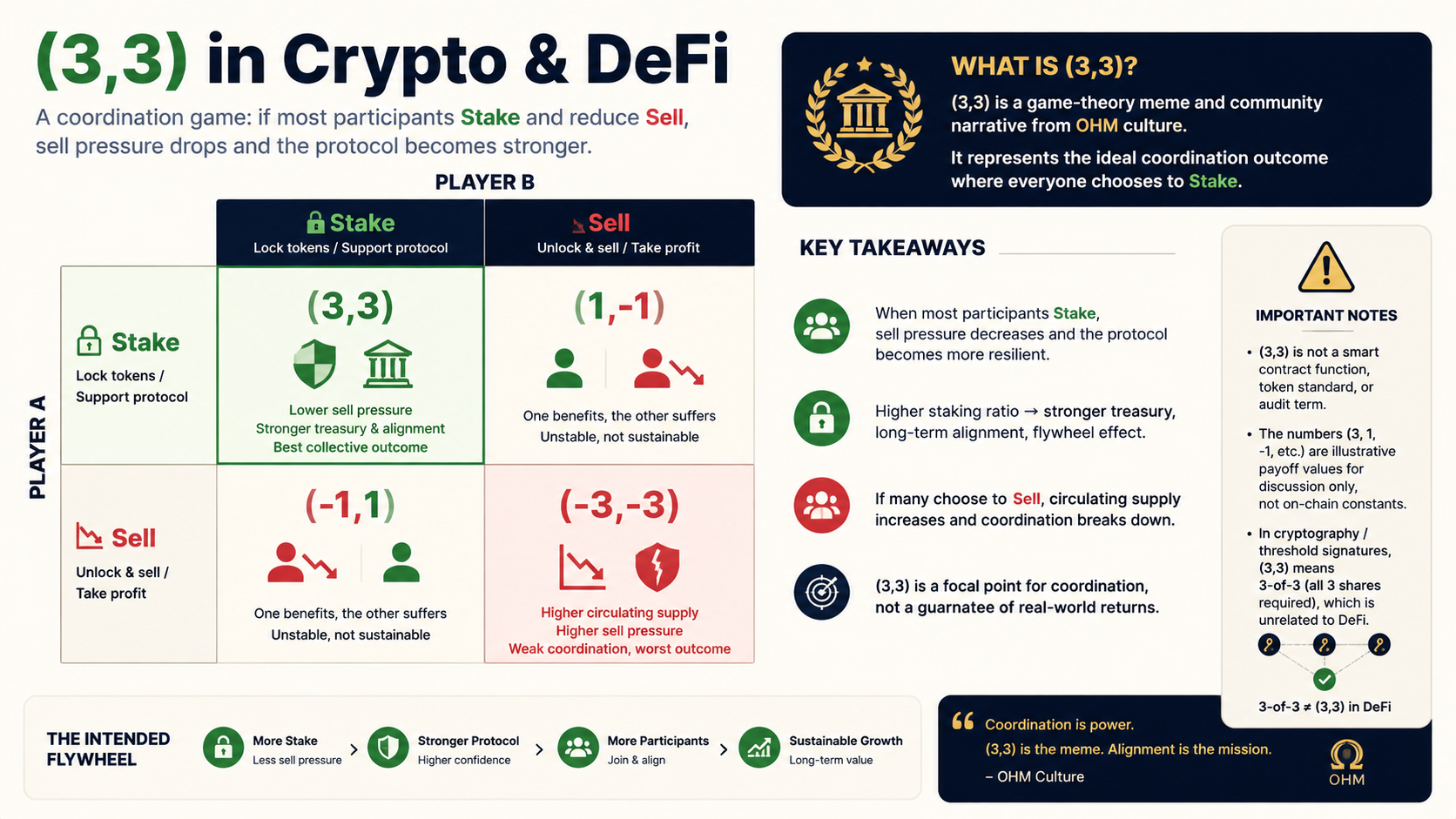
In crypto and Decentralized Finance (DeFi), (3,3) is a game theory metaphor and community consensus symbol. It describes a scenario where most market participants choose to Stake rather than Sell, reducing circulating sell pressure and increasing the protocol's lock-up ratio. Under certain models, this can create a favorable outcome for both the protocol and token holders.
A few boundary clarifications are essential:
- (3,3) is not a smart contract interface, token standard, or audit term.
- The numbers in the matrix (e.g., 3, 1, -1) are illustrative utility scores used for discussion and sharing — they are not on-chain constants.
- In cryptography and threshold signatures, (3,3) often means 3-of-3 (all three shards required), which is unrelated to the DeFi meaning (see Section 7).
Professionally, (3,3) is best understood as a "focal outcome" narrative from coordination games paired with an abbreviation of OHM-based mechanism culture — not a reproducible mathematical theorem or investment strategy.
Origin: OlympusDAO and the OHM Ecosystem

The widespread adoption of (3,3) is closely tied to OlympusDAO and its token, OHM. Around 2021, OHM — an algorithmic stablecoin and reserve currency experiment — aimed to decouple its token price and narrative from pure secondary market trading using mechanisms like a Treasury, high staking yields, and Bonding.
To condense these complex ideas into a shareable slogan, the community created a 2x2 payoff matrix, labeling the optimal cell for "both parties stake" as (3,3). This spawned many OHM forks that reused the (3,3) rhetoric to promote long-term lock-ups and liquidity provision.
Historically, (3,3) gained traction alongside the 2021–2022 DeFi boom of high APY (Annual Percentage Yield), rebasing, and DAO governance. Both its price and Total Value Locked (TVL) later experienced significant cyclical swings — proof that narrative strength doesn't guarantee long-term stability.
Game Theory Framework: Payoff Matrix and Nash Equilibrium
Relationship with the Prisoner's Dilemma and Nash Equilibrium
(3,3) discussions often reference the Prisoner's Dilemma and Nash Equilibrium: without credible coordination, individuals may sell; but if both parties commit — or social norms reinforce staking — a higher joint payoff can emerge.
A typical simplified payoff matrix (actions and scores are illustrative):
|
Other: Stake |
Other: Bond |
Other: Sell |
| Self: Stake |
(3, 3) |
(3, 1) |
(3, -1) |
| Self: Bond |
(1, 3) |
(1, 1) |
(1, -1) |
| Self: Sell |
(-1, 3) |
(-1, 1) |
(-1, -1) |
Commonly used values in the community:
- Stake: approximately +3
- Bond: approximately +1
- Sell: approximately -1
The "other" can be another trader or a generalized "user–protocol" entity. The matrix is designed to advocate behavior, not to provide rigorous empirical data.
Where (3,3) Sits in Equilibrium Discussions
Within the narrative, the (3,3) cell is described as a cooperative Pareto improvement: when both parties stake, the protocol's lock-up rises, sell pressure weakens, and holders enjoy staking returns plus scarcity expectations.
Three objective caveats:
- This outcome isn't a contractually enforceable equilibrium — you can't force others to stake on-chain.
- The (-1, -1) scenario (both sell) has occurred in multiple projects, triggering real sell pressure and price drops.
- Under information asymmetry, whales, insiders, and retail investors face asymmetric incentives; the matrix can't capture these power dynamics.
Thus, a professional view: (3,3) is a normative equilibrium narrative hoping for coordinated staking — not a uniquely verified Nash equilibrium.
Mechanism Correspondence: Staking, Bonding, and Selling
To grasp (3,3), you must understand the three core behaviors in the OHM ecosystem (parameters vary by fork, but logic remains similar).
Staking
Users stake tokens like OHM into the protocol, receiving sOHM, gOHM, or similar certificates, and earn rebasing or fixed/floating APY.
Mechanism effect: The amount of immediately sellable tokens in circulation decreases, supporting a "lock-up consensus" narrative.
Matrix mapping: +3 — directly corresponds to the (3,3) slogan.
Bonding
Users exchange assets (DAI, ETH, LP tokens, etc.) for discounted tokens from the treasury, typically subject to a vesting period.
Mechanism effect: Assets flow into the treasury, but at the cost of future token releases. Returns depend on the discount, vesting term, and market price.
Matrix mapping: Usually +1 — better than selling, but lower priority than staking in the narrative.
Selling
Selling on a DEX or CEX. Increases immediate supply and, under pessimistic expectations, may trigger a run.
Matrix mapping: -1; (-1, -1) serves as a warning outcome of mutual harm.
In short, (3,3) at the mechanism level advocates "stake primarily, bond if needed, avoid selling." Its actual performance depends on treasury quality, inflation, demand, and macro liquidity.
ve(3,3): Name Continuation and Different Mechanisms
Starting around 2022, Andre Cronje and others introduced the ve(3,3) model (first via Solidly, then Velodrome). It retained the (3,3) name but operates on a fundamentally different mechanism than the OHM narrative.
| Dimension |
OHM-based (3,3) |
ve(3,3) |
| Focus |
Staking, less selling, treasury narrative |
veToken lock-up governance plus liquidity incentives |
| Tools |
Stake / Bond / Treasury |
Vote-escrow, gauges, bribes |
| Goal |
Coordinate holder behavior |
Align interests of LPs, protocols, and locked voters |
| Name |
Optimal cell in a game matrix |
Design philosophy signaling "multi-party wins" |
"ve" comes from Curve's vote-escrow: users lock tokens to get veNFT/veToken and use voting power to direct token emissions toward specific trading pairs or pools. Third parties can pay bribes to ve holders for votes.
In professional content and SEO, clearly label "OHM (3,3)" and "ve(3,3)" separately to avoid confusion.
How (3,3) Spread — and Its Real Limitations
Why It Spread
- Low cognitive cost: Two numbers and a table — perfect for social media.
- Positive-sum framing: Paints trading as a win-win collaboration.
- High return expectations: Early OHM's sky-high APY made "staking is rational" feel intuitive.
- Fork replication: Many projects copied the meme, creating inertia.
Limitations and Criticisms
- Sustainability: If returns come mostly from minting/rebasing, you need continuous inflows or bonding. A sentiment shift can trigger sharp corrections.
- Coordination failure: Slogans can't stop liquidation cascades, deleveraging, or panic sells.
- Term dilution: Not every project tagged (3,3) offers the same mechanism or disclosure quality.
- Regulation: High APY, algorithmic stablecoins, etc., face varying compliance scrutiny worldwide. Evaluate independently.
Industry retrospectives now often cite (3,3) as a cultural artifact, but challenge it as a "risk-free best strategy." Objective writing should acknowledge its historical role and structural risks — not echo the hype.
Distinguishing from Cryptographic (3,3)
In contexts like MPC (Multi-Party Computation), threshold signatures, or Shamir's secret sharing, (3,3) or (t, n) = (3, 3) means:
- n = 3: The key or secret is split into three shares.
- t = 3: All three shares are required for recovery or signing (no fault tolerance).
This is completely unrelated to the DeFi "both stake" cell. To avoid cross-domain confusion, use clear subtitles or keywords: "DeFi (3,3)," "Olympus (3,3)," "threshold 3-of-3."
Summary
In Crypto/DeFi, (3,3) is a cooperative narrative born from game theory: the cell where both parties Stake in the matrix, used to encourage long-term lock-up, reduce sell pressure, and align with the protocol. Its popularity exploded via OlympusDAO and its fork ecosystem, and later ve(3,3) borrowed the name for ve governance and liquidity incentives — but the two have different mechanisms and risk profiles.
Three key takeaways for professional readers:
- Definition: A cultural symbol and mechanism pitch, not a technical standard.
- Mechanism: Maps to Stake/Bond/Sell behaviors. Outcomes depend on treasury, inflation, and market conditions.
- Risk: (-1, -1) has happened; (3,3) cannot replace due diligence and risk management.
In one sentence: (3,3) describes a "higher joint payoff if everyone coordinates to stake"; whether that coordination happens in real markets depends on liquidity, expectations, and mechanism design.
Disclaimer: This article is for educational and conceptual overview purposes only. It does not constitute investment advice. DeFi project mechanisms, tokenomics, and regulatory environments change over time. Please consult official documentation and on-chain data.
FAQs
-
What does (3,3) mean?
In DeFi, (3,3) is the game theory matrix cell where both parties Stake — symbolizing a cooperative outcome favorable to the protocol and participants. It comes from the OlympusDAO community narrative, not a contract name or token standard.
-
Are the numbers in (3,3) on-chain parameters?
No. The numbers 3, 1, -1 are illustrative utility scores showing relative priority of Stake, Bond, and Sell. They cannot be found on-chain and don't represent guaranteed returns.
-
Are (3,3) and ve(3,3) the same?
No. OHM-based (3,3) focuses on staking and avoiding selling. ve(3,3) (e.g., Solidly, Velodrome) focuses on vote-escrow lock-up governance and liquidity incentives — different mechanisms and goals.
-
Can (3,3) guarantee price rises or high APY?
No. It's a coordination narrative, not a return guarantee. High APY dependent on inflation can still lead to sharp drops during sell pressure or confidence loss.
-
Is DeFi (3,3) the same as cryptographic (3,3)?
No. In cryptography, (3,3) typically means a 3-of-3 threshold (all three shares needed). In DeFi, it's a game theory and cultural term. They are unrelated.







